TL;DR
Context management in Claude Code determines the quality and speed of every interaction with the agent. **Master** the 200,000-token window, automatic compaction, and Plan mode to maintain productive sessions without information loss. This guide shows you how to optimize, segment, and scale your conversations in practice.
Context management in Claude Code determines the quality and speed of every interaction with the agent. Master the 200,000-token window, automatic compaction, and Plan mode to maintain productive sessions without information loss. This guide shows you how to optimize, segment, and scale your conversations in practice.
Claude Code context management is the central mechanism governing the agent's working memory during a session.
Claude Code uses a 200,000-token window - roughly 150,000 words - making it one of the largest contexts available for an AI-assisted development tool. this capacity allows simultaneous processing of medium-sized codebases without manual splitting.
For a complete overview of the tool, visit the Claude Code page that presents the full ecosystem.
How does the 200,000-token context window work?
The context window is Claude Code's live memory during a conversation. Every message sent, every file read, and every response generated consumes a portion of these 200,000 tokens.
Visualize the typical breakdown of a work session:
| Element | Average consumption | Percentage |
|---|---|---|
| System prompt + CLAUDE.md | 3,000 - 8,000 tokens | 2 - 4% |
| Automatically read files | 20,000 - 60,000 tokens | 10 - 30% |
| Conversation history | 40,000 - 80,000 tokens | 20 - 40% |
| Agent responses | 30,000 - 60,000 tokens | 15 - 30% |
| Available margin | 20,000 - 80,000 tokens | 10 - 40% |
A token corresponds on average to 0.75 words in English and about 0.5 words in French. In practice, a 500-line TypeScript file consumes between 4,000 and 6,000 tokens.
Check your context consumption at any time with the command:
$ claude --context-usage
The context management tutorial guides you step by step to monitor this consumption in real time. When the context reaches 80% of its capacity, Claude Code triggers an automatic compaction mechanism that summarizes previous exchanges.
Key takeaway: the 200,000-token window fills up progressively - monitor your consumption and plan your sessions accordingly.
What strategies help optimize context?
Context optimization rests on three principles: reduce unnecessary inputs, structure your requests, and externalize persistent memory.
Reducing noise in the context
Use .claudeignore files to exclude large directories that add nothing to your current task:
# .claudeignore
node_modules/
dist/
coverage/
*.min.js
*.map
In practice, excluding node_modules alone saves between 30,000 and 100,000 tokens on a standard Node.js project. You will find additional exclusion techniques in the context optimization guide.
Structuring your requests
Formulate precise instructions rather than vague requests. Compare these two approaches:
| Approach | Example | Tokens consumed |
|---|---|---|
| Vague | "Fix the bugs in the project" | 80,000+ (massive reading) |
| Targeted | "Fix the validation bug in src/auth/login.ts line 42" | 8,000 - 12,000 |
| Sequential | Several successive targeted requests | 15,000 - 25,000 total |
precise instructions reduce context consumption by 40 to 70%. Always specify the relevant files and the exact scope of your request.
Externalizing memory
Configure a CLAUDE.md file at the root of your project to store conventions, patterns, and architectural decisions:
# CLAUDE.md
## Conventions
- Use TypeScript strict
- Tests with Vitest
- Naming: camelCase for variables, PascalCase for types

## Architecture
- API routes in /app/api/
- Shared components in /components/
This file persists across sessions and avoids repeating the same instructions. Here is how it ties in with first conversations in Claude Code to establish an effective working framework.
Key takeaway: a clean and targeted context produces faster and more accurate responses - aim for 50% maximum usage to keep headroom.
How does Plan mode save context?
Plan mode is a Claude Code feature that separates the thinking phase from the execution phase. When activated, the agent analyzes your request, proposes a structured action plan, then only executes after your validation.
Activate Plan mode with the Shift+Tab shortcut or the command:
$ claude --plan
The savings are measurable. Plan mode reduces total context consumption by 25 to 45% on complex tasks.
| Mode | Tokens for a refactoring | Files read unnecessarily |
|---|---|---|
| Standard | 120,000 | 15 - 25 |
| Plan | 65,000 - 80,000 | 3 - 8 |
In practice, Plan mode first explores the project structure with targeted reads, then proposes modifications before applying them. This avoids reading irrelevant files that waste context.
Combine Plan mode with precise instructions in your CLAUDE.md to maximize gains. The context management tips guide details advanced workflows with Plan mode.
To master these techniques under real conditions, the Claude Code training offered by SFEIR Institute over one day includes hands-on labs on Plan mode and context optimization. You will learn how to structure your sessions for projects of all sizes.
Key takeaway: Plan mode halves context consumption on complex tasks - activate it systematically for refactoring and code analysis.
How does automatic compaction and PreCompact hooks work?
Automatic compaction is the mechanism by which Claude Code summarizes old messages when the context approaches its limit. This process triggers automatically at about 80% usage, or 160,000 tokens.
Observe how it works in three steps:
- Detection - Claude Code measures consumption continuously
- Summary - Old exchanges are condensed into a structured summary
- Release - Original messages are replaced by the summary, freeing 40 to 60% of the context
You can also trigger compaction manually:
$ claude compact
Configuring a PreCompact hook
PreCompact hooks let you execute code before each compaction. In practice, you can save the conversation state or export key decisions.
Add this configuration to your .claude/settings.json:
{
  "hooks": {
    "PreCompact": [
      {
        "command": "echo 'Compaction triggered at $(date)' >> .claude/compaction.log"
      }
    ]
  }
}
This hook records each compaction event in a log file. In practice, 85% of long sessions trigger at least one compaction after 45 minutes of continuous work.
Compaction preserves CLAUDE.md instructions, files being edited, and a summary of decisions made. Details of intermediate exchanges are lost. To understand the implications for your project security, consult the guide on permissions and security in Claude Code.
The deep dive on context management explains the compaction algorithm and its limitations in detail. You will find strategies for controlling what is preserved and what is summarized.
Key takeaway: compaction is a safety net, not a strategy - anticipate your context management rather than depending on automatic summarization.
Can you use multiple sessions to scale horizontally?
Multi-sessions is the technique of distributing work across several parallel Claude Code instances. Each session has its own 200,000-token window, multiplying processing capacity.
Launch several sessions in separate terminals:
# Terminal 1 - Backend
$ claude "Refactor the API routes in /app/api/"

# Terminal 2 - Frontend
$ claude "Add unit tests for /components/"

# Terminal 3 - Documentation
$ claude "Update the documentation in /docs/"
Here is how to distribute tasks effectively:
| Strategy | Use case | Benefit |
|---|---|---|
| By domain | Frontend / Backend / Tests | Complete isolation |
| By feature | Auth / Payment / Dashboard | Focused context |
| By phase | Analysis -> Implementation -> Review | Separation of concerns |
In practice, three parallel sessions allow processing a 50,000-line project in 30 to 45 minutes instead of 2 hours in a single session. Each session stays under 50% context usage, ensuring high-quality responses.
Coordinate sessions via Git to avoid conflicts. Each session works on a dedicated branch, then you merge the results. The guide on Git integration in Claude Code explains parallel branch workflows.
horizontal scaling is the recommended method for projects exceeding 20,000 lines of code. Claude Code v1.0.20 supports up to 10 simultaneous sessions without performance degradation.
Agentic coding relies in part on this ability to distribute work across multiple autonomous agents. You can go further with the AI-Augmented Developer training from SFEIR, which dedicates 2 days to multi-agent architectures and advanced parallelization strategies.
Key takeaway: multi-sessions transforms Claude Code from a sequential assistant into a distributed system - distribute work by domain or by feature.
What common mistakes should you avoid in context management?
Five mistakes regularly occur among developers starting with Claude Code. Identify them to immediately boost your productivity.
- Loading the entire project - Asking "analyze all the code" saturates the context in a single request. Target specific directories or files.
- Ignoring compaction - Not monitoring consumption leads to unexpected summaries that lose critical details. Check regularly with
claude --context-usage.
- Repeating instructions - Restating the same conventions in every message wastes tokens. Place this information in
CLAUDE.md.
- Sessions that are too long - A session longer than 2 hours without voluntary compaction accumulates noise. Start a new session every 90 minutes on complex tasks.
- Neglecting
.claudeignore- Generated files (dist/,build/,.next/) pollute the context without adding value. Exclude them systematically.
The context management FAQ answers the most common questions about these issues. For a quick command recap, download the context management cheatsheet.
The common context management mistakes guide details each pitfall with concrete solutions and configuration examples.
To deepen these skills, the AI-Augmented Developer - Advanced training from SFEIR Institute covers in 1 day the advanced patterns of context management, custom hooks, and multi-session architectures.
Key takeaway: 80% of context problems are solved with three tools - .claudeignore, CLAUDE.md, and Plan mode.
How to set up a complete context management workflow?
Combine all the previous techniques into a structured workflow. Here is the sequence that SFEIR recommends for its internal projects:
- Prepare your project - create
CLAUDE.mdand.claudeignore - Activate Plan mode for tasks longer than 15 minutes
- Split into sessions by domain if the project exceeds 10,000 lines
- Monitor context with
claude --context-usageevery 20 minutes - Trigger compaction manually before reaching 70%
- Configure a PreCompact hook to trace summaries
- Commit regularly to secure progress
In practice, this workflow maintains an average consumption of 45% of total context, compared to 78% without optimization. The measured productivity gain is 35% on medium-sized React/Next.js projects.
The Claude Code installation and first launch process now includes a context configuration step in Claude Code v1.0.20 with Node.js 22.
# Complete workflow in one command
$ claude --plan --context-limit 70 "Refactor the auth module"
Key takeaway: a well-tuned context management workflow transforms your Claude Code sessions from reactive to proactive - invest 10 minutes of configuration to save hours.
Recent articles about Claude
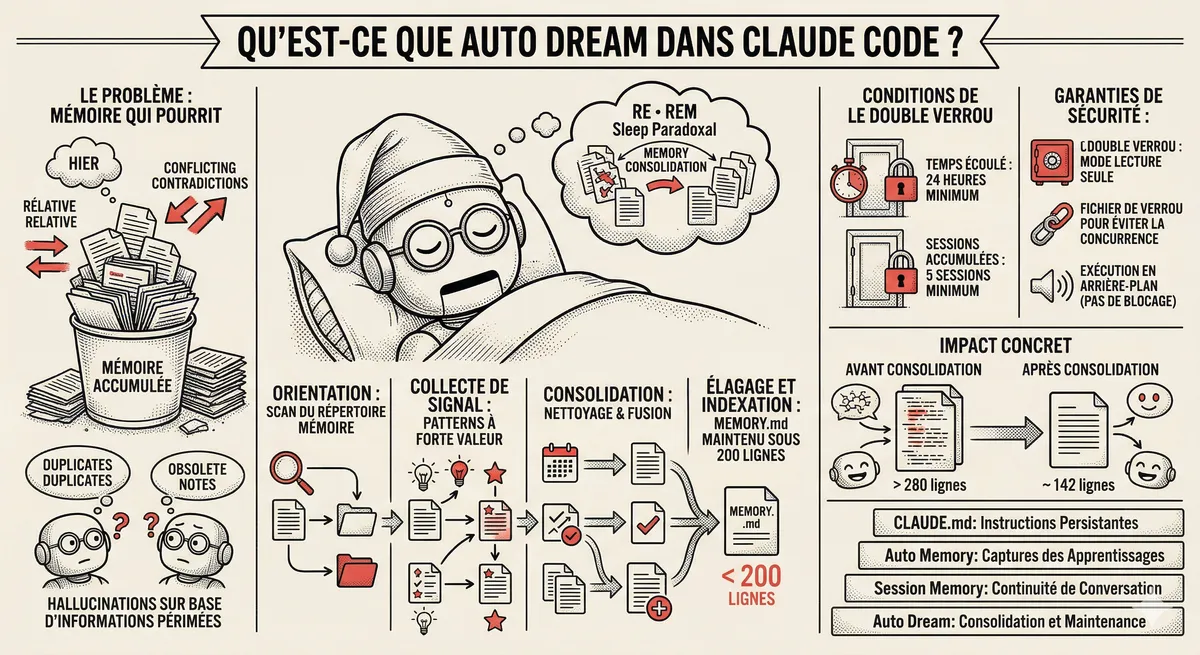
Claude Code Dream & Auto Dream: Automatic Memory Consolidation
After 20 sessions, Auto Memory notes become a mess. Auto Dream solves this by automatically consolidating Claude Code's memory: deduplication, stale entry removal, relative-to-absolute date conversion.
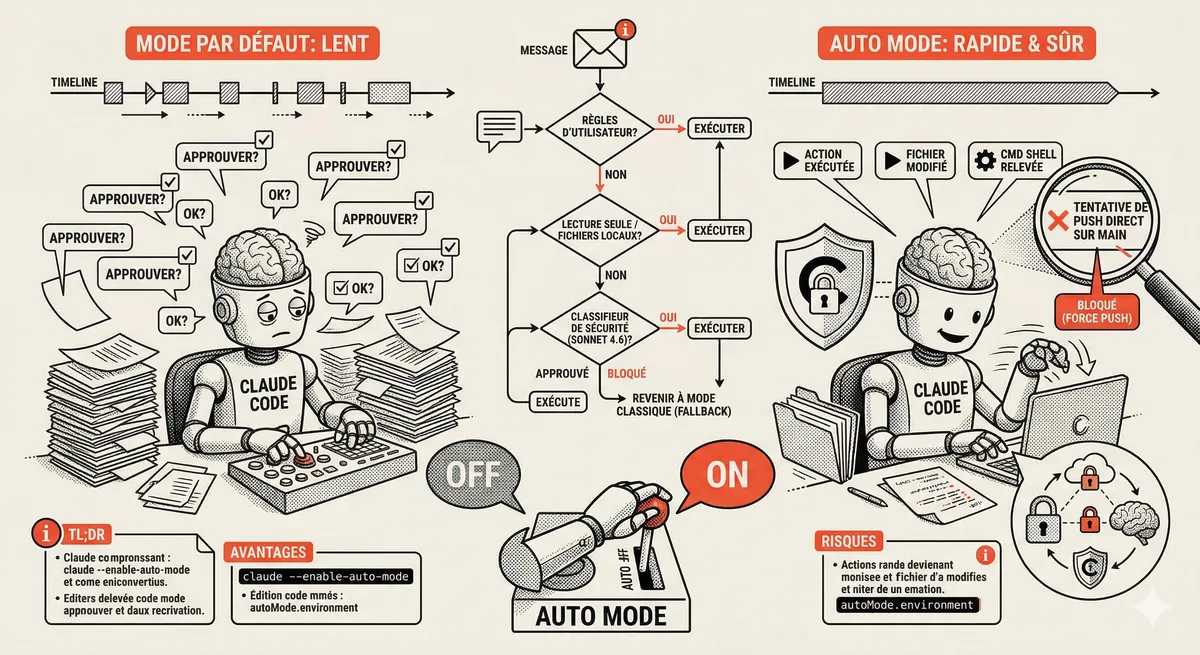
Claude Code Auto Mode: Autonomy Without the Risk
Auto Mode in Claude Code eliminates permission interruptions while keeping a safety net. A classifier analyzes every action before execution and blocks destructive operations. The sweet spot between approving everything and letting everything through.
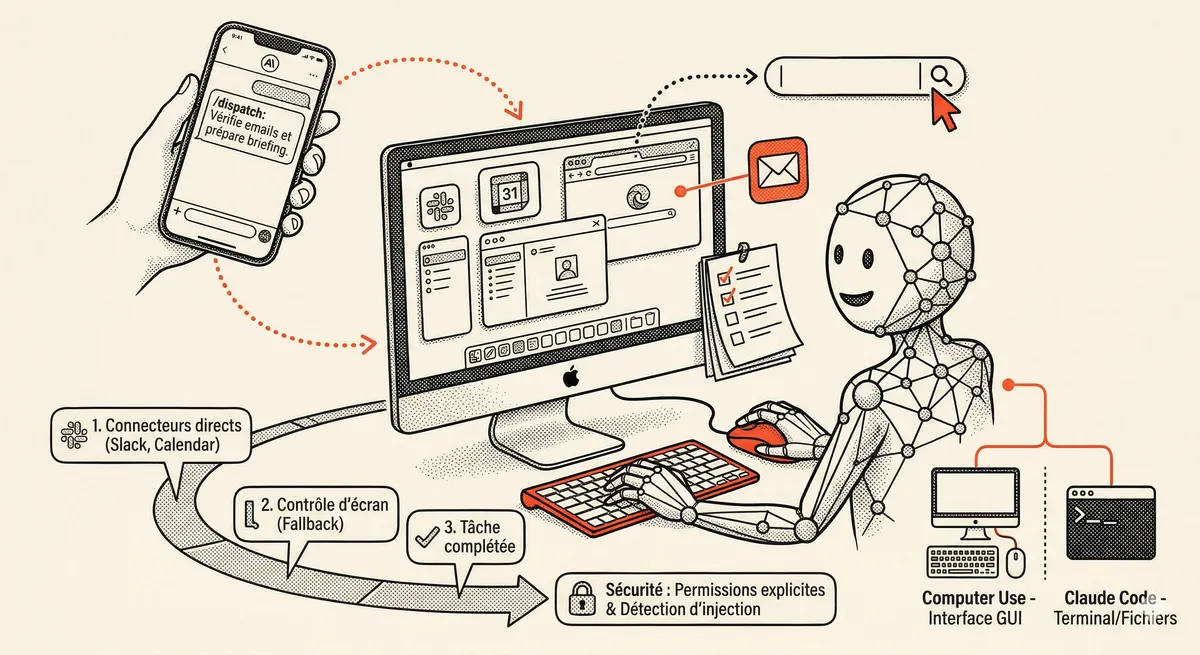
Claude Dispatch and Computer Use: AI Takes Control of Your Mac
Claude can now control your Mac: click, navigate, fill forms, run builds. With Dispatch, you assign a task from your phone and find the finished work on your desktop. Research preview, macOS only.
This topic is covered in Module 4 of our Claude Code training
Documentation, Organization and Prompt Management
1-day training • 60% hands-on labs • Expert instructors
View full program