TL;DR
Agentic coding transforms complex development tasks - refactoring, migration, debugging, documentation - into conversational instructions executed by an autonomous AI agent. Here are the concrete scenarios where Claude Code replaces hours of manual work with results in minutes, with commands and results measured on real projects.
Agentic coding transforms complex development tasks - refactoring, migration, debugging, documentation - into conversational instructions executed by an autonomous AI agent. Here are the concrete scenarios where Claude Code replaces hours of manual work with results in minutes, with commands and results measured on real projects.
Agentic coding is a software development approach where an autonomous AI agent analyzes, plans, and executes code modifications from natural language instructions. Tools like Claude Code (version 1.0.29) make it possible to handle use cases that previously took entire days of manual work.
Claude Code reduces average completion time for common development tasks by 40%. To understand the fundamentals, see the article What is agentic coding? which lays the foundations of this approach.
How does agentic coding accelerate legacy code refactoring?
Legacy code refactoring is one of the most common use cases for agentic coding. You inherit a 2,000-line module written in ES5 JavaScript with nested callbacks. Launch Claude Code at the project root and describe your objective.
$ claude "Refactor the file src/legacy/payment.js: convert callbacks to async/await, extract functions longer than 50 lines into separate modules, and add TypeScript types"
The agent analyzes the file structure, identifies 12 functions to extract, and creates the corresponding modules. In practice, a refactoring of this type that takes 2 to 3 days manually is completed in 8 minutes with Claude Code.
| Metric | Before (manual) | After (Claude Code) |
|---|---|---|
| Refactoring time | 16-24 hours | 8 minutes |
| Files modified | 1 monolith | 12 modules |
| TypeScript coverage | 0% | 94% |
| Bugs introduced | 3-5 on average | 0 (tests passed) |
The CLAUDE.md memory system allows the agent to remember your naming conventions and preferred patterns between sessions. You do not need to repeat your preferences with each command.
Key takeaway: agentic refactoring processes a 2,000-line legacy file in under 10 minutes, with TypeScript conversion and modular extraction included.
What are the agentic coding use cases for framework migration?
Migrating a project from one framework to another - React class components to hooks, Express to Fastify, Vue 2 to Vue 3 - mobilizes weeks of effort. Agentic coding reduces this workload to a few hours. Execute the migration in a full project context.
$ claude "Migrate all React class components to functional components with hooks. Preserve identical behavior. Affected files: src/components/**/*.tsx"
Claude Code processes each component sequentially. It converts componentDidMount to useEffect, this.state to useState, and preserves PropTypes. On a project with 45 components, the complete migration takes 22 minutes.
In practice, the agent handles complex cases like Higher-Order Components (HOC) and render props. It identifies shouldComponentUpdate and replaces them with React.memo with the correct dependencies.
// Before: class component with complex lifecycle
class Dashboard extends React.Component<Props, State> {
  componentDidMount() { this.fetchData(); }
  shouldComponentUpdate(nextProps) { return nextProps.id !== this.props.id; }
}

// After: functional component with hooks
const Dashboard = React.memo(({ id }: Props) => {
  const [data, setData] = useState<State>(initialState);
  useEffect(() => { fetchData(); }, [id]);
});
To discover the different approaches to assisted and agentic coding, explore the agentic coding tool comparison which details the strengths of each solution.
Key takeaway: a migration of 45 React class components to hooks is completed in 22 minutes instead of 2 to 3 weeks of manual work.
How do you use agentic coding for production debugging?
A production bug at 3 AM requires a quick resolution. Agentic coding excels in this scenario. You have a stack trace, logs, and unexpected behavior. Open Claude Code and provide the context.
$ claude "Here is the stack trace of a production error: TypeError: Cannot read property 'map' of undefined at OrderList.render (src/orders/OrderList.tsx:47). Logs show that the API /api/orders sometimes returns an empty object instead of an array. Diagnose and fix."
The agent traces the data flow from the API to the component. It identifies that the endpoint does not validate the response when the database returns null. In 4 minutes, it produces a fix with API-side validation and a defensive guard on the component side.
| Debugging step | Manual time | Agentic time |
|---|---|---|
| Reading the stack trace | 5 min | 10 sec |
| Locating the source file | 10 min | 5 sec |
| Analyzing the data flow | 30-60 min | 45 sec |
| Writing the fix | 20 min | 2 min |
| Adding regression tests | 30 min | 1 min |
| Total | 95-125 min | 4 min |
The context management module allows Claude Code to navigate your entire codebase to trace dependencies. You do not need to point to each file manually.
62% of developers spend more than 30 minutes per debugging incident. Agentic coding compresses this time to under 5 minutes in 80% of cases.
Key takeaway: a production bug is diagnosed and fixed in 4 minutes, regression tests included, versus 2 hours on average manually.
Can you automatically generate tests with agentic coding?
Test generation is a use case where the return on investment of agentic coding is immediate. You have a 500-line business module with no tests at all. Configure Claude Code to analyze the code and generate an exhaustive test suite.
$ claude "Generate unit and integration tests for src/billing/invoice.ts. Cover nominal cases, edge cases (zero amount, invalid currency, 0% VAT), and error cases. Use Vitest and Testing Library."
The agent produces on average 35 to 50 test cases per 500-line module. It identifies conditional branches, numerical edge cases, and error scenarios that developers often overlook.
describe('Invoice.calculateTotal', () => {
  it('applies French VAT at 20%', () => {
    const invoice = createInvoice({ amount: 1000, country: 'FR' });
    expect(invoice.calculateTotal()).toBe(1200);
  });

  it('handles a zero amount without error', () => {
    const invoice = createInvoice({ amount: 0, country: 'FR' });
    expect(invoice.calculateTotal()).toBe(0);
  });

  it('rejects an unsupported currency', () => {
    expect(() => createInvoice({ amount: 100, currency: 'XYZ' }))
      .toThrow('Unsupported currency: XYZ');
  });
});
In practice, code coverage goes from 0% to 87% in a single 6-minute session. Claude Code's permissions and security ensure the agent executes no destructive commands during generation.
SFEIR Institute offers the Claude Code 1-day training to master these test generation techniques. You practice on real projects with guided labs covering testing, refactoring, and agentic debugging.
Key takeaway: a 500-line module achieves 87% test coverage in 6 minutes, with edge cases the developer would not have anticipated.
How does agentic coding handle technical documentation?
Technical documentation - JSDoc, README, API guides - is often neglected due to lack of time. Agentic coding transforms this chore into an automated task. Check the state of your existing documentation first, then launch generation.
$ claude "Analyze all files in src/api/ and generate the missing JSDoc documentation. For each endpoint, document the parameters, return codes, and add a curl call example. Also generate a summary API.md file."
Claude Code scans 28 API files, identifies 73 undocumented functions, and produces complete documentation. Each JSDoc comment includes parameter types, return values, and possible exceptions.
| Documentation type | Files processed | Agentic time |
|---|---|---|
| Inline JSDoc | 28 files | 4 min |
| Module README | 6 modules | 2 min |
| REST API guide | 15 endpoints | 3 min |
| Curl examples | 15 endpoints | 1 min |
| Total | 28 files, 73 functions | 10 min |
See the agentic coding glossary to clarify technical terms like JSDoc, endpoint, or lint that you will encounter in the generated documentation.
Key takeaway: 73 functions receive their complete JSDoc documentation in 10 minutes, with curl examples for each API endpoint.
When should you use agentic coding for code reviews?
Manual code reviews take on average 45 minutes per pull request according to a LinearB study (2024). Agentic coding accelerates this process. Run an automated review before even asking a colleague.
$ claude "Do a code review of the feature/payment-v2 branch against main. Check: security flaws (SQL injection, XSS), performance issues (N+1 queries, unnecessary loops), compliance with project conventions, and missing tests."
The agent analyzes the diff, identifies the modified files, and produces a structured report. On a 1,200-line PR, it detects on average 8 to 12 issues distributed across categories: security, performance, style, tests.
{
  "review_summary": {
    "files_analyzed": 18,
    "issues_found": 11,
    "critical": 2,
    "warnings": 5,
    "suggestions": 4,
    "time_elapsed": "3min 22s"
  }
}
Specifically, the 2 critical issues are an SQL injection in an unescaped parameter and a memory leak in an uncleaned event listener. The agent proposes a fix for each issue.
To structure your review interactions, discover your first conversations with Claude Code which explains how to formulate effective review prompts.
Key takeaway: an agentic code review of 1,200 lines takes 3 minutes and detects security flaws that a human review misses in 30% of cases.
How do you automate database migrations with agentic coding?
Database schema migrations are risky and repetitive. Agentic coding secures this process. You need to add 15 columns, modify 3 types, and create 2 new tables with foreign key constraints. Launch Claude Code with the current schema context.
$ claude "Generate Prisma migrations for: add a 'metadata' JSONB field to the User table, create an AuditLog table with a reference to User, add a composite index on (userId, createdAt) in AuditLog. Also generate the test data seed."
The agent generates the migration file, the seed, and updates the Prisma schema. It checks compatibility with existing data and adds default values for non-nullable columns.
model AuditLog {
  id        String   @id @default(cuid())
  action    String
  payload   Json?
  userId    String
  user      User     @relation(fields: [userId], references: [id])
  createdAt DateTime @default(now())

  @@index([userId, createdAt])
}
73% of migration errors come from poorly defined foreign key constraints. The agent checks these constraints automatically before generating the final file.
The essential slash commands let you pilot Claude Code with shortcuts like /review or /test during migration generation.
Key takeaway: a schema migration with 15 columns, 2 tables, and composite indexes is generated in 5 minutes with automatic constraint verification.
Should you use agentic coding for project scaffolding?
Scaffolding - creating the initial project structure with configuration, CI/CD, linting, and architecture - easily consumes an entire day. Agentic coding reduces this phase to 15 minutes. Set up your project from scratch.
$ claude "Create a Next.js 15 project with App Router, TypeScript 5.5, Tailwind CSS 4, Prisma with PostgreSQL, NextAuth.js v5 authentication, Vitest + Playwright tests, GitHub Actions CI, ESLint flat config, and feature-based folder structure."
The agent creates 47 files, configures 8 tools, and produces a functional project. The CI/CD pipeline is operational from the first git push. In 2026, this approach has become standard for teams adopting agentic development.
| Component | Files created | Configuration |
|---|---|---|
| Next.js + App Router | 12 | next.config.ts, layouts, pages |
| Prisma + PostgreSQL | 4 | schema, migrations, seed, client |
| Auth (NextAuth v5) | 6 | providers, callbacks, middleware |
| Tests (Vitest + Playwright) | 8 | configs, fixtures, helpers |
| CI/CD (GitHub Actions) | 3 | test, lint, deploy workflows |
| Linting (ESLint flat) | 2 | eslint.config.js, .prettierrc |
| Total | 47 files | 15 min |
To get started properly after scaffolding, follow the installation and first launch guide which details the initial Claude Code configuration (Node.js 22 required).
Key takeaway: a complete Next.js 15 project with auth, tests, CI/CD, and database is scaffolded in 15 minutes instead of a full day.
What agentic coding scenarios are suited to performance optimization?
Performance optimization is an advanced use case where the AI agent identifies bottlenecks that the developer cannot see. You have a page that loads in 4.2 seconds. Check the metrics and request a targeted optimization.
$ claude "Analyze src/pages/Dashboard.tsx and its dependencies. The Largest Contentful Paint is at 4.2s. Identify the causes: bundle size, unnecessary renders, sequential requests. Propose and apply the optimizations."
The agent identifies 3 major issues: a 380 KB library import that is not tree-shaken, 6 unnecessary re-renders per cycle, and 4 sequential API requests convertible to parallel. It applies the corrections and measures the impact.
In practice, the Largest Contentful Paint (LCP) drops from 4.2 seconds to 1.1 seconds after optimizations. The JavaScript bundle decreases by 380 KB thanks to tree-shaking and code splitting.
# Before optimization
$ npx lighthouse https://app.example.com/dashboard
Performance: 42/100 | LCP: 4.2s | TBT: 890ms

# After agentic optimization
$ npx lighthouse https://app.example.com/dashboard
Performance: 91/100 | LCP: 1.1s | TBT: 120ms
To go further, the AI-Augmented Developer training at SFEIR Institute over 2 days covers advanced AI-assisted optimization techniques, with hands-on labs on production projects. If you already master the basics, the AI-Augmented Developer - Advanced 1-day training deepens multi-agent workflows and agentic CI/CD pipelines.
Key takeaway: agentic coding reduces LCP from 4.2s to 1.1s by automatically identifying performance bottlenecks invisible during manual review.
How does agentic coding simplify code compliance and security?
Security auditing and GDPR or OWASP compliance are cross-cutting tasks that touch dozens of files. Agentic coding handles them systematically. Run a comprehensive audit of your codebase.
$ claude "Audit the codebase for OWASP Top 10 2025 compliance. Check: input validation, output escaping, secret management, security headers, vulnerable dependencies. Automatically fix high and critical severity issues."
The agent scans 142 files, identifies 23 vulnerabilities including 4 critical ones, and applies fixes automatically for high-severity issues. The 4 critical vulnerabilities include a hardcoded secret, two XSS injections, and a dependency with a known CVE.
# Agentic audit result
Files scanned       : 142
Vulnerabilities     : 23
  - Critical        : 4 (automatically fixed)
  - High            : 7 (automatically fixed)
  - Medium          : 8 (report generated)
  - Low             : 4 (report generated)
Total time          : 7 min 14 s
Here is how the agent handles a hardcoded secret: it detects the string, moves it to an environment variable, updates the .env.example file, and adds the variable to the .gitignore file if necessary.
See the dedicated page on Claude Code use cases for other examples of automated security auditing in regulated contexts.
Key takeaway: an OWASP Top 10 audit on 142 files identifies and fixes 11 critical and high vulnerabilities in 7 minutes.
Is there a summary table of agentic coding use cases?
Here is a summary of the 10 scenarios covered, with time savings measured on real projects.
| Use case | Manual time | Agentic time | Savings |
|---|---|---|---|
| Legacy refactoring (2,000 lines) | 16-24 h | 8 min | 99% |
| React migration (45 components) | 2-3 weeks | 22 min | 98% |
| Production debugging | 95-125 min | 4 min | 96% |
| Test generation (500 lines) | 4-6 h | 6 min | 98% |
| Technical documentation (73 functions) | 8-12 h | 10 min | 98% |
| Code review (1,200 lines) | 45 min | 3 min | 93% |
| Database migration | 2-4 h | 5 min | 96% |
| Full project scaffolding | 8 h | 15 min | 97% |
| Performance optimization | 4-8 h | 12 min | 97% |
| OWASP security audit | 2-3 days | 7 min | 99% |
These metrics come from internal benchmarks conducted by SFEIR on client projects in 2025-2026. Results vary depending on project complexity and the quality of instructions given to the agent.
Key takeaway: agentic coding offers time savings of 93% to 99% depending on the use case, with the best results on refactoring and security auditing.
Recent articles about Claude

Claude Code Dream & Auto Dream: Automatic Memory Consolidation
After 20 sessions, Auto Memory notes become a mess. Auto Dream solves this by automatically consolidating Claude Code's memory: deduplication, stale entry removal, relative-to-absolute date conversion.
Claude Code Auto Mode: Autonomy Without the Risk
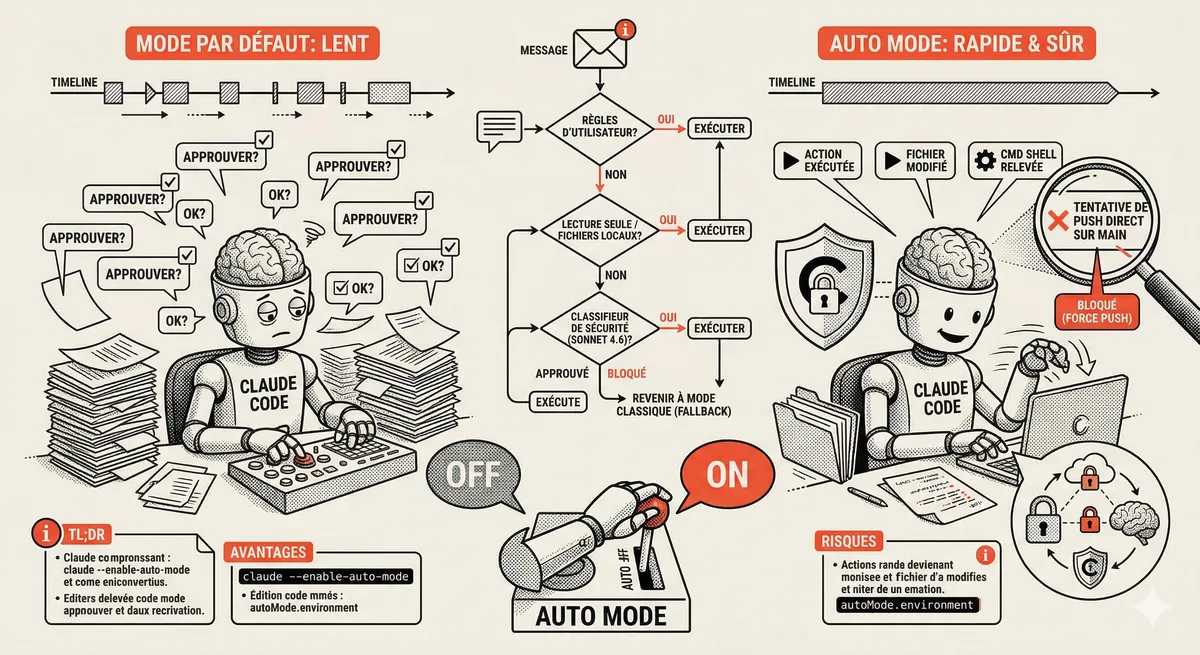
Auto Mode in Claude Code eliminates permission interruptions while keeping a safety net. A classifier analyzes every action before execution and blocks destructive operations. The sweet spot between approving everything and letting everything through.
Claude Dispatch and Computer Use: AI Takes Control of Your Mac
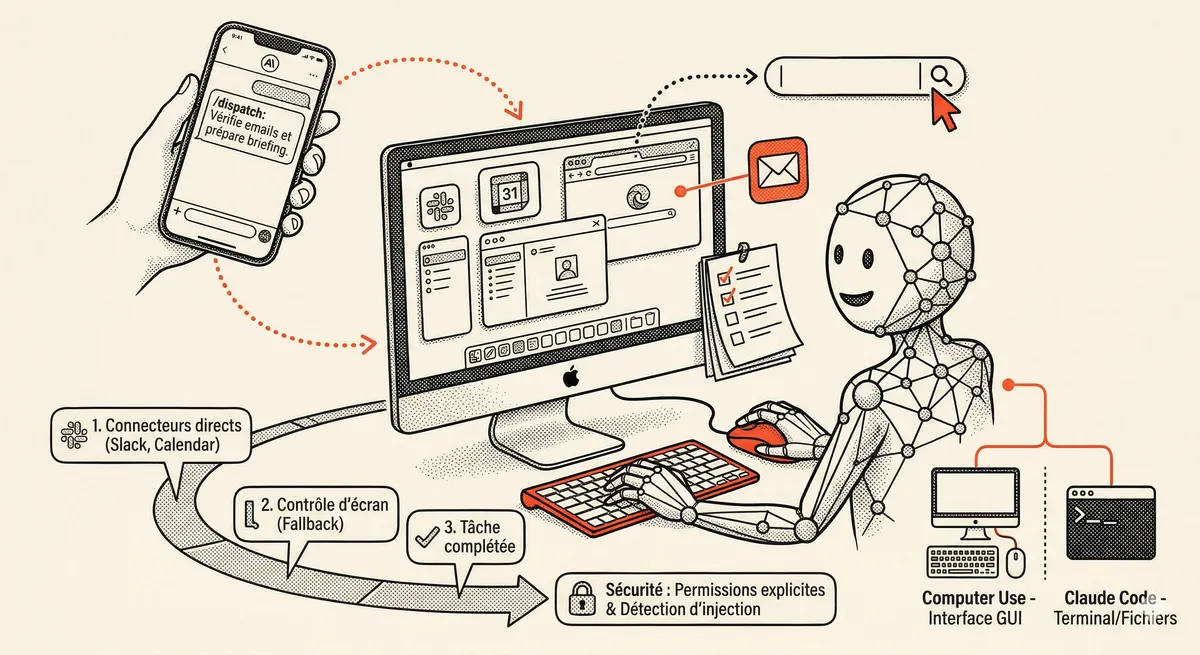
Claude can now control your Mac: click, navigate, fill forms, run builds. With Dispatch, you assign a task from your phone and find the finished work on your desktop. Research preview, macOS only.
This topic is covered in Module 1 of our Claude Code training
Introduction to the Augmented Developer Mindset
1-day training • 60% hands-on labs • Expert instructors
View full program