TL;DR
Claude Code, GitHub Copilot, and Cursor take three distinct approaches to AI-assisted coding. Claude Code focuses on agentic autonomy in the terminal, Copilot on native VS Code integration, and Cursor on a dedicated AI IDE. Choose according to your profile: maximum autonomy, quick completion, or guided refactoring.
Claude Code, GitHub Copilot, and Cursor take three distinct approaches to AI-assisted coding. Claude Code focuses on agentic autonomy in the terminal, Copilot on native VS Code integration, and Cursor on a dedicated AI IDE. Choose according to your profile: maximum autonomy, quick completion, or guided refactoring.
Agentic coding is an approach where an AI agent executes development tasks end-to-end (code reading, file editing, command execution) without manual intervention at each step. Three tools dominate this market: Claude Code (Anthropic), GitHub Copilot (Microsoft/OpenAI), and Cursor (Anysphere).
Understanding their differences lets you choose the assistant that matches your daily workflow. For an in-depth definition, see the article What is agentic coding? published on SFEIR Institute.
SFEIR Institute trainings
Claude Code Training
1 day · Fundamentals
AI-Augmented Developer
2 days · Intermediate
How do you compare Claude Code, Copilot, and Cursor at a glance?
Examine this comparison table that summarizes the major differences between the three tools. Each criterion reflects a concrete developer need.
| Criterion | Claude Code | GitHub Copilot | Cursor |
|---|---|---|---|
| Interface | Multi-surface: terminal CLI, IDE extensions (VS Code/Cursor, JetBrains), desktop app, web | VS Code / JetBrains extension | Dedicated IDE (VS Code fork) |
| Primary AI model | Claude Opus 4.8, Sonnet 4.6 (default is plan-dependent: Sonnet 4.6 on Pro/Team Standard, Opus 4.8 on Max/Team Premium/Enterprise/API) | GPT-4o, Claude 3.5 Sonnet | GPT-4o, Claude Sonnet |
| Agentic mode | Native, autonomous in terminal | Copilot Workspace (preview) | Integrated agent mode |
| Max context | Up to 1M tokens on current models (Opus 4.6+/Sonnet 4.6); 200K on older or Bedrock/Vertex defaults | 128K tokens | 128K tokens |
| Multi-file editing | Yes, autonomous | Limited (one file at a time) | Yes, via Composer |
| CLI execution | Direct (bash, git, npm) | No | Limited (integrated terminal) |
| Monthly price (pro) | see official pricing (API usage) | see official pricing | see official pricing |
Claude Code handles a large share of refactoring tasks autonomously in the terminal, while Copilot Workspace and Cursor Agent typically require more manual guidance.
To explore the essential slash commands of Claude Code, browse the dedicated guide on our silo.
Key takeaway: Claude Code excels in terminal autonomy, Copilot in IDE integration, Cursor in interactive refactoring.
What distinguishes agentic coding from traditional autocompletion?
Traditional autocompletion predicts the next line of code. Agentic coding goes further: the AI understands the overall objective, plans the steps, and executes modifications across multiple files.
In practice, an agent like Claude Code can receive the instruction "add a REST endpoint with tests" and create the route file, the controller, the unit tests, and update the documentation, all in a single command.
| Capability | Autocompletion | Agentic coding |
|---|---|---|
| Scope | Line or block | Entire project |
| Autonomy | Passive suggestion | Autonomous execution |
| Files modified | 1 | Unlimited |
| Terminal access | No | Yes (Claude Code) |
In practice, developers report substantial time savings on repetitive tasks with an autonomous agent, typically more than with autocompletion alone. The agentic coding FAQ answers frequent questions about this approach.
The agentic coding glossary defines each technical term you will encounter in this article.
Key takeaway: agentic coding automates entire flows where autocompletion is limited to the next line.
What are the strengths and weaknesses of Claude Code?
Claude Code is Anthropic's terminal agent. Install it via npm:
npm install -g @anthropic-ai/claude-code
claude
Strengths:
- Large context window: up to 1M tokens on current models (Opus 4.6+ and Sonnet 4.6, generally available), with 200K on older models or Bedrock/Vertex defaults
- Direct execution of bash, git, and npm commands
- Multi-file editing without leaving the terminal
- Persistent memory system via CLAUDE.md
- Fine-grained permission management (read, write, execute)
Weaknesses:
- Learning curve for developers used to IDEs (though Claude Code is editor-agnostic and also runs as IDE extensions for VS Code/Cursor and JetBrains, a desktop app, and on the web, not only in the terminal)
- Variable cost depending on API consumption (see the official pricing for current rates)
In practice, Anthropic's Claude models post strong scores on the SWE-bench Verified benchmark for real-world bug resolution (see Anthropic's published results). The CLAUDE.md memory system allows retaining project context between sessions, a unique advantage.
Want to master Claude Code in a single day? The Claude Code training offered by SFEIR Institute covers installation, CLAUDE.md configuration, and agentic workflows through hands-on labs.
Key takeaway: Claude Code offers maximum autonomy for developers comfortable in the terminal.
What are the advantages and limitations of GitHub Copilot?
GitHub Copilot is one of the most widely adopted AI coding assistants. Activate it from the VS Code extension:
code --install-extension GitHub.copilot
Strengths:
- Native integration in VS Code, JetBrains, Neovim
- Real-time autocompletion with latency under 200 ms
- Copilot Chat for asking contextual questions
- Support for 20+ programming languages
- GitHub ecosystem (PR reviews, Actions)
Weaknesses:
- Agentic mode still in preview (Copilot Workspace)
- Context limited to 128,000 tokens
- No direct terminal command execution
- Multi-file editing still limited
Copilot can generate a meaningful share of the code lines accepted by developers. This contribution comes mainly from pure autocompletion, not agentic mode.
To understand context management and its impact on suggestion quality, explore our technical guide.
Key takeaway: Copilot remains the default choice for fast autocompletion integrated into the IDE.
How does Cursor position itself against its competitors?
Cursor is a complete IDE based on a fork of VS Code, designed from the ground up for AI-assisted development. It offers an Agent mode capable of editing multiple files simultaneously via its Composer feature.
# Installing Cursor on macOS
brew install --cask cursor
Strengths:
- Dedicated IDE with AI-optimized UX
- Composer mode for multi-file editing
- Automatic codebase indexing for rich context
- Integration of multiple models (GPT-4o, Claude Sonnet)
- Built-in visual diff for validating modifications
Weaknesses:
- Requires leaving VS Code for a fork
- VS Code extensions sometimes incompatible
- No autonomous system command execution
- Same price as Copilot with fewer native integrations
Cursor has seen rapid adoption among enterprise teams. Its Composer mode handles refactorings that span several files at once.
Permissions and security are a major selection criterion: check how each tool manages access to your files.
Key takeaway: Cursor suits developers who want an all-in-one IDE centered on AI.
How much do these tools cost?
Compare the pricing models to choose according to your budget and usage. Plan figures change over time, so always confirm against each vendor's live pricing page.
| Plan | Claude Code | GitHub Copilot | Cursor |
|---|---|---|---|
| Free | No (limited trial) | Limited free tier | Limited free trial |
| Pro individual | see official pricing | see official pricing | see official pricing |
| Team / Business | see official pricing | see official pricing | see official pricing |
| Enterprise | On quote (API) | see official pricing | On quote |
| API billing | Pay-per-use | Included | Included (quota) |
In practice, a developer using Claude Code intensively consumes a variable amount of API credits per month, while the higher Max plan offers a larger usage allowance for intensive users. Check the official pricing for current rates.
Specifically, Copilot remains the most accessible for teams already on GitHub Enterprise. Total cost depends on request volume and chosen model.
To get started without extra cost, follow the installation and first launch guide which details the initial configuration step by step.
Key takeaway: the three tools sit in a similar range for individual use, but Claude Code's API cost varies with intensity. Check each vendor's live pricing for exact figures.
Which use cases should you prioritize for each tool?
Each tool excels in specific scenarios. Identify your primary use case to make the right choice.
| Use case | Best choice | Why |
|---|---|---|
| Massive refactoring (>10 files) | Claude Code | Native multi-file autonomy |
| Real-time autocompletion | Copilot | <200 ms latency, IDE integration |
| Rapid prototyping with visual diff | Cursor | Composer + built-in diff |
| Complex bug resolution | Claude Code | Large context (up to 1M tokens), CLI execution |
| Guided pair programming | Cursor | Chat + editing in the same IDE |
| CI/CD and automation scripts | Claude Code | Direct terminal access |
| Collaborative code review | Copilot | Native GitHub PR integration |
Here is how to choose in 3 questions:
- Do you work primarily in the terminal? -> Claude Code
- Do you want to stay in VS Code without changes? -> Copilot
- Are you looking for a dedicated AI IDE with visual diff? -> Cursor
You can also combine these tools. In practice, many developers use two AI assistants simultaneously. The Claude Code comparison page deepens the technical benchmarks.
Key takeaway: there is no universal best tool. The choice depends on your daily workflow.
How do you configure Claude Code for an optimal agentic workflow?
Launch Claude Code in your project and configure the CLAUDE.md file to customize the agent's behavior:
cd your-project
claude
# In the Claude Code session:
/init
This command generates a CLAUDE.md file at the project root. Edit it to define your conventions:
# CLAUDE.md
- Language: TypeScript strict
- Tests: Vitest, coverage >80%
- Style: ESLint + Prettier
- Commits: conventional commits (feat:, fix:, chore:)
Check permissions inside the session with the /permissions slash command (run it within Claude Code, not in the shell):
/permissions
The first conversations guide walks you through formulating effective instructions. The Claude Code npm package requires Node.js 18 or later, and the native installer does not require Node at all. It works on macOS, Linux, and WSL 2.
Here is how to validate your configuration in 60 seconds: run claude "describe this project" and verify that the agent correctly identifies the technical stack, dependencies, and file structure.
Specifically, a well-written CLAUDE.md file noticeably reduces the number of iterations needed to get a result that meets your standards.
If you want to go beyond basic configuration, the AI-Augmented Developer training from SFEIR Institute offers 2 days of hands-on labs covering Claude Code, Copilot, and Cursor with real enterprise use cases. For experienced profiles, the AI-Augmented Developer - Advanced training deepens multi-agent workflows and optimization strategies in 1 intensive day.
Key takeaway: a well-configured CLAUDE.md file transforms Claude Code from a generic tool into a personalized assistant.
Should you combine multiple AI assistants?
Many developers use at least one AI assistant daily. A common pattern is to combine them: Copilot for real-time autocompletion, Claude Code for heavy agentic tasks.
Here is how to structure a hybrid workflow:
- Activate Copilot in VS Code for line-by-line completion
- Switch to Claude Code in the terminal for multi-file refactorings
- Use Cursor occasionally for visual prototyping sessions
| Combination | Typical use | Estimated gain |
|---|---|---|
| Copilot + Claude Code | Senior dev, complex projects | Significant |
| Copilot + Cursor | Front-end dev, prototyping | Moderate |
| Claude Code alone | DevOps, CI/CD automation | Significant |
In practice, the extra cost of a dual subscription pays for itself after only a couple of hours of time saved per week for a developer billed at a typical day rate (check current rates on each vendor's pricing page).
Adoption of AI code assistants among enterprise developers keeps growing, and the AI development tooling market continues to expand.
Explore all the resources available on our silo to deepen your understanding of each tool. The installation and first launch guide remains the recommended entry point for getting started with Claude Code.
Key takeaway: combining Copilot and Claude Code offers the best coverage/cost ratio for a professional developer.
Recent articles about Claude

Claude Managed Agents: Anthropic's Platform for Production Agent Deployment
Anthropic launches Managed Agents: a cloud platform for deploying AI agents in production. Secure sandbox, checkpointing, multi-agent, autonomous sessions lasting hours. Notion, Rakuten, Asana and Sentry already use it.

Claude Code Dream & Auto Dream: Automatic Memory Consolidation
After 20 sessions, Auto Memory notes become a mess. Auto Dream solves this by automatically consolidating Claude Code's memory: deduplication, stale entry removal, relative-to-absolute date conversion.
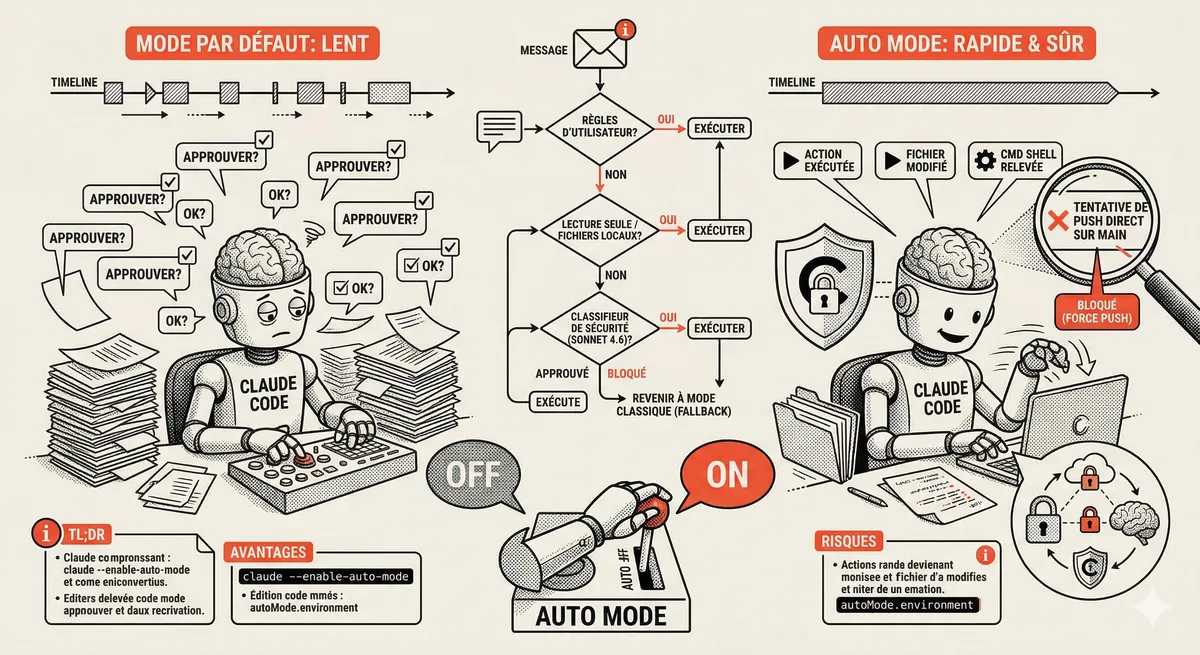
Claude Code Auto Mode: Autonomy Without the Risk
Auto Mode in Claude Code eliminates permission interruptions while keeping a safety net. A classifier analyzes every action before execution and blocks destructive operations. The sweet spot between approving everything and letting everything through.
This topic is covered in Module 1 of our Claude Code training
Introduction to the Augmented Developer Mindset
1-day training • 60% hands-on labs • Expert instructors
View full program