TL;DR
Agentic coding transforms the way you develop: instead of writing each line, you orchestrate an AI agent that codes, tests, and iterates autonomously. This FAQ answers the most frequent questions about Claude Code, its models, its pricing, and its differences with Copilot and Cursor.
Agentic coding transforms the way you develop: instead of writing each line, you orchestrate an AI agent that codes, tests, and iterates autonomously. This FAQ answers the most frequent questions about Claude Code, its models, its pricing, and its differences with Copilot and Cursor.
Agentic coding is a development paradigm where an autonomous AI agent executes complete programming tasks, from context analysis to code writing, through testing and debugging. Anthropic's Claude Code has established itself as one of the leading tools in this category. It is editor-agnostic and available across multiple surfaces: the terminal CLI, IDE extensions (VS Code, Cursor, JetBrains), a desktop app, and the web.
To understand the foundations of this approach, see the complete guide on agentic coding which details each key concept.
Key takeaway: agentic coding replaces line-by-line autocompletion with autonomous orchestration of complete tasks.
SFEIR Institute trainings
Claude Code Training
1 day · Fundamentals
AI-Augmented Developer
2 days · Intermediate
How does agentic coding differ from traditional autocompletion?
Agentic coding entrusts an AI agent with completing tasks end-to-end, whereas autocompletion suggests code fragments.
With a tool like GitHub Copilot, you type a line and the AI completes what follows. With an agent like Claude Code, you describe an objective ("add an API route with validation and tests") and the agent reads your codebase, writes the code, creates the test files, and fixes errors.
| Criterion | Autocompletion | Agentic coding |
|---|---|---|
| Scope | 1-3 lines | Complete multi-file task |
| Context | Open file | Entire codebase |
| Autonomy | Passive suggestion | Autonomous execution |
| Iteration | Manual | Automatic loop (write, test, fix) |
In practice, an agent can substantially reduce time spent on repetitive refactoring tasks by handling them end-to-end. The in-depth analysis of agentic coding explores this approach in detail.
Key takeaway: autocompletion helps you type faster, agentic coding frees you from entire repetitive tasks.
What is Claude Code and how does it work?
Claude Code is a development agent created by Anthropic. It runs in the terminal, in IDE extensions (VS Code, Cursor, JetBrains), in a desktop app, and on the web, so you can use it wherever you work.
Launch Claude Code with a simple command:
$ claude
The agent accesses your file tree, reads your project context, and performs concrete actions: file creation, code editing, shell command execution. It works in an agentic loop: it plans, executes, observes the result, then adjusts its approach.
Claude Code is editor-agnostic: it works the same whether you launch it from the terminal, an IDE extension, the desktop app, or the web, and your settings, CLAUDE.md, and MCP servers carry across every surface. Claude Code works with a wide range of programming languages.
To get started quickly, follow the installation and first launch tutorial step by step.
Key takeaway: Claude Code executes complete development tasks across the terminal, IDE extensions, a desktop app, and the web.
How do you install Claude Code on your machine?
Install Claude Code in a single command via npm with Node.js 18 or higher.
Here is how to proceed:
$ npm install -g @anthropic-ai/claude-code
$ claude --version
Claude Code vX.Y.Z
Technical prerequisites:
- Node.js 18 or later (Node.js 22 LTS recommended at the time of writing)
- A compatible terminal (bash, zsh, PowerShell)
- An Anthropic API key or a Claude Max/Team subscription
Installation is quick via npm. Verify your installation with claude --version to confirm everything works.
In an interactive session, use /model to change the model:
claude> /model
The beginner's guide to Claude Code walks you through initial configuration with concrete examples.
Key takeaway: a single npm command is all it takes to install Claude Code: Node.js 18+ is the only prerequisite.
What are the three available models: Haiku, Sonnet, and Opus?
Anthropic offers three Claude models suited to different use cases: Haiku for speed, Sonnet for balance, and Opus for maximum power.
| Model | Relative speed | Context window | Primary use |
|---|---|---|---|
| Claude Haiku 4.5 | Fastest | 200K tokens | Quick tasks, autocompletion |
| Claude Sonnet 4.6 | Balanced | Up to 1M tokens | Daily development |
| Claude Opus 4.8 | Most capable | 1M tokens | Complex refactoring, architecture |
Haiku is the most economical model, Sonnet offers the best value for daily agentic coding, and Opus handles the most demanding tasks such as codebase migrations, architecture design, and multi-file debugging. For exact per-token rates, see the official pricing.
In practice, the default model in Claude Code depends on your plan: Sonnet 4.6 on Pro and Team Standard, Opus 4.8 on Max, Team Premium, Enterprise, and API. Change the model in session with /model or at launch with the --model flag:
$ claude --model claude-sonnet-4-6
To dive deeper into the differences between these models, see the beginner's guide to agentic coding which compares use cases.
Key takeaway: the default is plan-dependent (Sonnet 4.6 on Pro and Team Standard, Opus 4.8 on Max, Team Premium, Enterprise, and API), with Opus for complex tasks and Haiku for speed.
How does Claude Code compare to Copilot and Cursor?
Claude Code is an autonomous, editor-agnostic agent, while Copilot is an IDE autocompletion assistant and Cursor is an integrated AI editor.
| Feature | Claude Code | GitHub Copilot | Cursor |
|---|---|---|---|
| Interface | Terminal, IDE extensions, desktop app, web | IDE extension | Full IDE |
| Operating mode | Autonomous agent | Autocompletion + chat | Autocompletion + agent |
| Max context | Up to 1M tokens | Smaller (varies) | Varies |
| Multi-file | Native | Limited | Yes |
| Shell execution | Yes | No | Partial |
| Monthly price | See official pricing | See vendor pricing | See vendor pricing |
Claude Code excels at tasks that require a global understanding of the project. With its default models supporting a context window of up to 1M tokens (200K for Haiku 4.5), it can analyze entire codebases. Copilot remains performant for real-time rapid autocompletion in the IDE.
Anthropic's models score strongly on the SWE-bench Verified benchmark, which measures how many real-world software issues a model can resolve autonomously. This translates into Claude Code's strength on multi-file, repository-wide tasks.
The first conversations with Claude Code show how to take advantage of this agentic approach from day one.
Key takeaway: Claude Code dominates on multi-file tasks and refactoring; Copilot remains strong in inline autocompletion.
What are the pricing plans and token consumption?
Claude Code offers several plans: pay-as-you-go API, the Claude Pro and Claude Max individual subscriptions, and Claude Team with Standard and Premium seats. For current figures, see the official pricing.
| Plan | Included tokens | Ideal for |
|---|---|---|
| API (pay-as-you-go) | Unlimited (billed) | Occasional use |
| Claude Pro | Limited | Moderate personal use |
| Claude Max 5x | ~5x Pro | Intensive developers |
| Claude Max 20x | ~20x Pro | Teams, heavy use |
| Claude Team Standard | Team quota | Organizations |
| Claude Team Premium | Higher quota | Heavy team use |
For the exact prices of each plan, see the official pricing.
Token consumption varies widely with task complexity, codebase size, and how much context the agent reads. A heavier agentic session naturally consumes more than a quick edit, so treat any figure you see as an illustrative estimate rather than a fixed rate.
API costs vary by model, with Haiku the cheapest, Sonnet in the middle, and Opus the most expensive per token. For the current per-token rates of each model, see the official pricing.
Monitor your consumption with:
In session, use the /cost command:
claude> /cost
Discover the essential slash commands to efficiently manage your token budget and optimize your interactions.
Key takeaway: Claude Max 5x covers the needs of most professional developers.
How do you launch your first agentic coding session?
Open your terminal in your project directory and type claude to start an interactive session.
Here is how to perform your first agentic task:
$ cd my-project
$ claude
> Analyze this project and list the main files
> Add a GET /api/health route with a unit test
Claude Code begins by reading your project structure. It identifies the frameworks used, existing patterns, then generates code consistent with your codebase. The agent creates the necessary files, writes the tests, and runs them automatically.
The CLAUDE.md file at the root of your project allows you to persist preferences and conventions. Configure it from the start to guide the agent:
# CLAUDE.md
- Framework: Next.js 15 with App Router
- Tests: Vitest
- Style: TypeScript strict
The CLAUDE.md memory system is essential for getting consistent results from one session to the next. Also see the FAQ on your first conversations for common beginner questions.
Key takeaway: create a CLAUDE.md file from day one to guide the agent and get code that conforms to your conventions.
Why is agentic coding more effective than AI pair-programming?
Agentic coding eliminates manual back-and-forth by executing an autonomous planning-execution-verification loop.
In traditional AI pair-programming, you ask a question, receive a suggestion, copy it, adapt it, then test. An agentic agent collapses this multi-step cycle into a single autonomous pass, often far faster than manual copy-paste iteration.
Developers using Claude Code in agentic mode often complete development tasks faster than with a traditional conversational assistant. The gain is especially visible on multi-file tasks: the agent can read and edit many files in a single session without losing context.
The Claude Code one-day training at SFEIR Institute lets you master these agentic workflows with hands-on labs on real projects. You learn to formulate effective prompts and configure the agent for your technical stack.
Key takeaway: agentic mode is faster than AI pair-programming thanks to the elimination of manual copy-paste.
What are the concrete use cases for agentic coding?
The most common use cases are refactoring, test generation, code migration, and automated documentation.
- Refactoring - Rename a variable across 200 files in a single command
- Unit tests - Generate a substantial suite of unit tests for existing code in a single session
- Migration - Convert a JavaScript codebase to TypeScript
- Documentation - Produce docstrings and READMEs from existing code
- Debugging - Analyze a stack trace and propose a fix
- Code review - Identify anti-patterns and suggest improvements
- Prototyping - Create a functional MVP in under 2 hours
In practice, multi-file refactoring and test generation are among the most common uses of Claude Code in enterprise settings.
Claude Code can dramatically compress large JavaScript-to-TypeScript migrations that would otherwise take weeks of manual effort.
To develop these skills in a structured way, the AI-Augmented Developer training at SFEIR Institute over 2 days covers the entire range of agentic workflows: from prompt engineering to AI-assisted debugging strategies.
Key takeaway: refactoring and test generation are among the most common agentic coding use cases in enterprise.
How do you secure agent execution in your terminal?
Claude Code works with a permissions system that asks for confirmation before any sensitive action.
Three permission levels control execution:
- Read-only - The agent reads files without modification
- Supervised writing - Each modification requires your approval
- Autonomous mode - The agent writes and executes freely (must be explicitly enabled)
Claude Code asks for confirmation before any sensitive action. You can configure permission rules in your project's .claude/settings.json file or in ~/.claude/settings.json for global rules.
The agent can never execute destructive commands (rm -rf, git push --force) without your explicit validation. Every action is logged in the terminal, giving you full traceability.
Claude Code offers an optional OS-level sandbox (Seatbelt on macOS, bubblewrap on Linux/WSL2) that restricts Bash commands to the working directory and to approved network domains.
The slash commands FAQ details the permission management commands available in Claude Code.
Key takeaway: the three-level permissions system ensures the agent modifies nothing without your explicit agreement.
Can Claude Code be used in a CI/CD pipeline?
Yes, Claude Code integrates into CI/CD pipelines via headless mode which accepts instructions from standard input.
Run Claude Code in non-interactive mode:
$ echo "Generate missing tests for src/api/" | claude -p
This mode allows you to automate test generation, code review, and documentation in your GitHub Actions, GitLab CI, or Jenkins workflows. The agent returns an exit code of 0 on success, making integration into existing scripts straightforward.
| CI/CD Platform | Integration | Difficulty |
|---|---|---|
| GitHub Actions | Official action | Easy |
| GitLab CI | Bash script | Medium |
| Jenkins | Community plugin | Medium |
A growing number of teams integrate Claude Code into their CI/CD pipeline to automate code review. The installation and first launch includes a dedicated section on CI/CD configuration.
Key takeaway: Claude Code's headless mode enables direct integration into GitHub Actions, GitLab CI, and Jenkins.
Is a permanent Internet connection required to use Claude Code?
Yes, Claude Code requires an active Internet connection because Claude models run on Anthropic's servers.
Each request is sent to the Anthropic API for processing. Network latency adds to the model's generation time. In practice, a stable broadband connection is sufficient for a smooth experience.
Claude Code caches your project context locally. Data handling and retention depend on your plan and Anthropic's data usage policy; consult the official privacy documentation.
For those who want to go further in mastering AI development tools, the AI-Augmented Developer - Advanced one-day training at SFEIR explores advanced architectures, including network resilience strategies and token optimization.
Key takeaway: an Internet connection is required because Claude models run on Anthropic's servers, and a stable broadband connection is enough for a smooth experience.
What languages and frameworks does Claude Code support?
Claude Code works with a wide range of programming languages, with optimal performance on TypeScript, Python, Java, Go, and Rust.
The best-supported frameworks include:
- Frontend - React, Next.js 15, Vue 3, Angular 18, Svelte 5
- Backend - Express, FastAPI, Spring Boot 3, Gin, Actix
- Mobile - React Native, Flutter, Swift UI
- Infrastructure - Terraform, Pulumi, Docker, Kubernetes
Support is not limited to syntax. Claude Code understands the idiomatic patterns of each ecosystem. It generates React code with hooks and Server-Side Rendering when the project uses Next.js, or Pythonic code with type hints when the project is in Python 3.12+.
In practice, TypeScript and Python are among the most common languages used with Claude Code, and the agent performs especially well on tasks in these ecosystems.
Key takeaway: TypeScript and Python are the best-supported languages, but Claude Code works with a wide range of languages.
Recent articles about Claude

Claude Managed Agents: Anthropic's Platform for Production Agent Deployment
Anthropic launches Managed Agents: a cloud platform for deploying AI agents in production. Secure sandbox, checkpointing, multi-agent, autonomous sessions lasting hours. Notion, Rakuten, Asana and Sentry already use it.

Claude Code Dream & Auto Dream: Automatic Memory Consolidation
After 20 sessions, Auto Memory notes become a mess. Auto Dream solves this by automatically consolidating Claude Code's memory: deduplication, stale entry removal, relative-to-absolute date conversion.
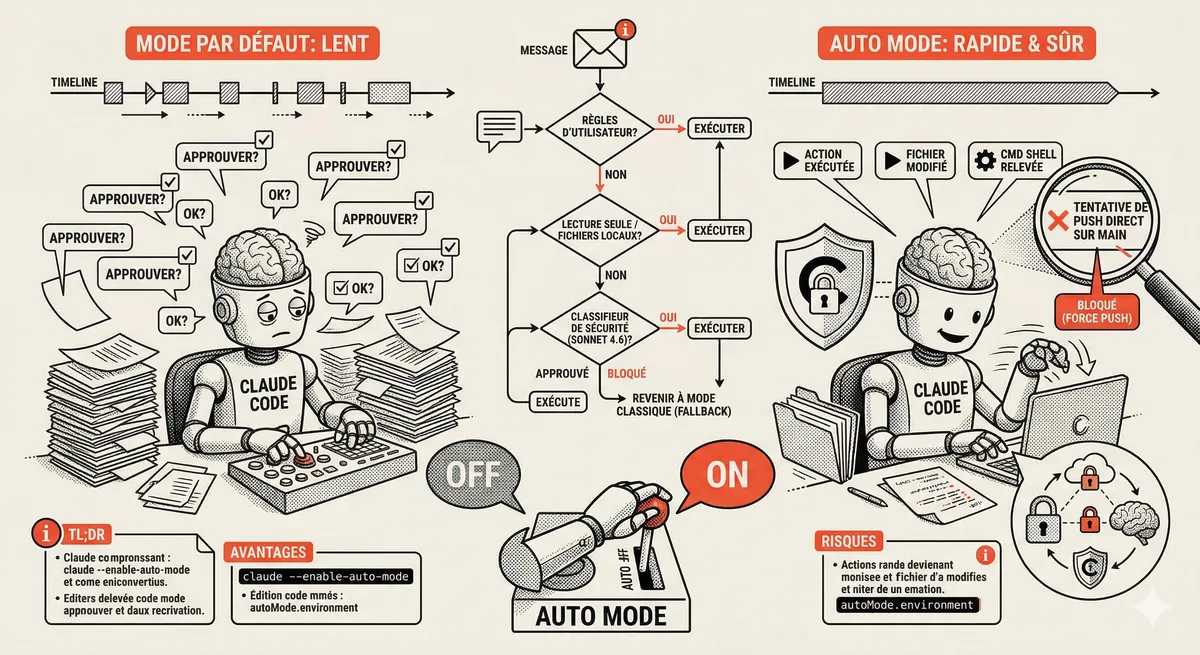
Claude Code Auto Mode: Autonomy Without the Risk
Auto Mode in Claude Code eliminates permission interruptions while keeping a safety net. A classifier analyzes every action before execution and blocks destructive operations. The sweet spot between approving everything and letting everything through.
This topic is covered in Module 1 of our Claude Code training
Introduction to the Augmented Developer Mindset
1-day training • 60% hands-on labs • Expert instructors
View full program