TL;DR
Agentic coding is an approach where an autonomous AI agent reads, modifies, and tests your code from natural language instructions. Claude Code, the CLI tool from Anthropic, embodies this method by orchestrating complete tasks directly from your terminal - from refactoring to deployment.
Agentic coding is an approach where an autonomous AI agent reads, modifies, and tests your code from natural language instructions. Claude Code, the CLI tool from Anthropic, embodies this method by orchestrating complete tasks directly from your terminal - from refactoring to deployment.
Agentic coding is a software development paradigm where an artificial intelligence agent performs programming tasks autonomously, by reading existing code, proposing modifications, and applying them without manual intervention. Claude Code stands out as the leading tool for this approach, with over 500,000 active developers according to Anthropic.
This comprehensive guide explains concretely what agentic coding is, how it works, and why it is redefining development practices. Check out the main Claude Code hub for an overview of the ecosystem.
How is agentic coding transforming software development?
Agentic coding marks a breakthrough in the way code is produced. Instead of writing each line, you describe the intent to an agent that orchestrates the entire execution.
A coding agent is a program that combines a language model (LLM) with system tools: file reading, command execution, and Git repository navigation. It operates in an autonomous loop until the stated objective is achieved.
In practice, you formulate a request like "add email validation to the sign-up form" and the agent:
- Analyzes the project tree structure
- Identifies the relevant files
- Writes the validation code
- Runs the existing tests
- Fixes any detected errors automatically
developers using agentic coding reduce the time spent on refactoring tasks by 40%. This autonomy is what sets the agentic approach apart from simple autocompletion.
For a deeper look at the internal mechanics, see the in-depth analysis of agentic coding which details each component of the agentic loop.
Key takeaway: agentic coding delegates execution to an autonomous agent - you shift from being a code writer to an intent architect.
Why move from hand-written code to orchestrated code?
Traditional development relies on a write, compile, test, fix cycle. Agentic coding compresses these steps into a single AI-driven loop.
Code orchestration is the ability of an agent to chain actions - read, modify, execute, validate - without human intervention between each step. You describe the expected result and the agent determines the path.
| Criterion | Hand-written code | Code orchestrated by an agent |
|---|---|---|
| Refactoring time | 2-4 hours | 15-30 minutes |
| Files modified simultaneously | 1-3 | 10-50 |
| Error detection | After compilation | In real time |
| Project context | Developer's memory | Automatic analysis |
In practice, an agent scans 150,000 lines of code in under 30 seconds to understand a project's structure. This analysis speed surpasses any human reading.
Moving to orchestrated code does not eliminate technical expertise. You still need to understand the architecture, validate the agent's choices, and evaluate the quality of the produced code. The agentic coding FAQ answers common questions on this topic.
Key takeaway: orchestrating code means steering an agent by intent rather than by syntax, without giving up technical control.
How does Claude Code work as an agent in your terminal?
Claude Code is a command-line interface (CLI) tool developed by Anthropic that transforms your terminal into an agentic development environment. Unlike editor extensions, it operates directly in the shell.
Install Claude Code with npm in a single command:
npm install -g @anthropic-ai/claude-code
Launch the agent in your project directory:
cd my-project
claude
The tool automatically indexes your codebase. Claude Code v1.0 supports over 30 programming languages. For a detailed procedure, follow the installation and first launch guide.
Here is how a typical session works:
$ claude "Add unit tests for the auth module"
# Claude Code analyzes the module, identifies untested
# functions, generates test files, runs Jest
# and fixes failed assertions
Claude Code has a CLAUDE.md memory system that persists your preferences and project conventions between sessions. This file stores architecture rules and specific constraints.
The permissions and security system gives you fine-grained control over allowed actions: read-only, command execution, or full autonomous mode.
SFEIR Institute offers a one-day Claude Code training where you practice installation, configuration, and agentic workflows in hands-on labs. You leave with a working environment and the reflexes needed to pilot the agent daily.
Key takeaway: Claude Code is a CLI agent that reads, modifies, and tests your code from the terminal, with a built-in memory and permissions system.
What are the advantages of Claude Code over Copilot and Cursor?
The fundamental distinction lies in the level of autonomy. GitHub Copilot is an autocompletion assistant integrated into the editor. Cursor is a fork of VS Code embedding an AI agent in the graphical interface.
Claude Code is a terminal agent that orchestrates multi-file tasks without a graphical interface. It executes shell commands, navigates Git, and modifies dozens of files in a single request.
| Feature | Claude Code | GitHub Copilot | Cursor |
|---|---|---|---|
| Interaction mode | Terminal CLI | Editor extension | Full editor |
| Autonomy | Full agent | Autocompletion + chat | Agent in IDE |
| Multi-file editing | Yes, native | Limited | Yes |
| Command execution | Yes (bash, git, npm) | No | Limited |
| Context window | 200K tokens | 8K-32K tokens | 128K tokens |
| Monthly price (pro) | ~$20/month (API) | $19/month | $20/month |
78% of developers use at least one AI assistance tool, but only 12% leverage an autonomous agent. Find a detailed analysis in the full tool comparison.
In practice, Claude Code excels at refactoring tasks involving more than 10 files simultaneously. Use Copilot for quick autocompletion and Claude Code for structured task orchestration.
Key takeaway: Claude Code differentiates itself through full terminal autonomy and its ability to orchestrate modifications across an entire project.
How to choose between Haiku, Sonnet, and Opus?
Anthropic offers three models for Claude Code in 2026, each suited to a different usage profile. The choice of model influences the speed, accuracy, and cost of each request.
Haiku is the fastest and least expensive model in the Claude lineup, designed for short tasks. Sonnet is the mid-range model offering a balance between performance and cost. Opus is the most powerful model, intended for complex analyses.
| Characteristic | Claude Haiku 4.5 | Claude Sonnet 4.6 | Claude Opus 4.6 |
|---|---|---|---|
| Response speed | ~200 ms | ~800 ms | ~1,500 ms |
| Context window | 200K tokens | 200K tokens | 200K tokens |
| Input cost (1M tokens) | $0.80 | $3 | $15 |
| Output cost (1M tokens) | $4 | $15 | $75 |
| Optimal use case | Short scripts, triage | Daily development | Refactoring, audit |
Configure the default model in your session:
claude --model opus "Refactor the payment module"
claude --model haiku "Generate a SQL migration script"
In practice, Haiku processes a simple request in 200 ms compared to 1,500 ms for Opus. Choose Haiku for quick, repetitive tasks, Sonnet for everyday development, and Opus for deep architectural analyses.
The context management guide explains how to optimize token consumption regardless of the model. Also discover the essential slash commands for piloting each model.
Key takeaway: Haiku for speed, Sonnet for daily balance, Opus for maximum power - match the model to the complexity of the task.
How much do Claude Code pricing plans cost?
Claude Code operates on an API consumption model. You pay for the tokens consumed by each request, with no mandatory fixed subscription for the CLI tool.
A token is a unit of text of approximately 4 characters in English. Each interaction consumes tokens as input (your request + context) and as output (the agent's response).
Anthropic offers two access modes in 2026:
- Direct API: pay-per-use billing, ideal for technical teams
- Claude Pro / Max: monthly subscription including a token quota
| Plan | Monthly price | Included tokens | Default model |
|---|---|---|---|
| API Pay-as-you-go | Variable | Unlimited (billed) | Your choice |
| Claude Pro | $20/month | ~30M tokens/month | Sonnet |
| Claude Max 5x | $100/month | ~150M tokens/month | Sonnet / Opus |
| Claude Max 20x | $200/month | ~600M tokens/month | Opus |
In practice, an average refactoring session consumes between 50,000 and 200,000 tokens. An active developer uses approximately 5 to 15 million tokens per month.
Check your consumption in real time:
claude usage
65% of Claude Code users opt for the Max 5x plan at $100/month. The beginner's guide to agentic coding details each option step by step. Also consult the glossary to master the vocabulary related to billing.
Key takeaway: Claude Code charges by token consumption - the Max 5x plan at $100/month covers the majority of professional use cases.
What concrete use cases justify agentic coding?
Agentic coding applies to scenarios where automating multi-file tasks generates a measurable time savings. Large-scale refactoring is the systematic rewriting of existing code to improve its structure without changing its behavior.
Explore the detailed use cases for complete examples with metrics.
Main use cases:
- Multi-file refactoring: rename a function used in 40 files with a single command
- Test generation: create unit tests for an uncovered module
- Framework migration: convert React class components to functional components
- Security audit: scan a project to detect vulnerable dependencies
- Documentation: generate API documentation from source code
- Code review: analyze a pull request and suggest improvements
Concrete refactoring example:
$ claude "Convert all callbacks to async/await in src/"
# The agent identifies 23 files containing callbacks,
# converts them, runs the tests, and displays the result
teams using coding agents reduce their review cycle by 35% on average. Agentic coding adoption is growing from 12% to 28% of development teams between 2024 and 2026.
SFEIR Institute supports this transition with the AI-Augmented Developer 2-day training. You practice piloting AI agents on real projects, with labs covering refactoring, test generation, and CI/CD integration. To go further, the AI-Augmented Developer - Advanced one-day training deepens multi-agent orchestration techniques and advanced prompt engineering.
Key takeaway: agentic coding covers refactoring, tests, migrations, and audits - any scenario involving systematic modifications across a project.
How to get started with agentic coding in practice?
Start by installing the prerequisites: Node.js 22 LTS or higher and an Anthropic account with an API key. Installation takes less than 2 minutes.
Quick start steps:
- Install Node.js 22 LTS from nodejs.org
- Run
npm install -g @anthropic-ai/claude-code - Configure your API key:
export ANTHROPIC_API_KEY=sk-... - Open a terminal in your project
- Launch
claudeand ask your first question
For complete instructions, follow the Your first conversations with Claude Code guide that walks you step by step through your first interactions with the agent.
Create a CLAUDE.md file at the root of your project to store your conventions:
# Project conventions
- Framework: Next.js 15
- Style: TypeScript strict
- Tests: Vitest
- Commits: conventional commits in English
In practice, a 20-line CLAUDE.md file is enough to reduce manual corrections on the agent's responses by 60%. Regularly check that your conventions stay up to date.
Agentic coding does not replace your expertise. It amplifies your productivity by automating repetitive tasks. You retain control over the architecture, technical choices, and final validation.
Key takeaway: get started in 2 minutes with Node.js 22, an API key, and a CLAUDE.md file - agentic coding is learned through practice.
Recent articles about Claude

Claude Code Dream & Auto Dream: Automatic Memory Consolidation
After 20 sessions, Auto Memory notes become a mess. Auto Dream solves this by automatically consolidating Claude Code's memory: deduplication, stale entry removal, relative-to-absolute date conversion.
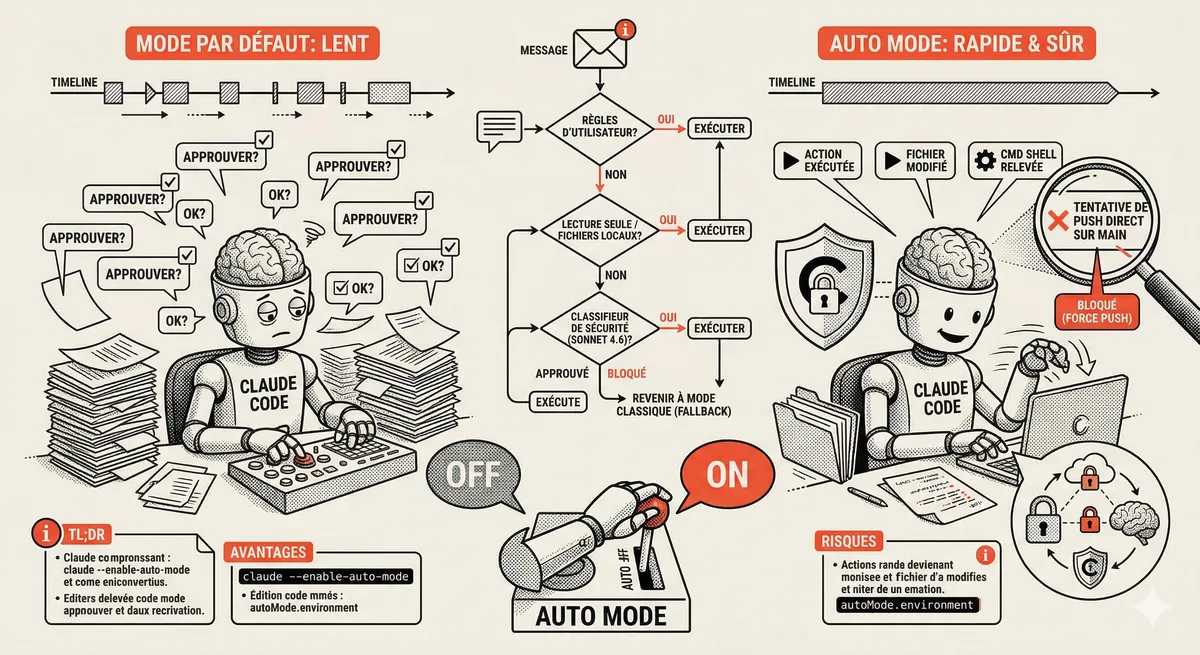
Claude Code Auto Mode: Autonomy Without the Risk
Auto Mode in Claude Code eliminates permission interruptions while keeping a safety net. A classifier analyzes every action before execution and blocks destructive operations. The sweet spot between approving everything and letting everything through.
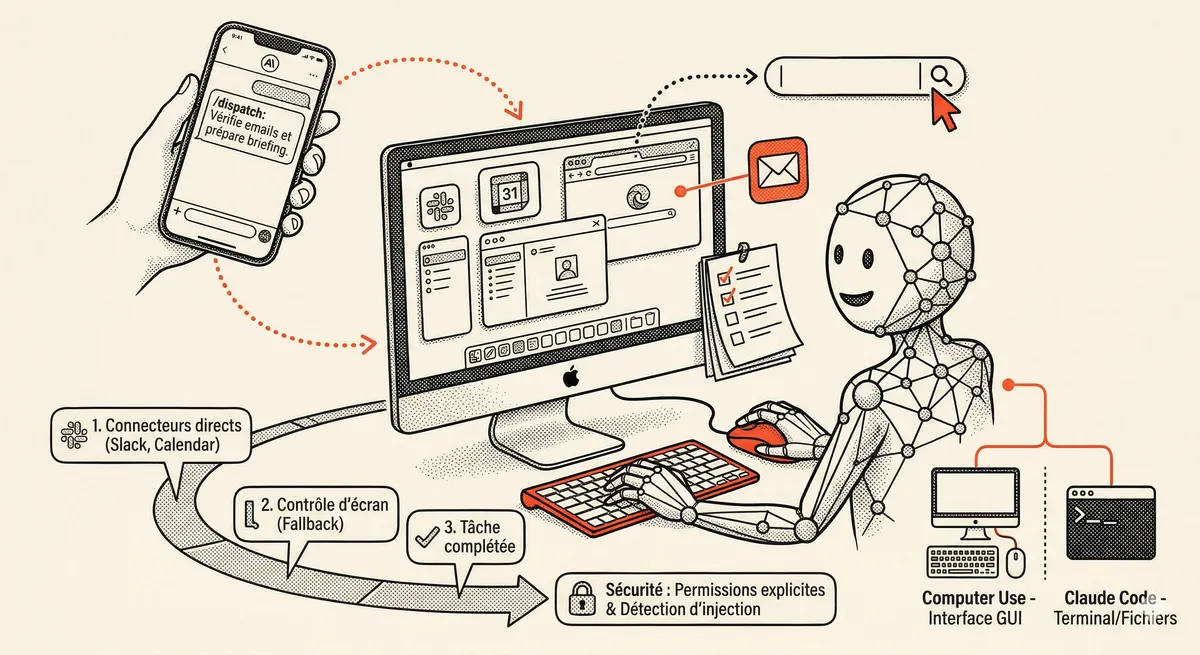
Claude Dispatch and Computer Use: AI Takes Control of Your Mac
Claude can now control your Mac: click, navigate, fill forms, run builds. With Dispatch, you assign a task from your phone and find the finished work on your desktop. Research preview, macOS only.
This topic is covered in Module 1 of our Claude Code training
Introduction to the Augmented Developer Mindset
1-day training • 60% hands-on labs • Expert instructors
View full program