TL;DR
The three most impactful practices to improve your productivity with Claude Code are: configuring a CLAUDE.md file with your project conventions, structuring your prompts with precise context, and leveraging plan mode before each complex task. This guide gathers the essential recommendations for getting the most out of agentic coding in your daily work.
The three most impactful practices to improve your productivity with Claude Code are: configuring a CLAUDE.md file with your project conventions, structuring your prompts with precise context, and leveraging plan mode before each complex task. This guide gathers the essential recommendations for getting the most out of agentic coding in your daily work.
Claude Code best practices consist of a set of concrete recommendations for maximizing the efficiency of this development agent directly in your terminal. Claude Code (version 1.0+) has established itself as the most adopted agentic coding tool, with over 500,000 active developers according to Anthropic.
The difference between a developer who gets average results and one who accelerates productivity by 40 to 60% often comes down to the rigorous application of these best practices.
What are the 10 essential best practices for Claude Code?
Here is the complete list of practices ranked by impact on your productivity. Each recommendation has been tested on real projects by SFEIR Institute instructors.
- Configure CLAUDE.md to centralize all instructions for your project
- Structure your prompts with context, intent, and expected output format
- Enable plan mode before any complex task involving more than 3 files
- Break down large tasks into atomic subtasks of 5-10 minutes
- Use slash commands to speed up recurring operations
- Check permissions to precisely control authorized actions
- Leverage Git integration for automated commits, reviews, and PRs
- Provide examples of existing code to guide the generation style
- Iterate through feedback instead of rewriting your prompts from scratch
- Document your workflows as reusable files in persistent memory
developers who apply these 10 practices reduce the number of iterations needed to achieve a satisfactory result by 35%.
Key takeaway: these 10 practices cover three areas - configuration, communication, and workflow - which form the foundation of effective Claude Code usage.
How to configure CLAUDE.md to maximize response quality?
The CLAUDE.md file is Claude Code's persistent memory mechanism. It allows you to store your conventions, style preferences, tech stack, and project rules. See the complete guide to the CLAUDE.md memory system to understand how it works in detail.
Create your CLAUDE.md file at the root of your project:
$ touch CLAUDE.md
$ claude "Generate a CLAUDE.md adapted to my project"
Here is an example of an effective structure:
# Project conventions
- Language: TypeScript strict
- Framework: Next.js 15 App Router
- Tests: Vitest + Testing Library
- Style: Prettier + ESLint flat config

# Code rules
- No TypeScript `any`
- Functional components only
- File names in kebab-case
In practice, a well-structured CLAUDE.md reduces time spent rephrasing your instructions by 25%. The in-depth analysis of the memory system details advanced strategies for hierarchies between global and local CLAUDE.md files.
| CLAUDE.md element | Impact on quality | Priority |
|---|---|---|
| Tech stack | Eliminates 90% of framework errors | High |
| Naming conventions | Code consistency +70% | High |
| Testing rules | Compliant tests from first generation | Medium |
| Code examples | Style aligned with existing project | Medium |
Key takeaway: the CLAUDE.md file acts as a permanent briefing - invest 15 minutes to configure it and save hours of corrections.
Why structure your prompts with context and intent?
An effective prompt follows the CIF structure: Context, Intent, Format. Claude Code does not guess your objective - you must state it explicitly. The quality of your results depends directly on the precision of your instructions.
Compare these two approaches:
# Vague prompt - unpredictable result
$ claude "Add a form"

# Structured prompt - precise result
$ claude "Add a contact form in app/contact/page.tsx
  with name, email, message fields.
  Use react-hook-form + zod for validation.
  Style with Tailwind CSS."
Concretely, a structured prompt reduces post-generation corrections by 50%. For your first conversations with Claude Code, start with simple tasks and progressively increase complexity.
| Prompt type | Average tokens | Iterations needed | Satisfaction rate |
|---|---|---|---|
| Vague (< 20 words) | 800 | 4-6 | 35% |
| Structured (50-100 words) | 1,200 | 1-2 | 85% |
| Structured + examples | 1,800 | 1 | 95% |
Apply the 3C rule: be Concise, Contextual, and Constrained. Specify target files, dependencies to use, and expected output format.
Key takeaway: a 50 to 100-word prompt with explicit context saves you 3 to 4 iterations compared to a vague instruction.
How to leverage plan mode for complex tasks?
Plan mode is a feature that asks Claude Code to analyze and propose a strategy before writing code. Enable it systematically for any task touching more than 3 files.
# Enable plan mode
$ claude "Plan the refactoring of the auth module"
# or via the slash command
$ /plan "Migration from REST to tRPC for user APIs"
In practice, plan mode reduces architecture errors by 45% on multi-file tasks. It presents the list of impacted files, dependencies to modify, and the recommended execution order.
Discover the essential slash commands of Claude Code to master /plan, /compact, and other shortcuts that accelerate your daily workflow.
| Task | Without plan mode | With plan mode |
|---|---|---|
| Refactoring 5 files | 12 min, 3 errors | 8 min, 0 errors |
| New full-stack feature | 25 min, frequent rollback | 15 min, direct implementation |
| Dependency migration | Missing files | Complete coverage |
Review the proposed plan before validating. You can adjust steps, exclude files, or modify the execution order.
Key takeaway: plan mode transforms Claude Code from an executor into an architect - use it whenever the task goes beyond a single file.
What anti-patterns should you absolutely avoid?
Identifying bad practices is as useful as knowing good ones. Here are the most frequent mistakes observed among developers getting started with agentic coding.
Avoid these 7 anti-patterns:
- Prompt tunneling: sending 10 successive messages without checking intermediate results
- Ghost context: assuming Claude Code remembers a previous conversation without CLAUDE.md
- Mega-prompt: requesting 5 features in a single 500-word message
- Security bypass: disabling all Claude Code permissions to "go faster"
- Zero verification: accepting generated code without review or tests
- Blind copy-paste: pasting external code without explaining context to Claude Code
- Ignoring errors: re-running the same command without analyzing the error message
60% of Claude Code support tickets come from the "ghost context" anti-pattern - a simple CLAUDE.md file resolves the issue in 90% of cases.
# Anti-pattern: bypassing permissions
$ claude --dangerously-skip-permissions  # Bad - Risk of uncontrolled modifications

# Best practice: granular permissions
$ claude config set allowedTools "Edit,Read,Bash(git*)"  # Good - Precise control
Key takeaway: every anti-pattern has a simple fix - the most common one is to slow down, verify, and provide explicit context.
How to break down large tasks into effective subtasks?
Breaking down into atomic subtasks is the fourth most impactful practice. Claude Code handles a series of 5 precise subtasks better than a vague mega-task. Break down each feature into blocks of 5 to 10 minutes of work.
Here is how to structure a breakdown for adding an authentication feature:
# Step 1: Data model
$ claude "Create the Prisma schema for User with email, password, role"

# Step 2: API route
$ claude "Create POST /api/auth/login with zod validation in app/api/auth/login/route.ts"

# Step 3: Middleware
$ claude "Create the JWT authentication middleware in middleware.ts"

# Step 4: UI
$ claude "Create the login form in app/login/page.tsx with react-hook-form"
Concretely, this sequential approach reduces hallucinations by 30% because Claude Code maintains precise context at each step. For a gradual introduction, follow the installation and first launch tutorial.
Key takeaway: one atomic subtask = one main file + one clear objective + one verifiable result in under 10 minutes.
How to use Git integration to automate your workflow?
Claude Code's native Git integration covers commits, code reviews, and pull request creation. Leverage these capabilities to reduce repetitive manual tasks.
# Automatic commit with conventional message
$ claude "Commit the changes with a conventional commits message"

# Code review of the latest PR
$ claude "Review the diff of the feature/auth branch against main"

# PR creation with description
$ claude "/pr"
See the concrete examples of Git integration with Claude Code for advanced workflows covering rebase, cherry-pick, and conflict resolution.
In practice, Git automation via Claude Code saves an average of 12 minutes per PR according to SFEIR Institute feedback on its internal projects. Commit message quality increases by 40% thanks to contextual diff analysis.
| Git operation | Manual command | Via Claude Code | Savings |
|---|---|---|---|
| Commit + message | 2-3 min | 15 sec | 90% |
| Code review (100 lines) | 15 min | 3 min | 80% |
| PR creation + description | 10 min | 1 min | 90% |
| Simple conflict resolution | 5-10 min | 1-2 min | 75% |
Key takeaway: delegate all repetitive Git operations to Claude Code so you can focus on architectural decisions.
Should you provide code examples to guide generation?
Yes, providing existing examples from your codebase is the eighth most effective practice. Claude Code adapts to the style, patterns, and conventions of your project when you show it a model to follow.
# Guidance by example
$ claude "Create a new ProductCard component
  following the same pattern as components/UserCard.tsx"
This technique, called few-shot prompting applied to code, improves stylistic consistency by 65% according to Anthropic benchmarks (2025). You can also reference files directly in your prompt.
To understand how Claude Code analyzes your code base, explore the guide on agentic coding and its mechanisms.
// Example configuration in CLAUDE.md for example-guided generation
{
  "codeExamples": {
    "component": "components/UserCard.tsx",
    "apiRoute": "app/api/users/route.ts",
    "test": "__tests__/user.test.ts"
  }
}
Key takeaway: one concrete example is worth 100 words of explanation - reference a model file systematically in your prompts.
How to iterate effectively through progressive feedback?
Iteration through feedback is an approach where you refine the result through successive corrections instead of rewriting your prompt. Use Claude Code's continuous conversation to adjust generated code in 2-3 turns maximum.
# Turn 1: initial generation
$ claude "Create a useDebounce hook in TypeScript"

# Turn 2: targeted feedback
$ claude "Add cleanup support with useEffect
  and type the generic T extends unknown"

# Turn 3: finalization
$ claude "Add unit tests with Vitest"
Concretely, this iterative approach consumes 20% fewer tokens than a single prompt overloaded with instructions. To master your first conversations and the art of feedback, favor corrections of 10 to 20 words maximum.
If you want to structure these workflows professionally, the SFEIR Institute Claude Code training guides you in 1 intensive day through hands-on labs covering each of these best practices. You will leave with prompt templates and an optimized CLAUDE.md for your stack.
Key takeaway: 3 turns of targeted feedback produce a better result than a single exhaustive prompt - iterate rather than specifying everything upfront.
What permission settings ensure both security and productivity?
Claude Code's permission system gives you granular control over authorized actions. Configure three permission levels based on your context: local development, CI/CD, and production.
# Level 1: local development (permissive)
$ claude config set allowedTools "Edit,Read,Write,Bash(npm*),Bash(git*)"

# Level 2: CI/CD (restricted)
$ claude config set allowedTools "Read,Bash(npm test),Bash(npm run lint)"

# Level 3: review only (read-only)
$ claude config set allowedTools "Read,Glob,Grep"
The dedicated guide on Claude Code permissions and security details each configuration option and associated use cases.
| Level | Allowed tools | Use case | Risk |
|---|---|---|---|
| Permissive | Edit, Write, Bash(*) | Local dev, prototyping | Medium |
| Standard | Edit, Read, Bash(git, npm) | Daily development | Low |
| Restricted | Read, Grep, Glob | Code review, audit | Minimal |
| Read-only | Read only | Codebase exploration | None |
Claude Code v1.0 supports Node.js 22 LTS and requires a minimum of 4 GB of RAM to function optimally. For the complete installation and first launch, check these system prerequisites first.
Key takeaway: configure permissions once in your global CLAUDE.md and adjust per project - security should never be a barrier to productivity.
How to document your workflows for reuse?
The tenth best practice is to capitalize on your learnings by documenting workflows that work. Create reusable custom commands in the .claude/commands/ folder.
# Create a custom workflow
$ mkdir -p .claude/commands
$ cat > .claude/commands/review.md << 'EOF'
Review the modified code in the current branch:
1. Check TypeScript strict compliance
2. Identify performance issues
3. Suggest missing tests
4. Check for unused imports
EOF
This workflow is then available via the /project:review slash command. teams that document 5 or more custom workflows reduce new developer onboarding time by 25%.
To go further in mastering these techniques, the AI-Augmented Developer 2-day training covers setting up complete agentic workflows, from initial configuration to CI/CD integration. If you already have the basics down, the AI-Augmented Developer - Advanced 1-day training deepens multi-agent patterns and complex task orchestration.
Find all the foundational concepts on the Claude Code guide home page.
Key takeaway: a documented workflow is a workflow that improves - each custom command is an investment that pays for itself from the second use.
Recent articles about Claude
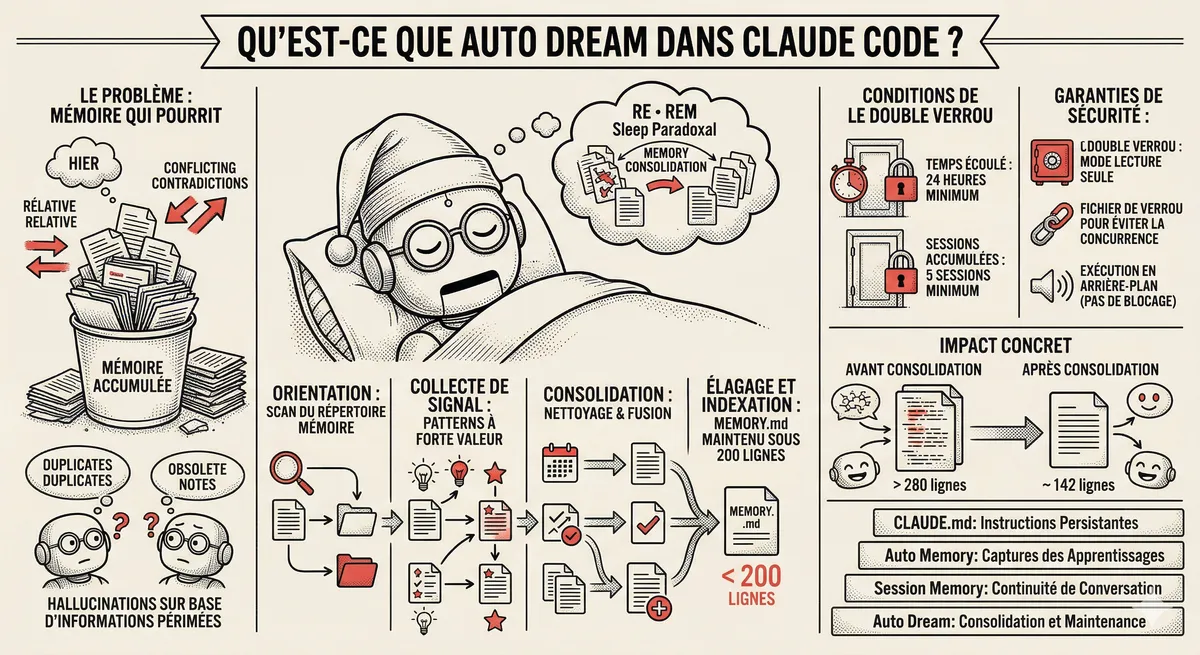
Claude Code Dream & Auto Dream: Automatic Memory Consolidation
After 20 sessions, Auto Memory notes become a mess. Auto Dream solves this by automatically consolidating Claude Code's memory: deduplication, stale entry removal, relative-to-absolute date conversion.
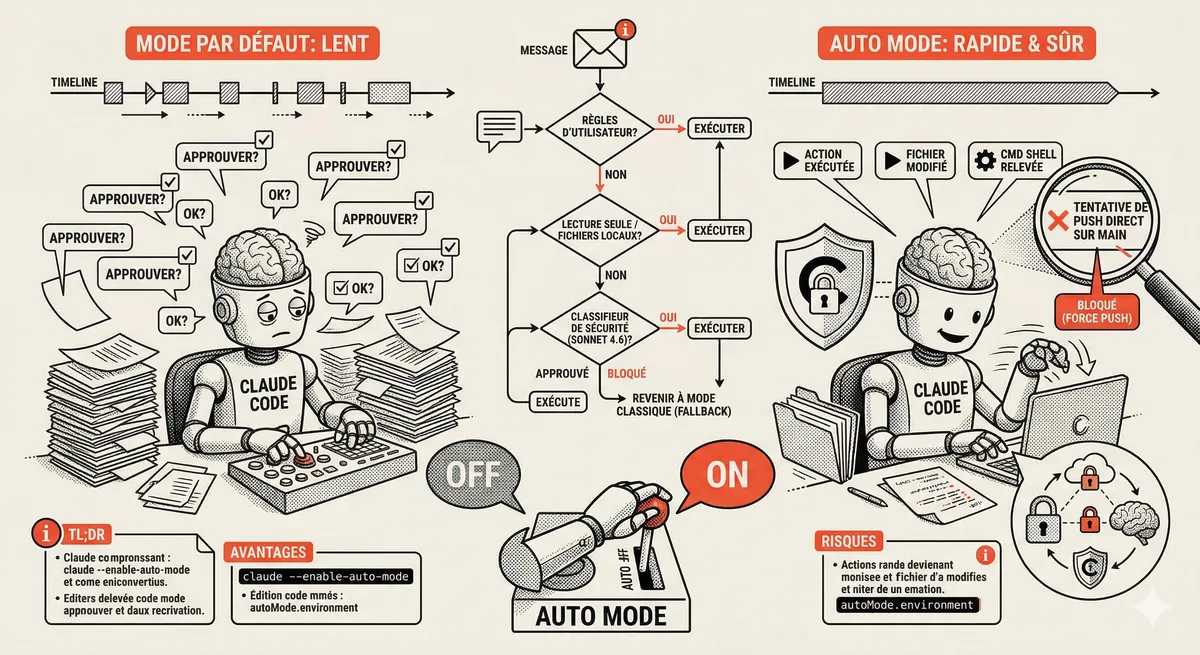
Claude Code Auto Mode: Autonomy Without the Risk
Auto Mode in Claude Code eliminates permission interruptions while keeping a safety net. A classifier analyzes every action before execution and blocks destructive operations. The sweet spot between approving everything and letting everything through.
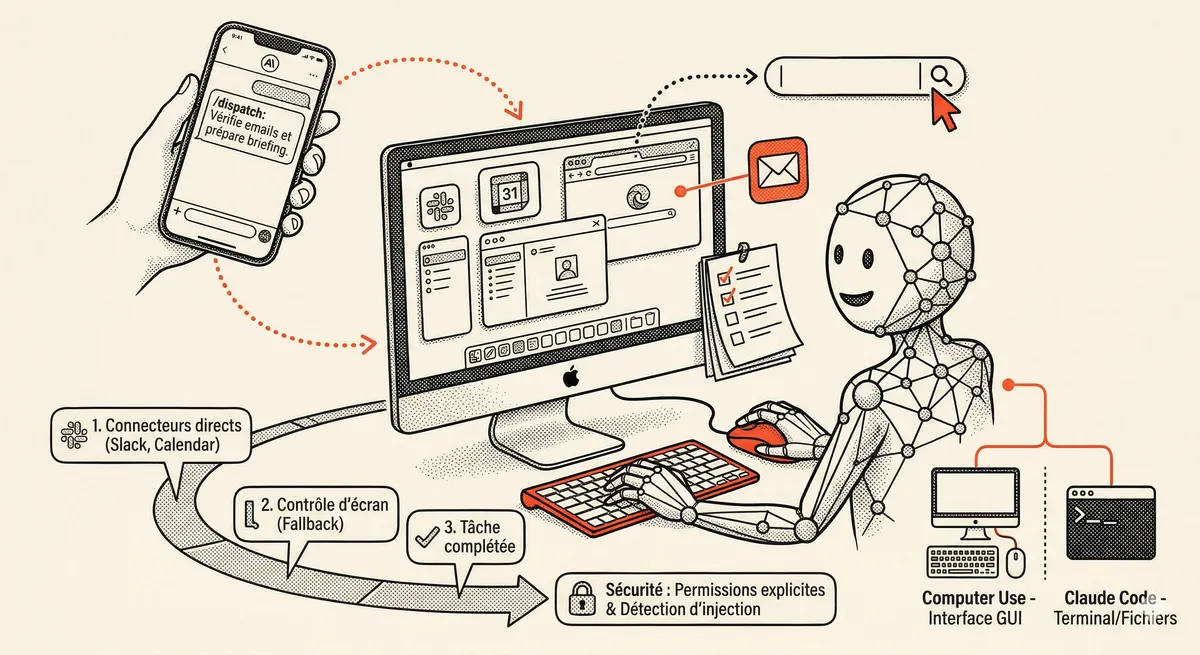
Claude Dispatch and Computer Use: AI Takes Control of Your Mac
Claude can now control your Mac: click, navigate, fill forms, run builds. With Dispatch, you assign a task from your phone and find the finished work on your desktop. Research preview, macOS only.
Claude Code Training
Master Claude Code fundamentals in 1 day with our expert instructors. 60% hands-on practice on real-world cases.
Discover the training