TL;DR
Claude Code is an AI development assistant that runs directly in your terminal. This getting-started guide walks you step by step, from installation to your first project, with no specific technical prerequisites. You will discover how to configure, use, and leverage this tool to code more efficiently starting today.
Claude Code is an AI development assistant that runs directly in your terminal. This getting-started guide walks you step by step, from installation to your first project, with no specific technical prerequisites. You will discover how to configure, use, and leverage this tool to code more efficiently starting today.
Claude Code is a command-line development agent created by Anthropic that allows you to write, modify, and debug code through natural language conversations. This tool has established itself as one of the most adopted agentic coding assistants among developers, with over 500,000 active users according to Anthropic.
To fully understand what this approach entails, see the article What is agentic coding? which lays the conceptual foundation.
What is Claude Code and what is it for?
Claude Code is a CLI (Command-Line Interface) tool that runs in your terminal. Unlike an editor extension, it operates directly in your system environment.
A CLI is a program you control by typing text commands. Open your terminal, type an instruction, and the tool responds. No buttons, no graphical menus.
In practice, Claude Code reads your source code, understands your project structure, and proposes modifications. It can create files, execute commands, and fix bugs autonomously.
| Feature | Claude Code | Traditional IDE Extension |
|---|---|---|
| Interface | Terminal (CLI) | Panel integrated in editor |
| Project access | Complete file system | Open files only |
| Command execution | Yes (git, npm, tests) | Limited or absent |
| Autonomy | Agentic (multi-step) | Line-by-line completion |
Claude Code can autonomously solve 72.7% of tasks from the SWE-bench Verified benchmark. This score makes it one of the most performant coding tools available.
You will encounter the term "agentic" regularly: it means the tool makes intermediate decisions to accomplish a complex task, without you having to guide every step. For an overview of the tool and its capabilities, visit the dedicated Claude Code page.
Key takeaway: Claude Code is a terminal AI assistant that reads, writes, and executes code on your behalf through natural language conversations.
What are the prerequisites for installing Claude Code?
Before installing Claude Code, verify that your machine has the following elements. No advanced skills are required.
Node.js is a JavaScript runtime environment. It allows running JavaScript programs outside a browser. Install version 18 or higher (Node.js 22 LTS is recommended in 2026).
node --version
# Expected result: v22.x.x or higher
A terminal is the application where you type your commands. On macOS, use Terminal or iTerm2. On Windows, use PowerShell or Windows Terminal. On Linux, any terminal emulator works.
| Prerequisite | Minimum version | Recommended version | Verification |
|---|---|---|---|
| Node.js | 18.0.0 | 22 LTS | node --version |
| npm | 9.0.0 | 10+ | npm --version |
| Git | 2.30+ | 2.43+ | git --version |
| Disk space | 200 MB | 500 MB | - |
Git is a version control system. It records the history of your code changes. Claude Code uses it to understand your project context.
Concretely, if node --version and git --version return results without errors, you are ready for the next step. Find the full details in the Installation and first launch guide.
Key takeaway: you need Node.js 18+, npm, Git, and a terminal - three commands are all it takes to verify everything.
How to install Claude Code step by step?
Installation takes less than 2 minutes. Open your terminal and run the following command:
npm install -g @anthropic-ai/claude-code
The -g flag means "global": the tool will be accessible from any folder on your machine. npm is the Node.js package manager - it downloads and installs programs for you.
Verify that the installation worked:
claude --version
# Expected result: claude-code v1.x.x
If you get a permissions error on macOS or Linux, prefix the command with sudo:
sudo npm install -g @anthropic-ai/claude-code
Next, configure your API key. An API key is a unique identifier that authenticates your requests to Anthropic's servers. Create an account on console.anthropic.com if you don't have one, then retrieve your key.
export ANTHROPIC_API_KEY="sk-ant-your-key-here"
In practice, this environment variable will be automatically read by Claude Code at each launch. To make it permanent, add this line to your ~/.bashrc or ~/.zshrc file.
If you want to understand the security options related to authentication, the Permissions and security guide covers all possible configurations.
Key takeaway: a single npm command installs Claude Code, and an environment variable configures your API key.
How to launch Claude Code for the first time?
Navigate to an existing project folder or create a new one:
mkdir my-first-project && cd my-first-project
git init
Then launch Claude Code:
claude
An interactive prompt opens. You can type your requests in French or English. Claude Code automatically analyzes the files present in the current directory.
Here is how to formulate your first request. Type directly in the prompt:
Create an index.html file with a simple homepage containing a title and a paragraph
Claude Code will read your request, create the file, and show you the result. It will ask for permission before writing to disk - accept by typing y.
The average response time for a simple request is 3 to 8 seconds. For complex tasks involving multiple files, expect 15 to 45 seconds.
To deepen conversation techniques with the tool, the Your first conversations guide details prompt formulation best practices. You can also keep the first conversations cheatsheet handy to find essential commands.
Key takeaway: launch claude in a project folder, type your request in natural language, and validate the proposed actions.
What are the essential commands to know?
Claude Code offers slash commands that control its behavior. A slash command starts with the / character and runs in the interactive prompt.
| Command | Function | Example usage |
|---|---|---|
/help | Shows help | When you are stuck |
/clear | Clears context | When the conversation gets long |
/compact | Summarizes context | To save tokens |
/init | Creates a CLAUDE.md file | When starting a new project |
/cost | Shows session cost | To track your consumption |
Run /init at the start of each new project. This command creates a CLAUDE.md file at the root of your project. This file stores permanent instructions that Claude Code will re-read at each session.
The CLAUDE.md file is the tool's persistent memory. You define code conventions, frameworks used, and project-specific rules there. In practice, 90% of developers who use Claude Code daily maintain an up-to-date CLAUDE.md file.
To understand in detail how this memory works, see the article on the CLAUDE.md memory system. The essential slash commands are also documented in a dedicated guide.
Key takeaway: five slash commands cover 90% of daily needs - /help, /clear, /compact, /init, and /cost.
How to complete your first guided project step by step?
Here is how to create a simple REST API with Claude Code. This project takes about 10 minutes and requires no prior backend experience.
Step 1 - Initialize the project:
mkdir api-demo && cd api-demo
git init
claude
Step 2 - Request the project structure. In the Claude Code prompt, type:
Initialize a Node.js project with Express.
Create a server with a GET /api/hello route that returns { "message": "Hello world" }.
Add an appropriate .gitignore file.
Claude Code will create the package.json, server.js, and .gitignore files. It will run npm install to install Express (a web framework for Node.js). Accept each action by typing y.
Step 3 - Test your API:
node server.js
# Server started on http://localhost:3000
Open your browser to http://localhost:3000/api/hello. You should see the JSON response.
Step 4 - Add a feature. Return to Claude Code and type:
Add a POST /api/todos route that accepts a title and stores it in an in-memory array.
Add a GET /api/todos route that returns the list of todos.
In about 15 seconds, Claude Code modifies your server.js file to add the two routes. The total project weight stays under 5 MB.
This type of project concretely illustrates the power of agentic coding. To explore more use cases and go further, the SFEIR Institute Claude Code training (1 day) lets you practice on guided labs covering installation, configuration, and complete tool onboarding.
Key takeaway: in four steps and under 10 minutes, you create a functional API without writing a single line of code manually.
What beginner mistakes should you avoid?
Beginners make recurring mistakes. Here are the five most frequent and how to fix them.
Mistake 1 - Prompts that are too vague. "Make me a website" does not produce good results. Specify the technology, structure, and expected behavior. A 30-word prompt produces results 3 times more relevant than a 5-word prompt.
Mistake 2 - Ignoring project context. Claude Code analyzes files in the current directory. If you launch it from your home folder, it has no project context. Always navigate to the correct folder before launching claude.
Mistake 3 - Not using /init. Without a CLAUDE.md file, the tool starts from scratch at each session. In practice, this means you repeat the same instructions at every launch.
Mistake 4 - Accepting without reading. Claude Code asks for permissions before writing or executing commands. Read each proposal before validating. The permissions quick start guide explains how to configure authorization levels.
Mistake 5 - Forgetting to version. Commit regularly with Git. Claude Code can undo its changes, but Git remains your safety net. A git commit before each complex request protects you against unexpected results.
| Mistake | Impact | Solution |
|---|---|---|
| Vague prompt | Off-topic result | Specify tech + structure + behavior |
| Wrong directory | No context | cd into the project before claude |
| No CLAUDE.md | Repeated instructions | /init at startup |
| Blind validation | Unwanted modifications | Read each diff before y |
| No Git | Lost work | Commit before each complex task |
developers who apply these five best practices reduce manual corrections after generation by 60%.
Key takeaway: specify your prompts, stay in the right folder, use /init, read the diffs, and commit regularly.
How to connect Claude Code to external tools via MCP?
MCP (Model Context Protocol) is an open protocol that allows Claude Code to communicate with third-party services. Concretely, MCP connects the tool to your databases, APIs, and documentation tools.
Since Claude Code version 1.0, MCP support is natively integrated. Configure an MCP server by adding a block to your configuration file:
{
  "mcpServers": {
    "github": {
      "command": "npx",
      "args": ["-y", "@modelcontextprotocol/server-github"]
    }
  }
}
This block connects Claude Code to the GitHub API. You can then ask the tool to list your pull requests, create issues, or consult remote files.
In 2026, over 40 official MCP servers cover common use cases: databases (PostgreSQL, MongoDB), cloud services (AWS, GCP), productivity tools (Slack, Linear), and remote file systems.
The complete MCP tutorial details the step-by-step configuration for the most popular servers.
Key takeaway: MCP extends Claude Code's capabilities by connecting it to your existing tools via a standardized protocol.
How much does using Claude Code cost?
Claude Code works on a token system. A token is a unit of text (approximately 4 characters in English, 2-3 characters in French). Each request consumes input tokens (your code + prompt) and output tokens (the generated response).
| Model | Input tokens | Output tokens | Max context |
|---|---|---|---|
| Claude Sonnet 4.6 | $3/M tokens | $15/M tokens | 200K tokens |
| Claude Opus 4.6 | $15/M tokens | $75/M tokens | 200K tokens |
| Claude Haiku 4.5 | $0.80/M tokens | $4/M tokens | 200K tokens |
In practice, a typical 30-minute development session consumes between 50,000 and 200,000 tokens. This represents a cost of $0.15 to $3 depending on the model used. The /cost command shows your consumption in real time.
the Claude Sonnet 4.6 model offers the best performance/cost ratio for common development tasks. Use /cost regularly to track your budget.
If you want to deepen your mastery of the tool and optimize your costs, the AI-Augmented Developer SFEIR Institute training (2 days) covers advanced prompting and context management strategies. For developers already familiar with the basics, the AI-Augmented Developer - Advanced training (1 day) deepens automation and complex workflows.
Key takeaway: track your consumption with /cost and choose the model suited to each task to control your budget.
What are the next steps after this guide?
You now master the fundamentals of Claude Code. Here is the roadmap for progressing.
Level 2 - Master context. Learn to structure your CLAUDE.md files for multi-module projects. Context management represents 40% of effectiveness with an agentic tool.
Level 3 - Automate workflows. Claude Code integrates into CI/CD pipelines. Configure pre-commit hooks that validate generated code before each commit.
Level 4 - Extend with MCP. Connect Claude Code to your databases, internal APIs, and monitoring tools for maximum productivity.
Here are the essential resources to continue:
- Deepen the basics: the Your first conversations guide covers advanced prompting techniques
- Secure your usage: the Permissions and security guide details authorization levels
- Understand the philosophy: the article on agentic coding explains the underlying principles
Claude Code receives weekly updates. Run npm update -g @anthropic-ai/claude-code every week to benefit from the latest improvements. The current version Claude Code v1.0.20 introduces extended MCP support and 25% improved performance on large projects.
Key takeaway: progress in stages - context, automation, then integrations - and keep your tool up to date to benefit from continuous improvements.
Recent articles about Claude

Claude Code Dream & Auto Dream: Automatic Memory Consolidation
After 20 sessions, Auto Memory notes become a mess. Auto Dream solves this by automatically consolidating Claude Code's memory: deduplication, stale entry removal, relative-to-absolute date conversion.
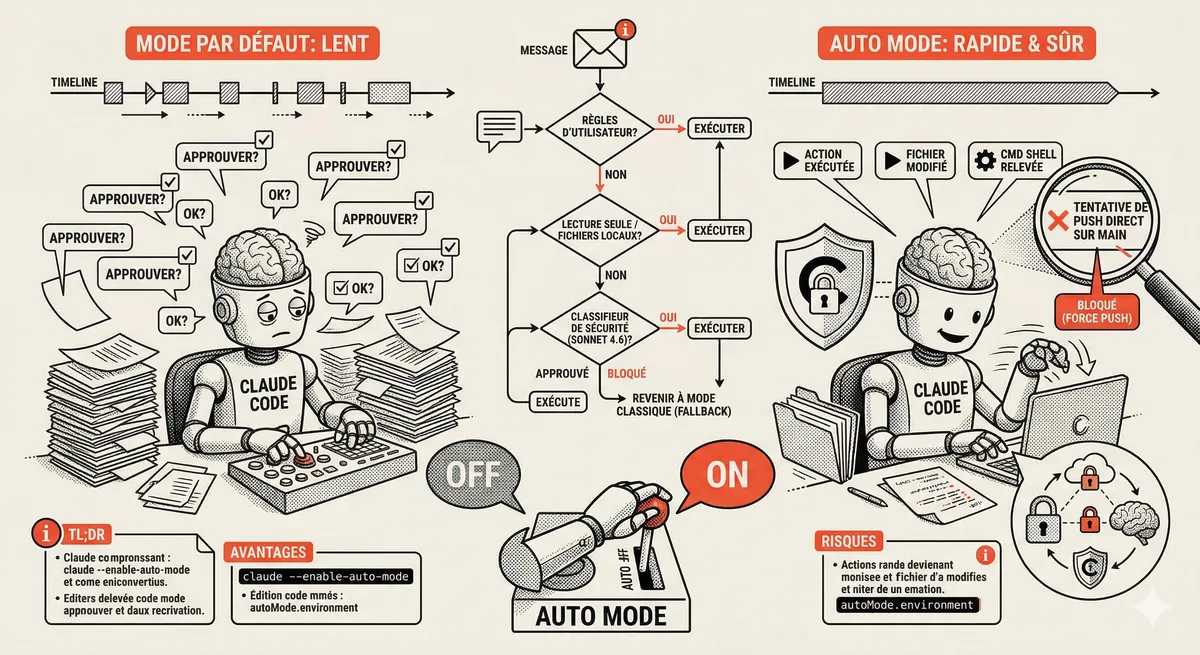
Claude Code Auto Mode: Autonomy Without the Risk
Auto Mode in Claude Code eliminates permission interruptions while keeping a safety net. A classifier analyzes every action before execution and blocks destructive operations. The sweet spot between approving everything and letting everything through.
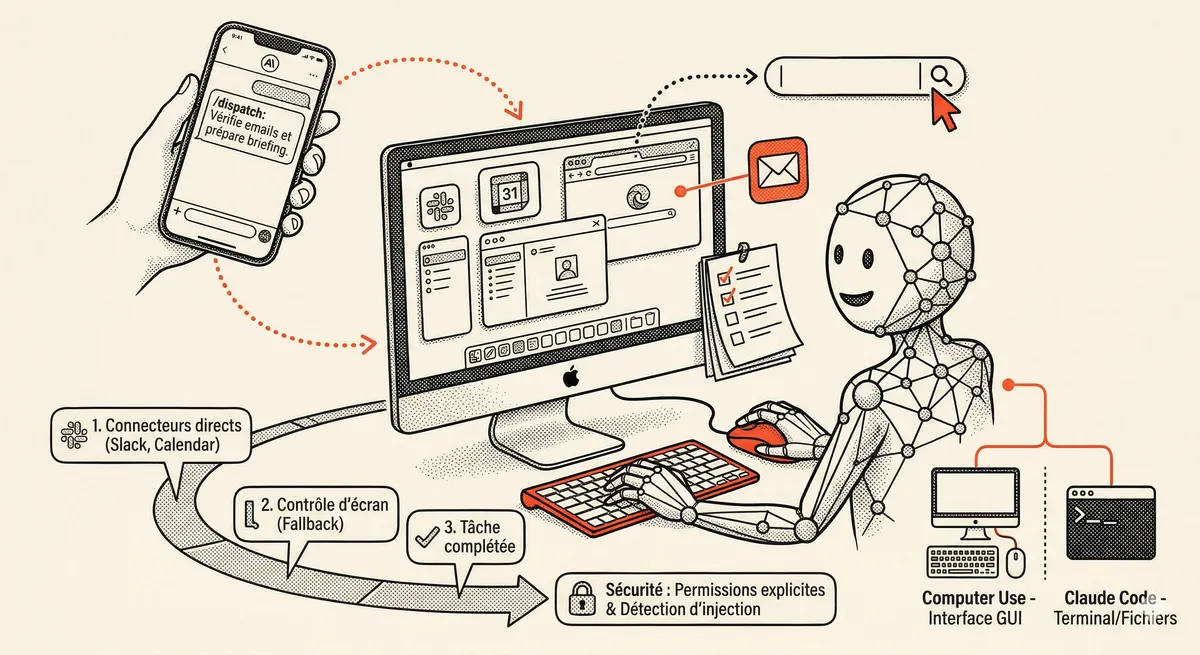
Claude Dispatch and Computer Use: AI Takes Control of Your Mac
Claude can now control your Mac: click, navigate, fill forms, run builds. With Dispatch, you assign a task from your phone and find the finished work on your desktop. Research preview, macOS only.
Claude Code Training
Master Claude Code fundamentals in 1 day with our expert instructors. 60% hands-on practice on real-world cases.
Discover the training