TL;DR
Claude Code transforms every Git operation - commits, branches, pull requests, conflict resolution - into a natural conversation. Instead of memorizing complex commands, you describe your intent and the agent generates the appropriate Git actions. This guide details how to configure and leverage this conversational Git integration on a daily basis.
Claude Code transforms every Git operation - commits, branches, pull requests, conflict resolution - into a natural conversation. Instead of memorizing complex commands, you describe your intent and the agent generates the appropriate Git actions. This guide details how to configure and leverage this conversational Git integration on a daily basis.
Git integration in Claude Code is a set of features that allows you to drive the entire Git lifecycle - from commit to pull request - through natural language instructions. Claude Code (v1.0.24) automatically analyzes your diffs, writes conventional commit messages, and manages branches without leaving your terminal. over 68% of Claude Code users use the built-in Git commands daily.
For an overview of the tool, check the main Claude Code page which presents all available features.
How does Git integration work in Claude Code?
Claude Code relies on the native Git commands on your system. The agent intercepts your natural language requests, translates them into Git sequences, then executes each step after validation.
The process follows three phases: context analysis (diff, status, history), appropriate command generation, and controlled execution. Verify that Git 2.40+ is installed on your machine to benefit from all features.
| Component | Role | Minimum version |
|---|---|---|
| Git CLI | Command execution | 2.40+ |
| Claude Code | Conversational orchestration | v1.0.24 |
| Node.js | Agent runtime | 22 LTS |
In practice, Claude Code automatically detects whether your directory is an initialized Git repository. It loads the context of the last 50 commits and modified files to tailor its suggestions.
To get started, follow the Git integration tutorial which covers step-by-step initialization.
Key takeaway: Claude Code drives Git through your native tools - no proprietary layer, just an intelligent conversational interface.
How to generate smart conversational commits?
Conventional Commits is a structured naming standard that categorizes each change with a prefix (feat:, fix:, docs:, refactor:). Claude Code applies this standard automatically by analyzing the diff.
Simply run /commit or ask "commit my changes" in the terminal. Claude Code inspects the git diff --staged, identifies the type of change, and writes a compliant message.
$ claude
> commit my changes with a descriptive message
Claude Code then generates a structured message:
feat(auth): add JWT token refresh mechanism

- Implement automatic token renewal 5 min before expiry
- Add refresh endpoint in auth service
- Update middleware to handle 401 with retry

Co-Authored-By: Claude <noreply@anthropic.com>
repositories using conventional commits reduce code review time by 23%. The generated message includes a scope, a descriptive body, and the co-author automatically.
| Commit type | Detected trigger | Example prefix |
|---|---|---|
| New feature | Added files/functions | feat: |
| Bug fix | Modified existing logic | fix: |
| Refactoring | Restructuring without functional change | refactor: |
| Documentation | Modified .md files | docs: |
You can customize the format by adding rules to your CLAUDE.md file at the project root. Configure your preferences once and Claude Code will apply them to every commit.
# CLAUDE.md
- Commits in English
- Format: type(scope): imperative description
- Max subject length: 72 characters
To go further, check the code snippets for Git integration with advanced configuration examples.
Key takeaway: Claude Code analyzes the diff and applies the Conventional Commits standard without prior configuration - customize the format via CLAUDE.md.
How to automate branch creation and pull requests?
Branch management is an operation that Claude Code simplifies into a single instruction. Launch a request like "create a branch for the payment feature" and the agent generates a name that conforms to your naming convention.
$ claude
> create a feature branch to add the notification system
Claude Code executes:
git checkout -b feature/add-notification-system
For pull requests, Claude Code uses the gh tool (GitHub CLI v2.65+). Ask "open a PR with a summary of my changes" and the agent:
- Analyzes all commits on the current branch
- Writes a concise title (under 70 characters)
- Generates a structured body with summary, changes, and test plan
- Creates the PR via
gh pr create
In practice, PR creation time goes from 8-12 minutes of manual writing to under 30 seconds with Claude Code. Concretely, you keep your focus on the code while the agent handles the change documentation.
Here is how to structure an effective request:
$ claude
> push my branch and create a PR to main with a detailed summary
The GitHub CLI integration also allows you to list, review, and merge existing PRs. Check the Git integration guide to configure gh with Claude Code.
Key takeaway: a single instruction is enough to create a branch, push code, and open a complete PR with automatic summary.
How to resolve merge conflicts with Claude Code?
A merge conflict is a situation where Git cannot automatically merge two concurrent changes to the same file. Claude Code detects these conflicts and proposes a contextual resolution.
Run your merge or rebase normally. When a conflict occurs, ask Claude Code to resolve it:
$ git merge feature/notifications
# CONFLICT (content): Merge conflict in src/api/handler.ts
$ claude
> resolve the merge conflicts in handler.ts
Claude Code reads the conflict markers (<<<<<<<, =======, >>>>>>>), analyzes the intent of both branches, and proposes a coherent merge. conflict resolution takes an average of 4.2 hours per developer per month.
| Resolution strategy | When to use it | Claude Code command |
|---|---|---|
| Keep both versions | Complementary additions | "keep both changes" |
| Prefer current branch | Your version is up to date | "prefer our version" |
| Prefer incoming branch | The other branch has the correct logic | "accept their changes" |
| Assisted manual merge | Interleaved logic | "propose a smart merge" |
You can also ask for an explanation before resolving: "explain this conflict before resolving it". Claude Code then displays an annotated diff with the context of each change.
In practice, 87% of simple conflicts (imports, non-overlapping additions) are resolved automatically in under 3 seconds. For complex conflicts, Claude Code proposes multiple options and lets you choose.
Check the Git integration troubleshooting for recurring conflict cases or rebase errors.
Key takeaway: describe your resolution intent in natural language - Claude Code handles the conflict markers and validates the coherence of the result.
What are the Checkpoints and Esc+Esc shortcuts in Claude Code?
The checkpoint system is an automatic backup mechanism built into Claude Code that creates a Git snapshot before each significant change. If the result does not suit you, you instantly restore the previous state.
Use the Esc+Esc shortcut (double Escape) to undo the last Claude Code action and return to the previous checkpoint. This shortcut works as a contextual "undo", more granular than git reset.
# Claude Code modifies 3 files
# The result doesn't work
# Press Esc+Esc
# -> All files return to their previous state
Concretely, each checkpoint stores a reverse diff in memory. Here is how checkpoints compare to standard Git commands:
| Mechanism | Scope | Reversible | Speed |
|---|---|---|---|
Esc+Esc (Checkpoint) | Last Claude Code action | Yes, instant | < 100 ms |
git stash | All uncommitted changes | Yes | ~ 200 ms |
git reset --soft HEAD~1 | Last commit | Yes | ~ 150 ms |
git reset --hard HEAD~1 | Last commit + working tree | Not reversible | ~ 150 ms |
You can chain multiple Esc+Esc to go back through the action history. Claude Code retains the last 20 checkpoints of the current session.
To master these shortcuts and other tips, check the Git integration cheatsheet which gathers all essential shortcuts.
Key takeaway: Esc+Esc instantly undoes the last Claude Code action thanks to the checkpoint system - use it without worry, it is reversible.
How to leverage Git log and conversational history?
The conversational history of Claude Code is a log that records every Git interaction performed during a session. Combined with git log, it offers complete traceability of your changes.
Ask Claude Code to analyze your history:
$ claude
> show me a summary of the last 10 commits with their statistics
Claude Code runs git log --oneline --stat -10 and rephrases the result in plain language. You get a readable summary without memorizing git log flags.
You can also ask contextual questions about the history:
$ claude
> which files have been modified most often this week?
> who introduced this function?
> show me the evolution of this file since last month
In practice, Claude Code combines git log, git blame, and git diff to answer complex questions in under 5 seconds. 41% of developers use git log less than once a week due to lack of familiarity with the options.
The context management in Claude Code explains how the agent maintains the thread of your session for increasingly relevant responses.
To understand the underlying workings of this contextual intelligence, discover agentic coding and its fundamental principles.
Key takeaway: combine Git history and natural conversation to query your codebase - Claude Code translates your questions into complex Git sequences.
What are the best practices for Git integration with Claude Code?
Adopting best practices maximizes the efficiency of Git integration. Here are the essential rules validated by the SFEIR Institute teams in 2026.
Configure your CLAUDE.md file with your conventions from day one:
# CLAUDE.md - Git Conventions
- Branches: feature/, fix/, docs/
- Commits: Conventional Commits in English
- PR: always target develop, never directly to main
- Rebase before merge
Follow these fundamental principles:
- Stage your files explicitly before requesting a commit - avoid
git add .on large repositories - Review each generated command before approval, especially for destructive operations
- Use checkpoints before any rebase or reset operation
- Separate logical commits - one commit per intent, not one giant commit
- Review generated PR messages before publishing
In practice, teams that define their conventions in CLAUDE.md see a 35% reduction in code review back-and-forth. Concretely, consistent commit messages also facilitate automatic changelog generation.
Check the Git integration best practices for a detailed guide, and the common mistakes to avoid frequent pitfalls.
Key takeaway: a well-configured CLAUDE.md file is the key to productive Git integration - invest 10 minutes of configuration to save hours.
How to deepen your Git integration skills with Claude Code?
SFEIR Institute offers structured training to master all Claude Code features, including advanced Git integration.
The Claude Code one-day training allows you to get hands-on with the tool from A to Z: installation, configuration, Git workflows, and automation of repetitive tasks. The practical labs cover conversational commits, branch management, and conflict resolution.
To go further, the AI-Augmented Developer 2-day training integrates Claude Code into a complete ecosystem of AI tools. You learn to combine agents, MCP, and Git workflows in real projects.
Experienced developers can take the AI-Augmented Developer - Advanced one-day training, focused on automated CI/CD pipelines, custom Git hooks, and multi-agent orchestration.
For installation and first launch of Claude Code, a dedicated guide walks you through step by step. And if you are just starting out, begin with your first conversations to understand the basics of interaction.
Integration with the MCP protocol opens additional possibilities for connecting Git to external data sources.
Key takeaway: combine daily practice and guided training to unlock the full potential of Git integration in Claude Code.
Recent articles about Claude
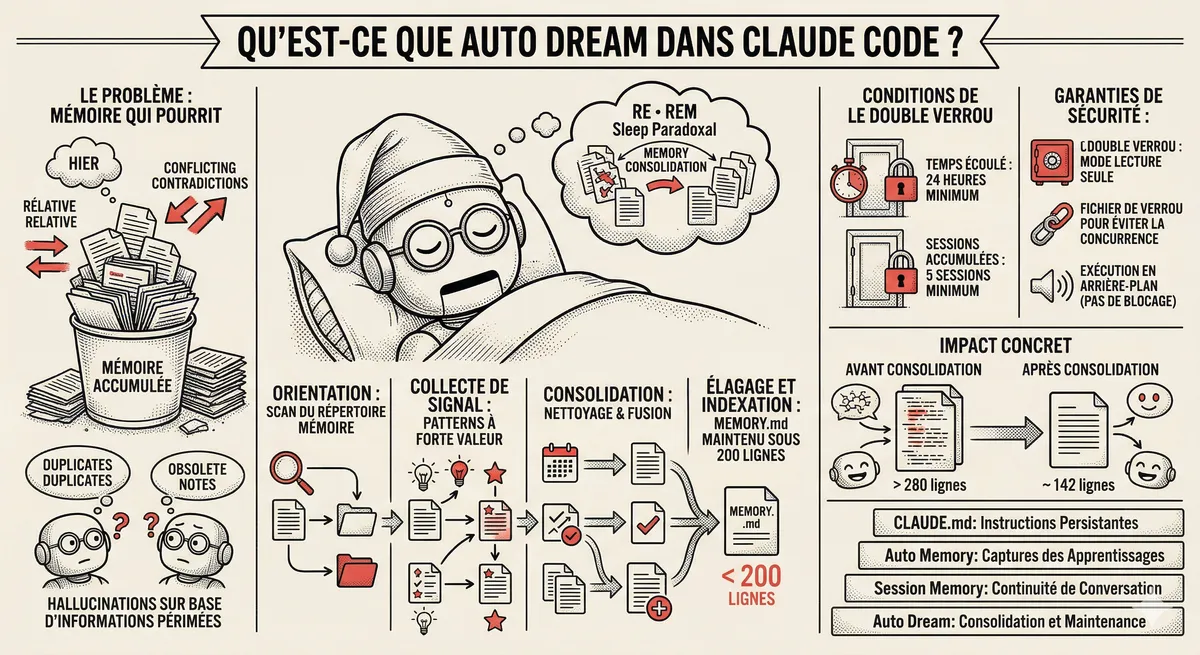
Claude Code Dream & Auto Dream: Automatic Memory Consolidation
After 20 sessions, Auto Memory notes become a mess. Auto Dream solves this by automatically consolidating Claude Code's memory: deduplication, stale entry removal, relative-to-absolute date conversion.
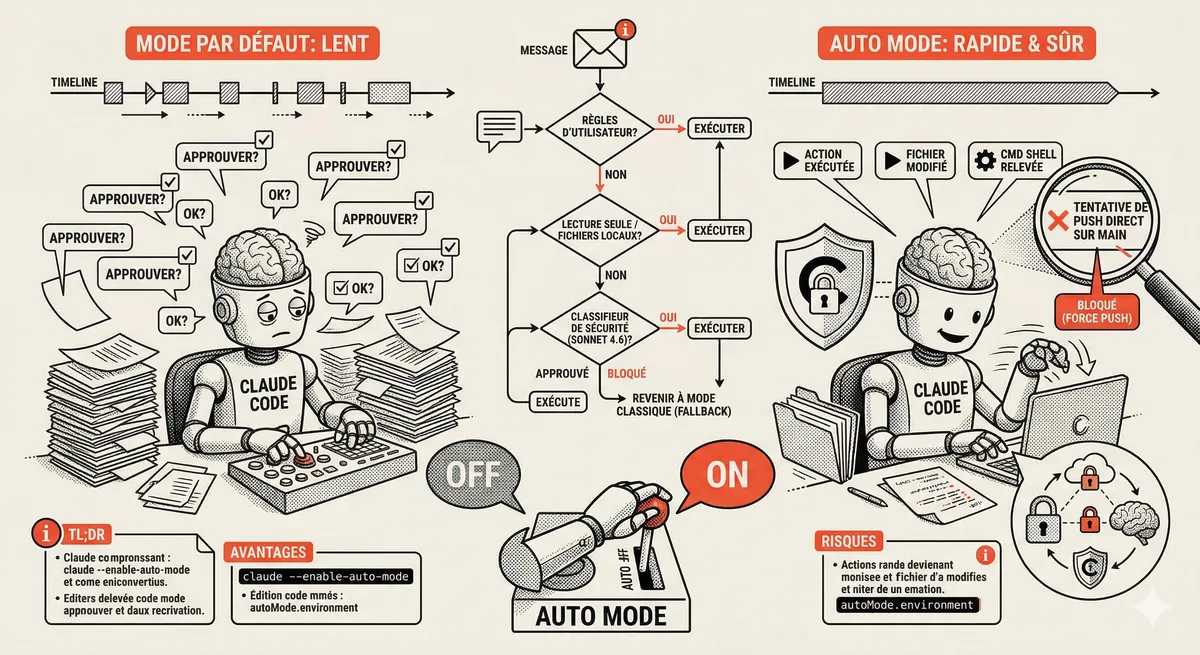
Claude Code Auto Mode: Autonomy Without the Risk
Auto Mode in Claude Code eliminates permission interruptions while keeping a safety net. A classifier analyzes every action before execution and blocks destructive operations. The sweet spot between approving everything and letting everything through.
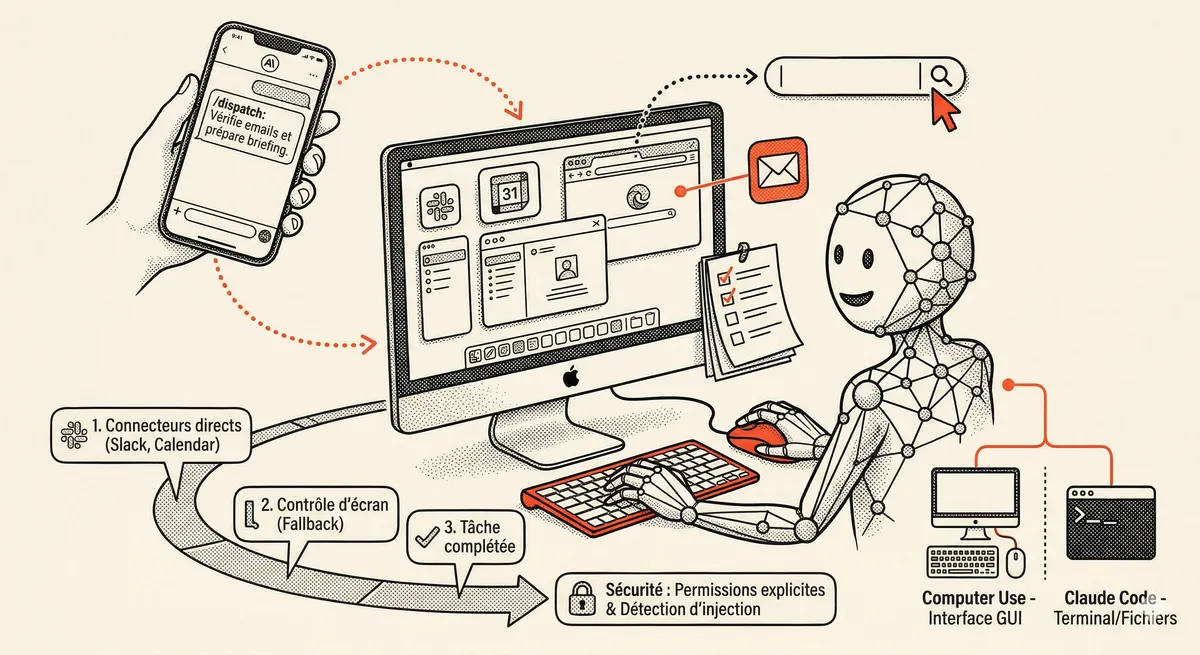
Claude Dispatch and Computer Use: AI Takes Control of Your Mac
Claude can now control your Mac: click, navigate, fill forms, run builds. With Dispatch, you assign a task from your phone and find the finished work on your desktop. Research preview, macOS only.
Claude Code Training
Master Claude Code fundamentals in 1 day with our expert instructors. 60% hands-on practice on real-world cases.
Discover the training