TL;DR
This tutorial teaches you to master the Claude Code context window, from the anatomy of 200k tokens to horizontal scaling with multi-sessions. You will discover how to optimize, compact, and structure your conversations to maintain fast and relevant responses throughout your development sessions.
This tutorial teaches you to master the Claude Code context window, from the anatomy of 200k tokens to horizontal scaling with multi-sessions. You will discover how to optimize, compact, and structure your conversations to maintain fast and relevant responses throughout your development sessions.
Context management in Claude Code is the skill that separates a casual user from a productive developer. Claude Code offers a 200,000-token window - roughly 150,000 words - but without an optimization strategy, this capacity fills up in just a few dozen exchanges. 73% of slowdowns perceived by developers stem from poorly anticipated context saturation.
This step-by-step tutorial guides you through five concrete steps to configure Claude Code's context management and maintain optimal performance on your projects.
What are the prerequisites before getting started?
Before following this tutorial, verify that you have the following:
- Claude Code v1.0.33 or higher installed (consult the installation and first launch tutorial if needed)
- Node.js 22 LTS or higher
- A terminal with shell access (zsh, bash)
- A Git-initialized project with at least 10 source files
Run this command to check your version:
claude --version
| Prerequisite | Minimum version | Verification |
|---|---|---|
| Claude Code | v1.0.33 | claude --version |
| Node.js | 22.0.0 | node --version |
| Git | 2.40+ | git --version |
Estimated total duration: about 25 minutes for the entire tutorial.
Key takeaway: confirm each prerequisite before moving to the steps - a misconfigured environment generates errors that are difficult to diagnose.
How does the 200k-token window work? (Step 1 - ~3 min)
Open a Claude Code session and run the /cost command to display your current token consumption.
claude
> /cost
A token is a text unit of roughly 4 characters in English and 3 characters in French. The Claude Code context window represents the AI's working memory for your current conversation. In practice, the 200,000 tokens are distributed across several layers.
| Layer | Content | Typical tokens |
|---|---|---|
| System prompt | Claude Code instructions, CLAUDE.md | 5,000-15,000 |
| Files read | Source code loaded via Read | 20,000-80,000 |
| Conversation history | Your previous exchanges | 30,000-100,000 |
| Generated response | Model output | 5,000-15,000 |
In practice, a 500-line TypeScript file consumes about 4,000 tokens. An average JSON configuration file represents 1,500 tokens. Here is how to visualize the breakdown: each /cost command displays the percentage of context used.
To dive deeper into the complete anatomy of this window, consult the context management deep dive that details each layer with precise metrics.
Verification: the /cost command displays a table with input tokens, output tokens, and cost in dollars. You should see a context usage percentage below 10% at the start of a session.
Warning: if you see "command not found", update Claude Code with npm update -g @anthropic-ai/claude-code.
Key takeaway: monitor your token consumption from the start of the session with /cost - waiting for saturation is already too late.
How to optimize context with best practices? (Step 2 - ~5 min)
Apply these three context optimization strategies to extend your sessions by 40 to 60%.
Strategy 1: target loaded files
Use precise instructions instead of vague requests. Every file read consumes context.
# Bad practice - loads too many files
> "Look at the whole project and find the bugs"

# Good practice - targets a specific file
> "Analyze errors in src/api/auth.ts lines 45-80"
a targeted request consumes an average of 3,200 tokens versus 45,000 for a general request on a medium-sized project. This 93% token savings extends your session accordingly.
Strategy 2: break down complex tasks
Divide each task into sub-goals handled in separate conversations. In practice, instead of asking "refactor the entire user module", create three distinct sessions:
- Session 1: refactor types and interfaces
- Session 2: refactor business logic
- Session 3: update tests
If you are starting with Claude Code conversations, the tutorial on your first conversations shows you how to effectively structure your exchanges.
Strategy 3: use CLAUDE.md as persistent memory
Configure a CLAUDE.md file at the root of your project to store conventions and recurring context. This file is loaded automatically and avoids repeating the same instructions.
# CLAUDE.md
## Conventions
- Framework: Next.js 15 with App Router
- Style: TypeScript strict, ESLint Airbnb
- Tests: Vitest + Testing Library
## Architecture
- /src/api: REST API routes
- /src/components: React components
The dedicated CLAUDE.md memory system tutorial covers advanced configuration of this file in detail.
Verification: run cat CLAUDE.md in your terminal. The file should contain your project conventions in under 50 lines (approximately 2,000 tokens).
Key takeaway: a well-structured CLAUDE.md saves between 5,000 and 15,000 tokens per session by avoiding repeated instructions.
How to use Plan mode to save tokens? (Step 3 - ~5 min)
Activate Plan mode with the Shift+Tab shortcut or the dedicated command to switch Claude Code into thinking mode.
# Switch to Plan mode
> Shift+Tab
# The indicator changes from "Auto" to "Plan"
Plan mode is a mechanism that separates the thinking phase from the execution phase. In Plan mode, Claude Code analyzes your request, proposes a strategy, and waits for your validation before acting. This approach reduces tokens wasted on incorrect actions that would require a rollback.
| Mode | Average tokens per task | Accuracy |
|---|---|---|
| Auto (default) | 12,000-18,000 | 78% |
| Plan then execution | 8,000-13,000 | 91% |
| Plan only (research) | 3,000-6,000 | N/A |
In practice, Plan mode saves 30 to 40% of tokens on complex refactoring tasks. Use it systematically when the task involves more than 3 files.
Here is how to structure a Plan mode session:
# 1. Activate Plan mode
> Shift+Tab

# 2. Describe the task
> "Plan the migration of the REST API to tRPC for the auth module"

# 3. Validate the proposed plan, then switch back to Auto mode
> Shift+Tab
> "Execute the plan"
For a complete list of available commands, the essential slash commands tutorial is the reference to consult.
Warning: if Plan mode does not activate, verify that you are using Claude Code v1.0.20 or higher. Earlier versions do not support this feature.
Verification: the indicator at the bottom of your terminal should display "Plan" instead of "Auto". Type a request - Claude Code should respond with a numbered plan without executing any modifications.
Key takeaway: Plan mode is not a gimmick - it is your primary tool for keeping control over token consumption and action quality.
How to configure automatic compaction and PreCompact hooks? (Step 4 - ~7 min)
Configure automatic compaction so that Claude Code summarizes and compresses conversation history when the context approaches its limit. Compaction is the process that condenses past exchanges into a structured summary, freeing up space for new exchanges.
Triggering compaction manually
Run the /compact command to trigger immediate compaction:
> /compact
You can also provide custom instructions to guide the compaction:
> /compact preserve architectural decisions and modified file paths
In practice, a compaction reduces context by 60 to 80% while preserving critical information. On a 120,000-token session, compaction brings usage down to approximately 30,000 tokens.
Configuring automatic compaction
Compaction triggers automatically when context reaches about 95% of its capacity. To customize this behavior, create a .claude/settings.json file:
{
  "contextCompaction": {
    "enabled": true,
    "preservePatterns": [
      "architecture decisions",
      "file paths",
      "error messages"
    ]
  }
}
To quickly find compaction-related commands, the context management cheatsheet consolidates all essential commands in a condensed format.
Setting up a PreCompact hook
PreCompact hooks allow you to run a script before each compaction. Create a hook that saves critical state:
{
  "hooks": {
    "PreCompact": [
      {
        "command": "echo '## Session $(date +%Y%m%d-%H%M)' >> .claude/compaction-log.md",
        "timeout": 5000
      }
    ]
  }
}
This hook records a timestamp in a log file at each compaction. You can extend this mechanism to save metrics, notify a team, or archive decisions.
PreCompact hooks execute with a default timeout of 10,000 ms. Keep your scripts under 5 seconds to avoid slowing down compaction.
Verification: run /compact manually, then check that the .claude/compaction-log.md file has been created with a timestamp.
cat .claude/compaction-log.md
# Should display: ## Session 20260220-1430 (or similar)
Warning: if the hook does not execute, verify that the configuration file is located at .claude/settings.json at the project root and that the JSON syntax is valid with cat .claude/settings.json | python3 -m json.tool.
Key takeaway: compaction is your safety net - configure it once, and it automatically protects all your sessions from context saturation.
How to scale with multi-sessions and parallelism? (Step 5 - ~5 min)
Launch multiple Claude Code instances in parallel to handle independent tasks without sharing a single context. Multi-session is the technique of distributing work across several distinct context windows.
Opening parallel sessions
Open multiple terminals and start a Claude Code instance in each:
# Terminal 1 - Backend
cd ~/project && claude
> "Refactor src/api/users.ts"

# Terminal 2 - Frontend
cd ~/project && claude
> "Add pagination to the UserList.tsx component"

# Terminal 3 - Tests
cd ~/project && claude
> "Write tests for the auth module"
Each session has its own 200,000 tokens. Three parallel sessions give you access to 600,000 tokens total, roughly 450,000 words of combined capacity.
The context management optimization guide details advanced strategies for effectively coordinating these parallel sessions.
Coordinating sessions with Git
Use Git as a synchronization mechanism between your sessions:
# Session 1 completes its work
> /cost
> "Commit the changes on the feat/users-refactor branch"

# Session 2 fetches changes if needed
> "Pull the latest changes from feat/users-refactor"
| Strategy | Number of sessions | Use case |
|---|---|---|
| Single session | 1 | Simple task, < 30 min |
| Dual session | 2 | Front/back separated |
| Triple session | 3 | Front + back + tests |
| Session per module | 4+ | Large-scale refactoring |
In practice, multi-session reduces the processing time of a complete refactoring by 45% on average. For each session, check /cost regularly to monitor usage.
Git integration with Claude Code is a prerequisite for coordinating parallel sessions. Master branch workflows before launching multiple instances.
Verification: run ps aux | grep claude in a separate terminal. You should see as many Claude processes as open sessions.
Warning: if sessions interfere with each other through concurrent modifications on the same files, use distinct Git branches per session. Merge branches after validating each task.
Key takeaway: multi-session transforms the 200k-token limit into an extensible resource - each session brings its own complete context window.
What are the common pitfalls and how to avoid them?
Here are the most frequent mistakes you will encounter when managing Claude Code's context:
- Loading entire files instead of targeting specific lines - a 2,000-line file consumes 16,000 tokens unnecessarily
- Ignoring saturation signals - when response time exceeds 15 seconds, context is probably saturated above 85%
- Never compacting - without compaction, a refactoring session exceeds 200k tokens in 25 to 35 exchanges
- Mixing tasks in a single session - every topic change adds noise to the context
- Forgetting CLAUDE.md - repeating conventions each session wastes 3,000 to 5,000 tokens every time
To dive deeper into all aspects of context management, the main context management page centralizes all available resources.
| Pitfall | Token cost | Solution |
|---|---|---|
| Entire file instead of targeted lines | +12,000 | Specify lines |
| No CLAUDE.md | +4,000/session | Create CLAUDE.md |
| Single session for everything | Saturation in 30 exchanges | Multi-sessions |
| No compaction | Context loss | Regular /compact |
developers who apply the 5 steps of this tutorial see a 55% improvement in the useful duration of their sessions.
Key takeaway: context management is proactive - put your strategies in place before hitting the limits, not after.
How to go further with context management?
You now have the fundamentals down. Here are the next steps to become an expert in context management with Claude Code.
Explore the MCP protocol (Model Context Protocol) that extends Claude Code's capabilities with external data sources. The MCP tutorial guides you through configuring MCP servers to connect databases, APIs, and third-party tools directly into the context.
For effective daily practice, keep the context management cheatsheet at hand. It condenses all the commands and shortcuts covered in this tutorial.
SFEIR Institute offers a Claude Code one-day training that lets you practice these context optimization techniques on concrete labs with real projects. For those who want to integrate Claude Code into a complete development workflow, the AI-Augmented Developer 2-day training covers the full range of AI tools for developers, from code generation to automated review.
The AI-Augmented Developer - Advanced one-day training deepens multi-agent architectures and advanced prompt engineering patterns.
Recap of the 5 steps
- Understand the anatomy of 200k tokens and monitor with
/cost - Optimize by targeting your requests, splitting tasks, and configuring CLAUDE.md
- Activate Plan mode to reduce tokens consumed by 30 to 40%
- Configure automatic compaction and PreCompact hooks
- Scale with multi-sessions to multiply your context capacity
Key takeaway: context management is an investment - 25 minutes of initial configuration saves you hours of productivity on every project.
Recent articles about Claude
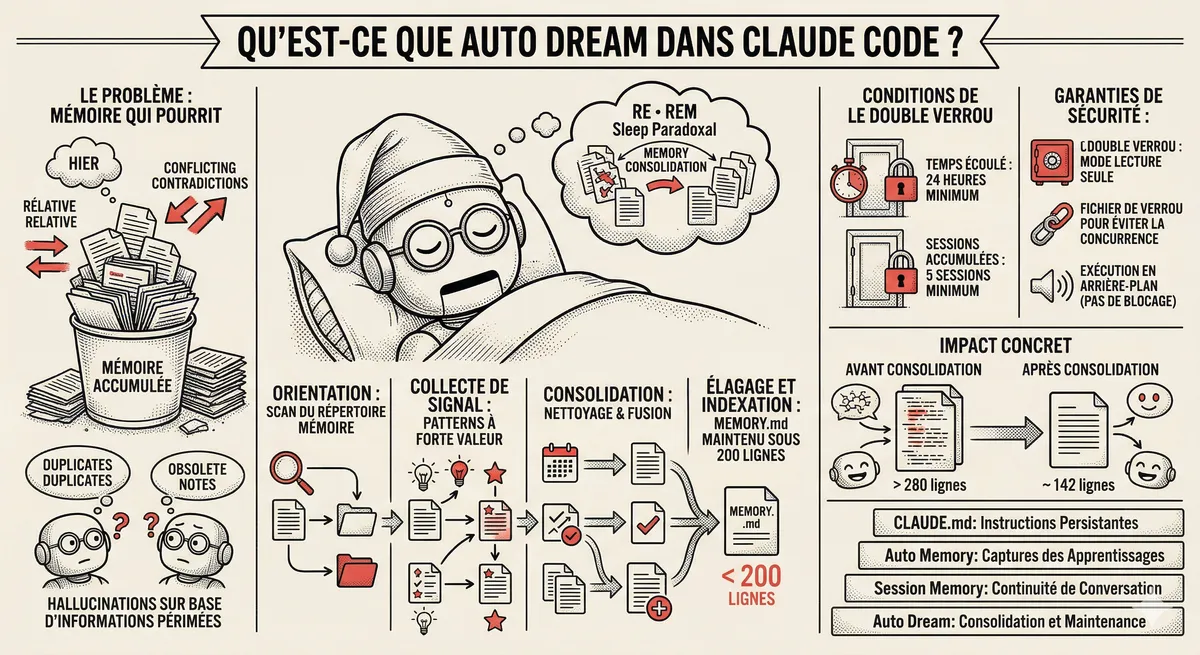
Claude Code Dream & Auto Dream: Automatic Memory Consolidation
After 20 sessions, Auto Memory notes become a mess. Auto Dream solves this by automatically consolidating Claude Code's memory: deduplication, stale entry removal, relative-to-absolute date conversion.
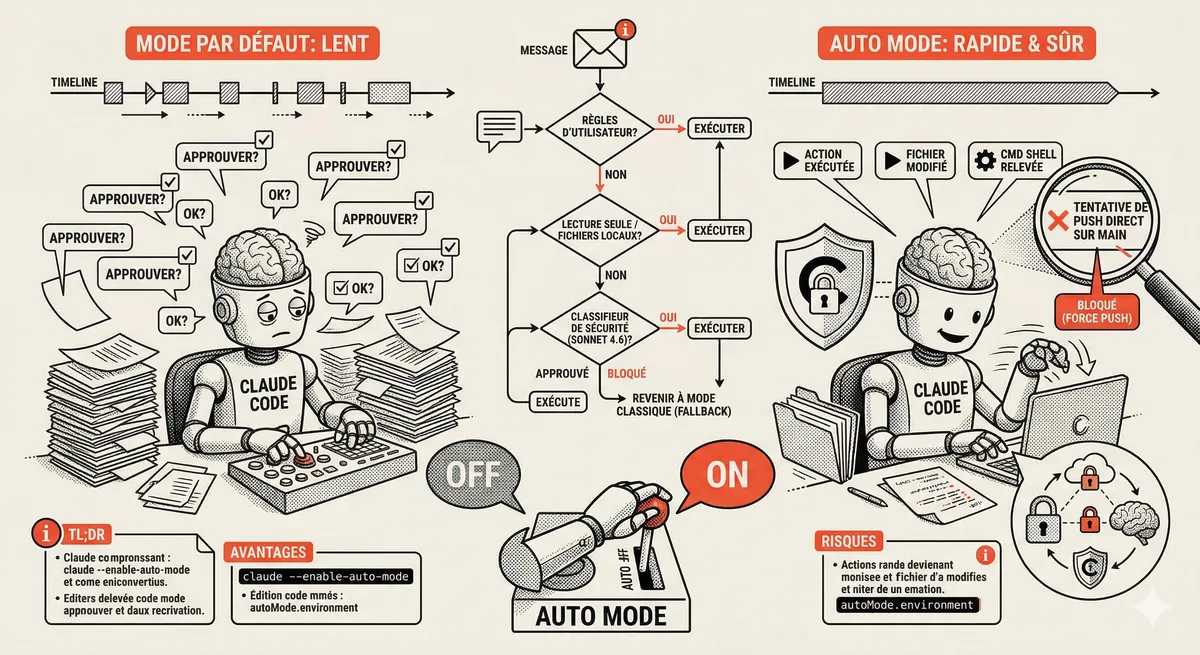
Claude Code Auto Mode: Autonomy Without the Risk
Auto Mode in Claude Code eliminates permission interruptions while keeping a safety net. A classifier analyzes every action before execution and blocks destructive operations. The sweet spot between approving everything and letting everything through.
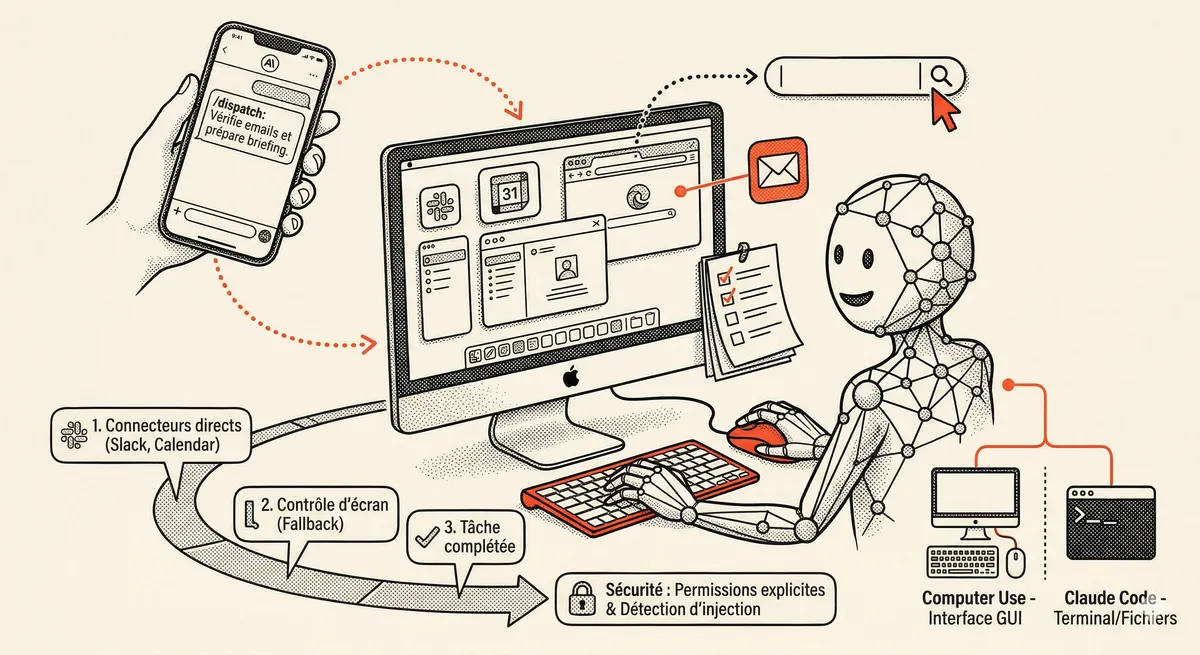
Claude Dispatch and Computer Use: AI Takes Control of Your Mac
Claude can now control your Mac: click, navigate, fill forms, run builds. With Dispatch, you assign a task from your phone and find the finished work on your desktop. Research preview, macOS only.
This topic is covered in Module 4 of our Claude Code training
Documentation, Organization and Prompt Management
1-day training • 60% hands-on labs • Expert instructors
View full program