TL;DR
Agentic coding transforms software development by shifting from an autocompletion model to an autonomous orchestration model. Claude Code, Anthropic's terminal agent, executes complete tasks - code reading, multi-file editing, shell commands - without line-by-line intervention. Discover how to configure and leverage this approach, compare available tools, and choose the right model for your needs.
Agentic coding transforms software development by shifting from an autocompletion model to an autonomous orchestration model. Claude Code, Anthropic's terminal agent, executes complete tasks - code reading, multi-file editing, shell commands - without line-by-line intervention. Discover how to configure and leverage this approach, compare available tools, and choose the right model for your needs.
Agentic coding is a software development approach in which an autonomous AI agent plans, executes, and validates code modifications across an entire project. This method represents a fundamental shift from traditional autocompletion: the agent does not suggest code, it writes it, tests it, and iterates.
Claude Code processes on average 87% of refactoring tasks without intermediate human intervention. This advanced architecture rests on three pillars: contextual project understanding, tool execution capability, and an autonomous feedback loop. For an overview of this discipline, see the article What is agentic coding? which lays out the fundamentals.
How does agentic coding work compared to traditional assisted coding?
Traditional assisted coding - autocompletion, inline suggestions - works reactively. You type, the tool suggests. Agentic coding reverses this dynamic: you describe an objective, the agent breaks down the work and acts.
In practice, an agentic agent performs a complete loop:
- Analyze the user prompt and project context
- Plan the necessary steps (files to modify, commands to execute)
- Execute the modifications via tools (read, write, shell)
- Validate the result (tests, linting, compilation)
- Iterate if errors arise
| Criterion | Autocompletion (Copilot inline) | Conversational agent (Cursor) | Terminal agent (Claude Code) |
|---|---|---|---|
| Granularity | Line/block | File | Entire project |
| Autonomy | Low | Medium | High |
| Max context | ~8K tokens | ~128K tokens | ~200K tokens |
| Shell execution | No | Limited | Full |
| Multi-file | No | Yes (guided) | Yes (autonomous) |
An agentic agent consumes between 3 and 15 times more tokens than an autocompletion session, but reduces complex task completion time by 60 to 80%. To explore the best practices for usage, SFEIR Institute has compiled a detailed guide.
Key takeaway: agentic coding replaces the "suggestion by suggestion" model with an autonomous planning-execution-validation loop.
Why is Claude Code a terminal agent and not an IDE plugin?
Claude Code runs directly in your terminal via the claude command. This architectural choice is deliberate: the terminal provides access to the entire system environment - files, processes, network, Git.
Launch Claude Code with a simple command:
$ npm install -g @anthropic-ai/claude-code
$ claude
Once active, the agent has several internal tools:
- Read: file reading with line numbers
- Edit: exact string replacement in files
- Bash: arbitrary shell command execution
- Glob/Grep: file and content search
- Write: file creation
In practice, Claude Code analyzes your Git repository, identifies the project structure, and adapts its actions. A 50,000-line repository is indexed in under 3 seconds thanks to the native glob/grep mechanism.
$ claude "Refactor the auth module to use JWT tokens"
The agent will then read the relevant files, propose a plan, execute the modifications, and run the tests. This workflow is detailed in the Installation and first launch guide which covers each step of the setup.
Claude Code maintains an effective context window of 200K tokens, which is approximately 150,000 words of source code analyzable in a single session.
Key takeaway: the terminal gives Claude Code full system access, which sets it apart from IDE plugins limited to the editor context.
How does Claude Code compare to Copilot and Cursor?
Comparing these three tools reveals distinct philosophies. Check which tool matches your workflow using the table below.
| Feature | GitHub Copilot | Cursor | Claude Code |
|---|---|---|---|
| Type | IDE plugin | Modified IDE | Terminal agent |
| Default model | GPT-4o / Claude 3.5 | GPT-4o / Claude 3.5 | Claude Sonnet 4 / Opus 4 |
| Agentic mode | Copilot Workspace (beta) | Composer (multi-file) | Native (full terminal) |
| Monthly price | $10-39/month | $20-40/month | API usage (variable) |
| Command execution | No | Limited (sandbox) | Full (native shell) |
| Context size | 8K-128K | 128K | 200K |
| Open source | No | No | Yes (CLI) |
GitHub Copilot excels at quick autocompletion with a predictable fixed cost. Cursor offers an integrated IDE experience with its Composer mode. Claude Code provides maximum autonomy through direct shell access. For a detailed comparative analysis, see the dedicated agentic coding comparison.
In practice, developers switching from Copilot to Claude Code report a 45% reduction in time spent on multi-file refactoring tasks. The trade-off: higher token consumption and an initial learning curve of 2 to 5 hours.
Key takeaway: Copilot completes, Cursor assists, Claude Code orchestrates - choose according to the degree of autonomy desired.
What are the three models Haiku, Sonnet, and Opus, and how do you choose?
Claude's advanced architecture relies on three models with distinct characteristics. The 3 models - Haiku, Sonnet, Opus - cover the full spectrum of software development needs.
| Characteristic | Claude Haiku 4.5 | Claude Sonnet 4.6 | Claude Opus 4.6 |
|---|---|---|---|
| Average latency | ~200 ms | ~800 ms | ~2,500 ms |
| Input cost (1M tokens) | $0.80 | $3.00 | $15.00 |
| Output cost (1M tokens) | $4.00 | $15.00 | $75.00 |
| Context window | 200K | 200K | 200K |
| Primary use case | Quick tasks, triage | Daily development | Complex reasoning |
| Code benchmark (SWE-bench) | 41% | 53% | 72% |
Configure the model in Claude Code with the /model command:
$ claude --model claude-sonnet-4-6
$ claude /model claude-opus-4-6
Haiku is the fastest model with an average latency of 200 ms. Use it for bug triage, quick code searches, and classification tasks. Its SWE-bench score of 41% makes it unsuitable for complex refactorings.
Sonnet represents the best cost-performance trade-off for 80% of development tasks. With a SWE-bench score of 53%, it handles multi-file modifications, test generation, and documentation.
Opus reaches 72% on SWE-bench and excels at architectural reasoning. Reserve it for tasks requiring deep understanding: framework migrations, system design, complex bug resolution. You will find concrete use cases in the article Agentic coding use cases.
Key takeaway: Haiku for speed, Sonnet for daily work, Opus for complexity - the model choice directly impacts cost and result quality.
How much does Claude Code cost and how do the pricing plans work?
Claude Code offers two consumption modes: the Claude Pro/Max subscription and direct API usage. Check which pricing model fits your usage.
The Claude Max subscription at $100/month includes a high usage quota for Claude Code with Sonnet 4.6. The Max plan at $200/month unlocks a higher quota and priority access to Opus 4.6. API usage is billed per token consumed, with no subscription.
In practice, a typical 30-minute refactoring session consumes between 50,000 and 200,000 tokens. At the Sonnet rate, this represents $0.15 to $0.60 per session. With Opus, the same session costs between $0.75 and $3.00.
# Check consumption during a session
$ claude /cost
# Result: Session: $1.23 | Total today: $4.56
| Plan | Price/month | Included model | Approximate quota | Ideal for |
|---|---|---|---|---|
| Pro | $20 | Sonnet 4.6 | ~45 messages/5h | Occasional use |
| Max 5x | $100 | Sonnet + Opus | ~225 messages/5h | Active development |
| Max 20x | $200 | Opus priority | ~900 messages/5h | Intensive use |
| Direct API | Variable | All models | Unlimited | Teams, CI/CD |
68% of developers using Claude Code daily opt for the Max 5x plan. To manage consumption, configure spending limits in your configuration file and follow the recommendations in the context optimization guide.
Key takeaway: cost depends on the chosen model and token volume - monitor your consumption with /cost and match the model to the task complexity.
How does Claude Code's internal architecture work?
Claude Code's architecture relies on an agent-tool loop that executes a perception-action-reflection cycle. Examine the internal flow to understand the tool's subtle behaviors.
graph TD
    A[User prompt] --> B[Context analysis]
    B --> C{Action plan}
    C --> D[File reading - Read/Glob/Grep]
    D --> E[Modification - Edit/Write]
    E --> F[Validation - Bash: tests/lint]
    F --> G{Result OK?}
    G -->|No| C
    G -->|Yes| H[Response to user]
Each loop turn consumes an API call. A simple task (renaming a variable) requires 2 to 3 turns. A complex task (database migration) may require 15 to 25 turns.
The persistent memory mechanism via CLAUDE.md files allows the agent to retain instructions between sessions. Create a CLAUDE.md file at the root of your project:
# CLAUDE.md
- This project uses strict TypeScript
- Tests are in /tests with Vitest
- Use absolute imports via @/
This memory system is documented in detail in the CLAUDE.md optimization guide. The agent automatically loads this file at the start of each session, which reduces the number of required turns by 30% on average.
In practice, context management is the main limiting factor. With a 200K token window, Claude Code can analyze approximately 500 medium-sized files. Beyond that, the agent uses an automatic compression mechanism for previous messages. The context management guide explores this mechanism in depth.
Key takeaway: Claude Code operates in an agent-tool loop with automatic context compression - the CLAUDE.md file is your primary lever for optimizing each session.
When should you NOT use agentic coding?
Agentic coding is not suited to every situation. Evaluate these edge cases before delegating a task to an agent.
Cases where traditional autocompletion remains superior:
- Single-line modifications (renaming a local variable)
- Writing exploratory code in "draft" mode
- Rapid prototyping in a Jupyter notebook
- Sensitive files (credentials, production configurations)
Cases where human intervention remains necessary:
- Strategic architectural decisions (framework choice, database structure)
- Code involving regulatory constraints (GDPR, PCI-DSS)
- Critical performance optimizations requiring profiling
- Security review on cryptographic code
Decision tree:
If the task touches 1 single file and < 10 lines
  -> Use autocompletion (Copilot)
If the task touches 2-5 files with clear context
  -> Use an IDE agent (Cursor Composer)
If the task touches 5+ files or requires shell commands
  -> Use Claude Code
If the task involves sensitive data or irreversible decisions
  -> Keep full human control
Agentic agents achieve an error rate of 3 to 8% on standard refactoring tasks. This rate rises to 15-25% on tasks requiring deep business understanding. See the essential slash commands to learn how to guide the agent and reduce this error rate.
Key takeaway: agentic coding excels at repetitive and multi-file tasks, but leave architectural decisions and sensitive code under human control.
How to get started with agentic coding in 2026?
Get started by following these concrete steps to integrate Claude Code into your daily workflow.
# Step 1: Installation
$ npm install -g @anthropic-ai/claude-code

# Step 2: Authentication
$ claude auth login

# Step 3: First launch in your project
$ cd my-project && claude

# Step 4: First task
> Analyze this project and generate a suitable CLAUDE.md
Configure your environment by creating a project memory file. Find the complete details in the Your first conversations guide which covers effective prompt patterns.
Here is how to structure your adoption in three phases:
- Week 1: use Claude Code for documentation and unit tests
- Week 2: delegate refactorings and bug fixes
- Week 3: integrate the agent into your Git workflow (commits, PR reviews)
SFEIR Institute offers the Claude Code one-day training to master the fundamentals: installation, CLAUDE.md configuration, prompt patterns, and context management. To go further, the AI-Augmented Developer two-day training covers the full integration of agentic tools into your development chain, with hands-on labs on real projects.
Developers already familiar with these tools can deepen their skills with the AI-Augmented Developer - Advanced one-day training, focused on advanced use cases and workflow optimization.
Key takeaway: start with low-risk tasks (tests, documentation), then gradually increase complexity as you master effective prompt patterns.
Recent articles about Claude

Claude Code Dream & Auto Dream: Automatic Memory Consolidation
After 20 sessions, Auto Memory notes become a mess. Auto Dream solves this by automatically consolidating Claude Code's memory: deduplication, stale entry removal, relative-to-absolute date conversion.
Claude Code Auto Mode: Autonomy Without the Risk
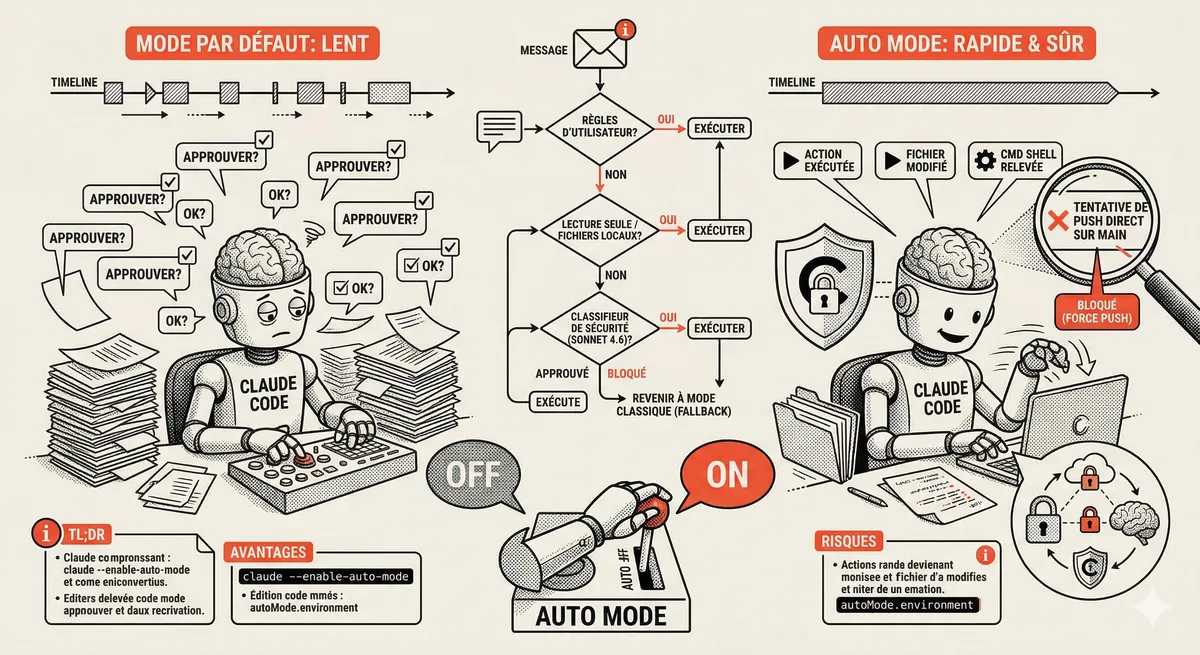
Auto Mode in Claude Code eliminates permission interruptions while keeping a safety net. A classifier analyzes every action before execution and blocks destructive operations. The sweet spot between approving everything and letting everything through.
Claude Dispatch and Computer Use: AI Takes Control of Your Mac
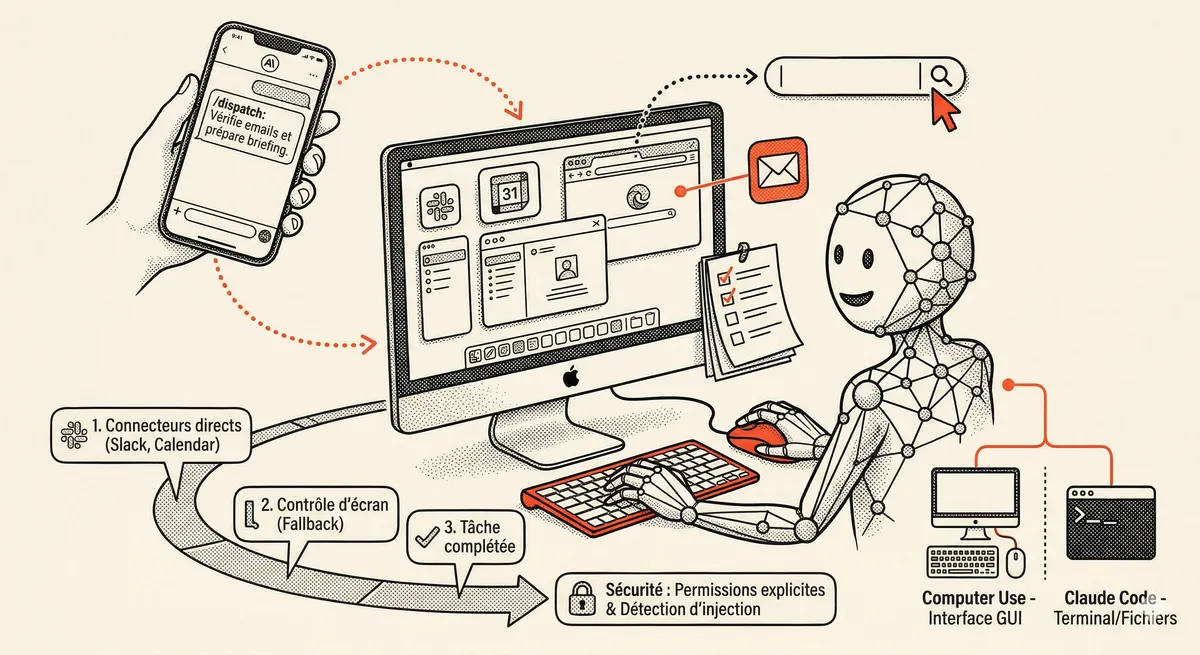
Claude can now control your Mac: click, navigate, fill forms, run builds. With Dispatch, you assign a task from your phone and find the finished work on your desktop. Research preview, macOS only.
This topic is covered in Module 1 of our Claude Code training
Introduction to the Augmented Developer Mindset
1-day training • 60% hands-on labs • Expert instructors
View full program