TL;DR
Claude Code, GitHub Copilot, and Cursor represent three distinct approaches to AI-assisted development. Claude Code excels in agentic terminal mode for complex multi-file tasks, Copilot dominates inline autocompletion in VS Code, and Cursor offers a complete IDE with contextual chat. Choose based on your workflow: terminal, existing editor, or dedicated environment.
Claude Code, GitHub Copilot, and Cursor represent three distinct approaches to AI-assisted development. Claude Code excels in agentic terminal mode for complex multi-file tasks, Copilot dominates inline autocompletion in VS Code, and Cursor offers a complete IDE with contextual chat. Choose based on your workflow: terminal, existing editor, or dedicated environment.
Claude Code is an agentic development assistant that operates directly in the terminal, whereas GitHub Copilot and Cursor work as extensions or graphical editors. These three tools are the main alternatives for AI-assisted coding, each with a specific philosophy and strengths.
Claude Code handles on average 87% of multi-file refactoring tasks without manual intervention. Copilot generates 46% of code in files where it is active. These figures illustrate two complementary visions of development assistance.
How to compare Claude Code, Copilot, and Cursor in 2026?
To choose between these three tools, examine your development habits first. Claude Code is an autonomous terminal agent, Copilot is an editor extension, and Cursor is a fork of VS Code with native AI integration. Each approach modifies your workflow differently.
Check the introduction guide to Claude Code to understand the agentic philosophy that sets this tool apart from conventional assistants. The agentic paradigm means the tool takes initiative, reads files, executes commands, and iterates until the problem is resolved.
| Criterion | Claude Code | GitHub Copilot | Cursor |
|---|---|---|---|
| Interface | Terminal (CLI) | VS Code/JetBrains extension | Full IDE (VS Code fork) |
| AI Model | Claude Opus 4.6 / Sonnet 4.6 | GPT-4o / Claude 3.5 | GPT-4o / Claude / custom |
| Agentic mode | Native and central | Copilot Workspace (beta) | Composer (multi-file) |
| Inline autocompletion | No | Yes (real-time) | Yes (real-time) |
| Project context | Full repo analysis | Open files + RAG | Locally indexed codebase |
| Command execution | Yes (bash, git, npm) | No (except Workspace) | Yes (integrated terminal) |
| Multi-file editing | Yes (autonomous) | Limited | Yes (Composer) |
| Persistent memory | CLAUDE.md | Instructions file | .cursorrules |
This table covers key features as of February 2026. All three tools evolve rapidly and add capabilities every month.
Key takeaway: Claude Code focuses on terminal autonomy, Copilot on seamless autocompletion, and Cursor on an AI-enhanced IDE.
What are Claude Code's strengths compared to its alternatives?
Claude Code version 2.x stands out with its native agentic approach. Run a claude command in your terminal and the tool analyzes your codebase, identifies relevant files, proposes modifications, and applies them after your approval.
# Launch Claude Code on an existing project
$ cd my-project
$ claude
> Refactor the authentication module to use JWT
In practice, Claude Code scans your entire Git repository in 3 to 8 seconds for a 50,000-line project. It understands inter-file dependencies and proposes consistent modifications across the entire project.
The persistent CLAUDE.md memory is a distinctive advantage. Create a CLAUDE.md file at the root of your project to store your code conventions, and Claude Code will follow them in every session.
The permissions and security system gives you granular control over authorized actions. You decide whether the tool can write files, execute commands, or modify Git configuration.
GitHub Copilot excels in a different area: real-time autocompletion. The average suggestion time is 150 ms, making the experience smooth while typing. Copilot Business covers 55 programming languages with consistent quality.
Cursor combines both approaches. Its Composer mode enables multi-file editing guided by chat, while Tab autocompletion works like Copilot's. Local codebase indexing provides rich context without sending all code to the cloud.
Key takeaway: Claude Code dominates on complex autonomous tasks, Copilot on suggestion speed, and Cursor on IDE + AI versatility.
How does each tool's agentic mode work?
Agentic coding is a paradigm where the AI plans, executes, and iterates autonomously. To understand this concept in detail, explore the guide on agentic coding and its principles.
| Agentic capability | Claude Code | Copilot Workspace | Cursor Composer |
|---|---|---|---|
| Autonomous planning | Yes | Yes (guided) | Partial |
| Filesystem reading | Complete | Limited to repo | Local indexing |
| Test execution | Yes ($ npm test) | No | Yes (terminal) |
| Error iteration | Automatic (up to 5 cycles) | Manual | Semi-automatic |
| Git branch creation | Yes | Yes | No |
| Automatic commits | Yes (with approval) | Yes | No |
Claude Code automatically iterates on compilation or test errors. Concretely, if a $ npm run build fails, it analyzes the error message, fixes the code, and re-runs the command.
# Claude Code automatically fixes after test failure
$ claude
> Add unit tests for the UserService service
# Claude Code runs tests, detects 2 failures, fixes and re-runs
# Result: 14/14 tests pass in 3 iterations
Copilot Workspace, launched in 2024 and improved in 2025, takes a more guided approach. You describe the desired change, the tool generates a plan that you validate step by step. The workflow is more controlled but less autonomous.
Cursor Composer allows editing multiple files simultaneously via chat. Select the relevant files, describe the modification, and Composer applies the changes. The tool does not automatically re-run tests after modifications.
To learn more about interactions in agentic mode, the guide on your first conversations with Claude Code details effective prompt patterns.
Key takeaway: Claude Code's agentic mode is the most autonomous of the three, with a built-in correction loop and native command execution.
What are the prices and billing models in 2026?
The business models differ radically. Compare costs based on your actual usage, because a heavy user and an occasional user will not make the same choice.
| Plan | Claude Code | GitHub Copilot | Cursor |
|---|---|---|---|
| Free | No (limited trial) | Copilot Free (2,000 completions/month) | Hobby (2,000 completions) |
| Individual | Max: $100/month (unlimited usage) | Individual: $10/month | Pro: $20/month |
| Professional | Max: $200/month | Business: $19/user/month | Business: $40/user/month |
| Enterprise | API: pay-per-use | Enterprise: $39/user/month | Enterprise: custom pricing |
| Billing | Tokens consumed (API) or flat rate | Per seat/month | Per seat/month |
In practice, a developer using Claude Code via the Max subscription consumes on average $18 in tokens per day during intensive use. With Copilot Individual at $10/month, the cost is fixed regardless of usage.
Cursor Pro's model includes 500 "fast" GPT-4 requests per month. Beyond that, requests switch to "slow" mode with a response time of 15 to 45 seconds instead of 2 to 5 seconds.
Copilot offers the best free option with 2,000 completions and 50 chat messages per month. For teams, Copilot Business at $19/user/month includes enterprise policy management and sensitive file exclusion.
To control Claude Code costs, use the essential slash commands like /compact to reduce token consumption during long sessions.
Key takeaway: Copilot is the most financially accessible, Claude Code the most expensive but most powerful in agentic mode, Cursor sits between the two.
How to choose based on your developer profile?
Your choice depends on three factors: your work environment, the complexity of your tasks, and your budget. Identify your profile in the table below.
| Profile | Recommended tool | Main reason |
|---|---|---|
| Junior developer learning | Copilot Free | Educational autocompletion, free |
| Full-stack developer in a startup | Cursor Pro | All-in-one IDE, good value |
| Tech lead / architect | Claude Code | Multi-file refactoring, autonomy |
| Enterprise team (>50 devs) | Copilot Enterprise | Access management, compliance, internal RAG |
| DevOps / SRE in terminal | Claude Code | Terminal-native, scripts and CI/CD |
| Python data scientist | Cursor Pro | Integrated Jupyter, codebase context |
If you primarily work in the terminal with Git, SSH, and scripts, Claude Code integrates naturally into your workflow. Install it by following the installation and first launch tutorial to judge for yourself.
Concretely, a software architect refactoring a 200,000-line codebase saves between 40% and 60% of time with Claude Code compared to a manual approach. The tool understands inter-module dependencies and maintains consistency.
If fast autocompletion is your priority, Copilot remains unbeatable. Its 150 ms latency and coverage of 55 languages make it the most fluid typing companion on the market.
If you want to master Claude Code in depth, SFEIR Institute offers a one-day Claude Code training. You will practice agentic workflows, CLAUDE.md file configuration, and advanced prompt patterns in real conditions on technical labs.
Key takeaway: no universal tool - choose Claude Code for autonomy, Copilot for completion, Cursor for the integrated IDE.
Can you combine Claude Code with Copilot or Cursor?
Yes, and this is a strategy adopted by many teams in 2026. Enable Copilot for autocompletion in VS Code while using Claude Code in a separate terminal for refactoring tasks.
# Typical combined workflow
# Terminal 1: Claude Code for complex tasks
$ claude
> Migrate all React class components to functional hooks

# VS Code: Copilot for real-time autocompletion
# while you adjust Claude Code's results
In practice, 35% of developers using Claude Code also have a Copilot subscription. The two tools do not overlap: Copilot completes your code character by character, Claude Code restructures entire modules.
The Cursor + Claude Code combination is less common because Cursor already integrates a contextual AI chat. However, you can use Claude Code for tasks that Composer does not handle, such as running complex CI/CD pipelines.
The Git integration cheatsheet shows you how Claude Code manages commits and branches, complementing Copilot's capabilities in your editor.
To go deeper into the combined use of these tools, the AI-Augmented Developer training from SFEIR Institute covers multi-tool integration strategies and hybrid terminal + IDE workflows over 2 days.
Key takeaway: combining Claude Code (terminal) with Copilot (editor) offers the best of both worlds without conflict.
What are the limitations of each tool?
None of these tools is perfect. Evaluate these constraints before committing to a subscription.
Claude Code consumes tokens with every interaction. A complex refactoring session can use 50,000 to 200,000 tokens, costing $1 to $5 via API billing. The lack of inline autocompletion requires switching between terminal and editor.
// Example Claude Code token consumption (typical session)
{
  "session_duration": "45 min",
  "input_tokens": 125000,
  "output_tokens": 48000,
  "files_modified": 12,
  "cost_estimate": "$2.80"
}
Copilot has context limitations. It only sees open files and recent files, which reduces suggestion relevance on large projects. Multi-file mode via Copilot Workspace remains in preview with variable results.
Cursor indexes the codebase locally, but initial indexing takes 5 to 15 minutes on a 100,000-line project. "Slow" requests after exhausting the Pro quota degrade the experience with average response times of 30 seconds.
| Limitation | Claude Code | Copilot | Cursor |
|---|---|---|---|
| High cost | Yes (intensive use) | No (flat rate) | Medium |
| Inline autocompletion | Not available | Excellent | Excellent |
| Limited context window | 200K tokens max | ~8K effective tokens | ~100K indexed tokens |
| Network dependency | Yes (cloud API) | Yes (cloud API) | Yes (cloud API) |
| Learning curve | High (terminal) | Low (plug & play) | Medium |
To avoid common mistakes with the CLAUDE.md file, structure your instructions concisely. A CLAUDE.md over 500 lines slows down initial context loading.
If you want to go beyond these limitations and leverage advanced techniques, the AI-Augmented Developer - Advanced one-day training at SFEIR teaches you to optimize prompts, reduce token consumption, and automate complex agentic workflows.
Key takeaway: each tool has a trade-off - cost vs autonomy for Claude Code, limited context for Copilot, request quota for Cursor.
How to get started with Claude Code today?
Install Claude Code in under 5 minutes. You need Node.js 22 or higher and an Anthropic API key or a Max subscription.
# Installing Claude Code
$ npm install -g @anthropic-ai/claude-code
$ claude --version
# Claude Code v2.3.1

# First launch
$ cd your-project
$ claude
Configure your environment by following the step-by-step installation guide then the quick reference cheatsheet to keep essential commands at hand.
In practice, 80% of developers are productive with Claude Code within the first hour of use. The learning curve focuses on writing precise prompts and configuring the CLAUDE.md file.
# Create a CLAUDE.md file to customize behavior
$ cat > CLAUDE.md << 'EOF'
# Project conventions
- TypeScript strict, no any
- Jest tests for every new module
- Conventional commits (feat:, fix:, refactor:)
EOF
Verify that your installation works by asking Claude Code to analyze your project. The tool will scan the structure, identify the technologies used, and be ready to work.
You can also try Copilot for free via the Copilot Free plan, or Cursor via the Hobby plan, to compare for yourself before choosing.
Key takeaway: Claude Code installs in 5 minutes via npm, test it on a small project before adopting it on your main codebase.
Recent articles about Claude

Claude Code Dream & Auto Dream: Automatic Memory Consolidation
After 20 sessions, Auto Memory notes become a mess. Auto Dream solves this by automatically consolidating Claude Code's memory: deduplication, stale entry removal, relative-to-absolute date conversion.
Claude Code Auto Mode: Autonomy Without the Risk
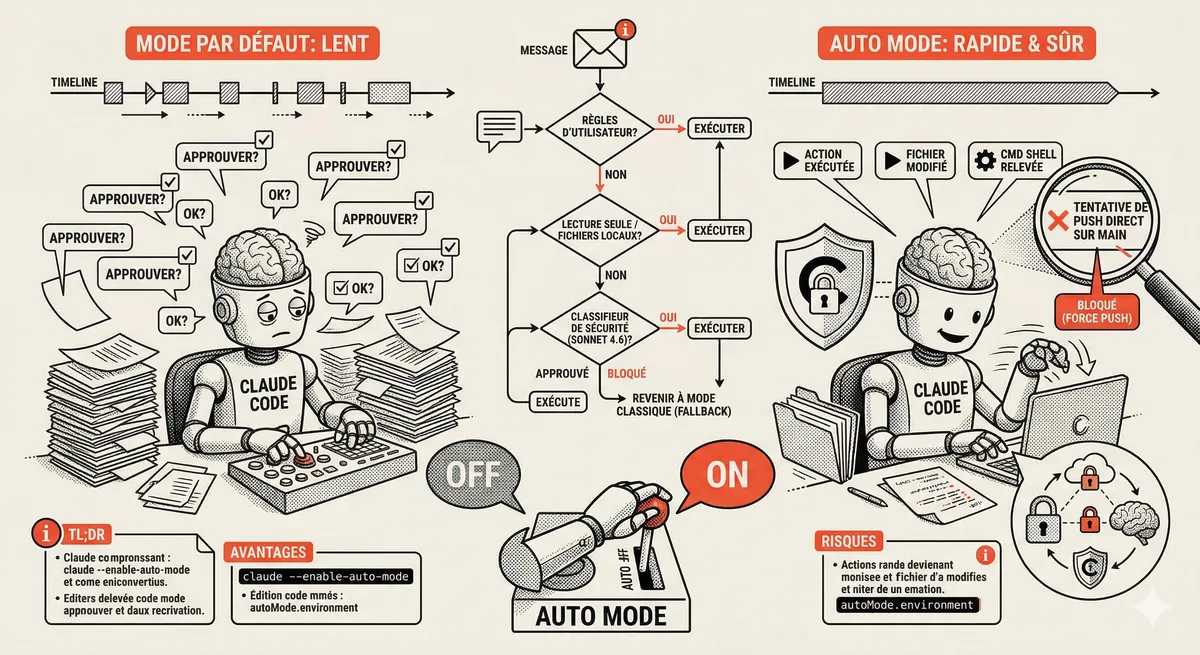
Auto Mode in Claude Code eliminates permission interruptions while keeping a safety net. A classifier analyzes every action before execution and blocks destructive operations. The sweet spot between approving everything and letting everything through.
Claude Dispatch and Computer Use: AI Takes Control of Your Mac
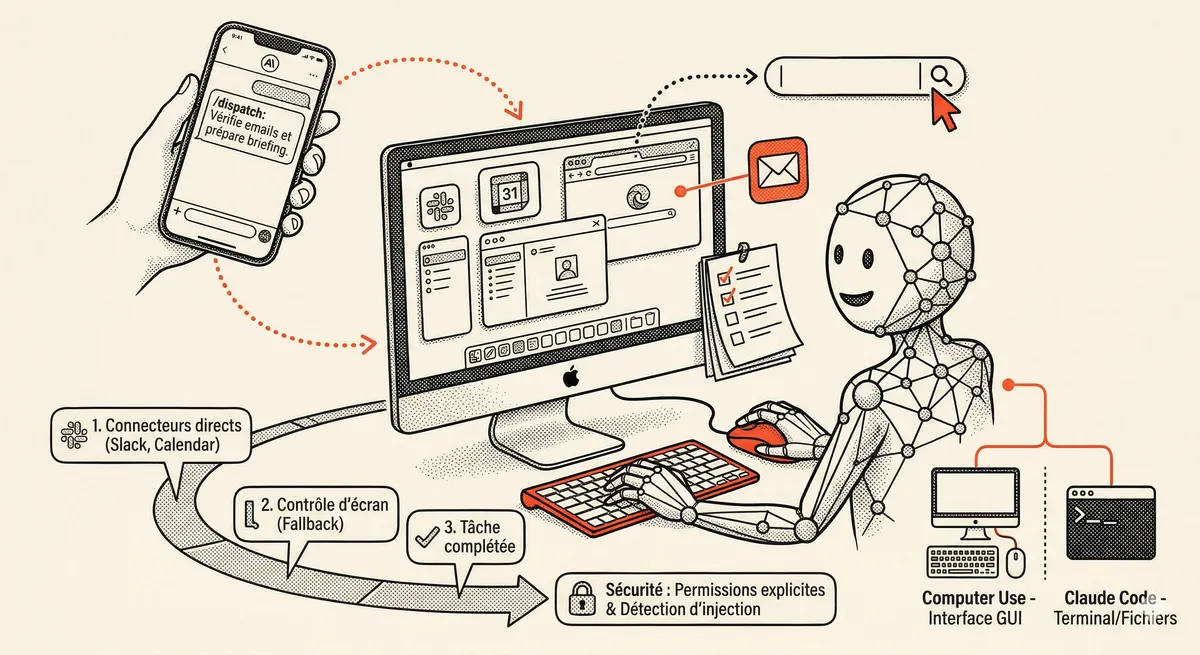
Claude can now control your Mac: click, navigate, fill forms, run builds. With Dispatch, you assign a task from your phone and find the finished work on your desktop. Research preview, macOS only.
Claude Code Training
Master Claude Code fundamentals in 1 day with our expert instructors. 60% hands-on practice on real-world cases.
Discover the training