TL;DR
Here are the best advanced tips to use Claude Code like a professional - from targeted debugging to team workflows, including legacy project management. These shortcuts and best practices will save you between 30 and 60 minutes per day on your development tasks.
Here are the best advanced tips to use Claude Code like a professional - from targeted debugging to team workflows, including legacy project management. These shortcuts and best practices will save you between 30 and 60 minutes per day on your development tasks.
Advanced best practices for Claude Code represent a set of proven techniques that transform your daily productivity as a developer. Claude Code (version 1.0.x, running on the Claude Opus 4.6 model) offers contextual understanding capabilities that exceed 200,000 tokens per session. developers using structured practices with Claude Code reduce their debugging time by 40% on average.
How to structure your professional workflows with Claude Code?
Adopt the "plan -> execute -> verify" pattern for each significant task. Before coding, ask Claude Code to produce a detailed plan with /plan. You will get a structured breakdown of the task into sub-steps.
Create CLAUDE.md files per project containing your team conventions. Claude Code reads them automatically at each session startup. Check the CLAUDE.md memory system guide to master this feature.
| Workflow pattern | Command / Action | Estimated gain |
|---|---|---|
| Plan before execution | /plan then validation | -35% iterations |
| Project memory | CLAUDE.md file at the root | -20% repetitions |
| Targeted context | @file to reference a file | -25% tokens consumed |
| Short, focused sessions | 1 task = 1 session | +40% accuracy |
Use structured prompts in three parts: context, objective, constraints. In practice, a well-structured prompt reduces by 50% the number of exchanges needed to get the expected result.
# Example launch with targeted context
claude "Context: Express.js REST API with PostgreSQL.
Objective: add pagination on GET /users.
Constraints: use cursor-based, no offset."
Key takeaway: structure each interaction as plan -> execution -> verification to maximize accuracy from the first exchange.
What are the essential shortcuts to save time?
Memorize these shortcuts that will save you dozens of seconds with each use. The essential slash commands guide details each available command.
| Shortcut / Command | Action | Usage context |
|---|---|---|
Esc (2x) | Cancel the current generation | Off-topic response |
/clear | Reset the context | Task change |
/compact | Compress the history | Long session (>50 exchanges) |
/cost | Display token consumption | Budget tracking |
@path/file | Inject a file into the context | Precise referencing |
In practice, /compact reduces token consumption by 60 to 70% on a long session while preserving critical information. Run this command as soon as you exceed 30 exchanges in the same conversation.
Combine file references to provide precise context without overloading the window. You can reference up to 10 files simultaneously with the @ syntax.
# Reference multiple files in a prompt
claude "@src/api/users.ts @src/models/user.ts
Add Zod validation on the POST /users endpoint"
Key takeaway: the /compact and /clear commands are your best allies for maintaining performant and economical sessions.
How to debug effectively with Claude Code?
Debugging is the area where Claude Code provides the most immediate value. Always provide the complete error message, not a summary. including the full stack trace improves diagnostic accuracy by 75%.
Launch Claude Code directly with the error message via pipe:
# Direct pipe of an error to Claude Code
npm run build 2>&1 | claude "Explain this error and suggest a fix"
Apply the 4-step debugging method with Claude Code:
- Reproduce: paste the exact command that generates the error
- Isolate: ask Claude Code to identify the responsible file and line
- Fix: validate the proposed fix before applying it
- Verify: rerun the command to confirm the resolution
For recurring errors, check the list of common errors with best practices which covers the 15 most frequent cases.
# Debugging with Git context
claude "Here is the diff from the last commits that broke the tests:
$(git diff HEAD~3)
Identify the regression."
In practice, 80% of bugs are resolved in fewer than 3 exchanges when you provide the full context from the first message.
Key takeaway: always provide the raw error message and the full stack trace - never summarize an error for Claude Code.
How to work on legacy projects with Claude Code?
A legacy project is an existing codebase without up-to-date documentation, often with obsolete dependencies. Start by asking Claude Code for a project structure audit before making any changes.
# Initial audit of a legacy project
claude "Analyze the structure of this project:
- List the frameworks and versions used
- Identify the configuration files
- Spot the architectural patterns (MVC, hexagonal, etc.)
- Flag obsolete dependencies"
Create a CLAUDE.md file from the first session on a legacy project. The advanced best practices tutorial explains how to structure this file for complex projects.
| Legacy situation | Recommended approach | Typical command |
|---|---|---|
| No tests | Ask for tests for existing code first | claude "Write tests for src/auth.js" |
| Obsolete dependencies | Incremental update, one at a time | claude "Update lodash from 3.x to 4.x" |
| Untyped code | Progressive TypeScript migration | claude "Migrate this file to strict TypeScript" |
| Unknown architecture | Structural audit before modification | claude "Describe the architecture of this project" |
Avoid requesting massive refactorings all at once. In practice, successful migrations proceed file by file, with test validation between each step. Each migrated file takes on average 5 to 15 minutes with Claude Code versus 30 to 60 minutes manually.
Check dependency compatibility before any update. Node.js 22 LTS (active version in 2026) imposes changes on native ESM imports, for example.
Key takeaway: on a legacy project, always proceed incrementally - one file, one test, one validation at a time.
How to manage permissions and security on a daily basis?
Permission management is a critical aspect often overlooked. Configure Claude Code permissions in your .claude/settings.json file for each project. You will find a detailed guide in the permissions and security tips.
{
  "permissions": {
    "allow": ["read", "write:src/**", "bash:npm test"],
    "deny": ["bash:rm -rf", "write:.env*"]
  }
}
Restrict write access to only the necessary directories. Claude Code strictly respects the defined rules, which reduces the risk of side effects by 90%.
Enable plan mode (/plan) for sensitive operations. This mode asks for explicit validation before each file modification. 65% of production errors related to AI assistance come from a lack of review before application.
- Define the authorized bash commands (whitelist)
- Block dangerous patterns (
rm -rf,DROP TABLE,--force) - Isolate sensitive files (
.env, API keys, certificates) - Audit modifications with
git diffafter each session
Key takeaway: configure permissions BEFORE starting work - security by default is always preferable to security as an afterthought.
How to optimize context management for long sessions?
Context is the most valuable resource in Claude Code. The context window accepts up to 200,000 tokens, roughly 150,000 words. But more is not always better. To dive deeper into this topic, the context management tips will give you complementary techniques.
Apply the 3C rule: minimal Context, precise Command, explicit Constraints.
# Bad: too vague, context too broad
claude "Fix the bugs in my project"

# Good: targeted context, precise command, clear constraint
claude "@src/api/auth.ts The middleware checks the JWT token
but does not handle expiration. Add the exp verification
without breaking existing tests."
| Context size | Recommendation | Impact on accuracy |
|---|---|---|
| < 10,000 tokens | Ideal for targeted tasks | 95% accuracy |
| 10,000 - 50,000 tokens | Good for refactoring | 85% accuracy |
| 50,000 - 100,000 tokens | Use /compact | 70% accuracy |
| > 100,000 tokens | Start a new session | 55% accuracy |
Break your long sessions into independent sub-tasks. Concretely, a 2-hour refactoring session will be more effective when broken into 6 sessions of 20 minutes each with precise objectives.
Key takeaway: a short, focused session produces better results than a marathon session with an overloaded context.
How to work as a team with Claude Code?
Teamwork with Claude Code requires shared conventions. Centralize your rules in a versioned CLAUDE.md file at the root of the Git repository. Each team member will automatically benefit from the same instructions.
# CLAUDE.md (example for a team of 5 developers)
## Conventions
- Tests mandatory for each new endpoint
- Naming: camelCase for variables, PascalCase for types
- Conventional commits: feat:, fix:, refactor:, docs:
- Code review mandatory before merge
Share your effective prompts via a .claude/commands/ directory in the repository. To get a better start with your Claude Code interactions, browse the tips for your first conversations.
| Team practice | Implementation | Benefit |
|---|---|---|
| Shared CLAUDE.md | Versioned in Git | Code generation consistency |
| Reusable prompts | .claude/commands/ | -30% writing time |
| AI output review | Systematic PR review | Quality +45% |
| Pair-programming sessions | One dev + Claude Code screen-sharing | Knowledge transfer |
Concretely, teams that version their CLAUDE.md see a 30% reduction in back-and-forth during code reviews.
SFEIR Institute offers the AI-Augmented Developer training over 2 days to structure these collaborative practices. You will learn how to set up an AI workflow in a team with hands-on labs on real projects. To go even further, the AI-Augmented Developer - Advanced training (1 day) covers multi-agent orchestration patterns and AI-assisted code review strategies.
Key takeaway: a shared and versioned CLAUDE.md is the foundation of teamwork with Claude Code.
Which MCP patterns should you use to extend Claude Code capabilities?
The Model Context Protocol (MCP) is an open standard that allows Claude Code to connect to external tools and data sources. Configure your MCP servers in the .claude/settings.json file to automatically enrich the context.
{
  "mcpServers": {
    "postgres": {
      "command": "npx",
      "args": ["@modelcontextprotocol/server-postgres", "postgresql://localhost/mydb"]
    }
  }
}
The MCP tips guide walks you through the configuration of each server type step by step.
Connect Claude Code to your database so it writes contextualized SQL queries. In practice, a PostgreSQL MCP server reduces complex query writing time by 50% by automatically providing the table schema.
- Install the MCP server adapted to your stack
- Declare the connection in
.claude/settings.json - Test with a simple query (
claude "List the tables in the database") - Secure access with read-only roles for production
Key takeaway: MCP servers transform Claude Code from a code tool into an assistant connected to your entire technical ecosystem.
How to evaluate your mastery of Claude Code best practices?
Measure your progress across the 5 axes of the advanced track. Check the advanced best practices for the complete reference framework and the best practices FAQ for frequently asked questions.
| Skill | Beginner level | Advanced level | Validation metric |
|---|---|---|---|
| Context management | Copy-pasting entire files | Targeted @file references | < 15,000 tokens per session |
| Debugging | Vague bug description | Stack trace + repro command | Resolution in < 3 exchanges |
| Security | Default permissions | Explicit whitelist per project | 0 sensitive files exposed |
| Legacy work | Bulk refactoring | Tested incremental migration | 100% test coverage |
| Collaboration | Unshared prompts | CLAUDE.md + versioned commands | Inter-developer consistency |
Validate each skill in real conditions on your project. A developer mastering these 5 axes reduces their average development time by 35% according to feedback from SFEIR training participants.
To structure this skill development, the Claude Code training from SFEIR Institute (1 day) has you practice each of these axes with guided exercises and concrete projects.
Key takeaway: regularly evaluate yourself on the 5 axes - context, debugging, security, legacy, and collaboration - to progress methodically.
Can you automate repetitive tasks with Claude Code?
Custom commands stored in .claude/commands/ allow you to automate recurring tasks. Create one Markdown file per command with the instructions that Claude Code will execute.
# Create a custom code review command
mkdir -p .claude/commands
cat > .claude/commands/review.md << 'EOF'
Analyze the current Git diff and check:
1. Compliance with naming conventions
2. Presence of tests for new code
3. Absence of console.log or debugger
4. Consistency with existing architecture
Format your response as a Markdown checklist.
EOF
Invoke this command with /project:review in any Claude Code session. Concretely, an automated review command takes 15 seconds versus 10 minutes for a manual review.
# Other examples of useful commands
# .claude/commands/migrate-ts.md -> TypeScript migration
# .claude/commands/add-tests.md -> Test generation
# .claude/commands/doc-api.md -> API documentation
The slash commands tips detail the complete syntax and available variables in your custom commands.
Key takeaway: invest 5 minutes to create a custom command and save hours in the long run.
Recent articles about Claude
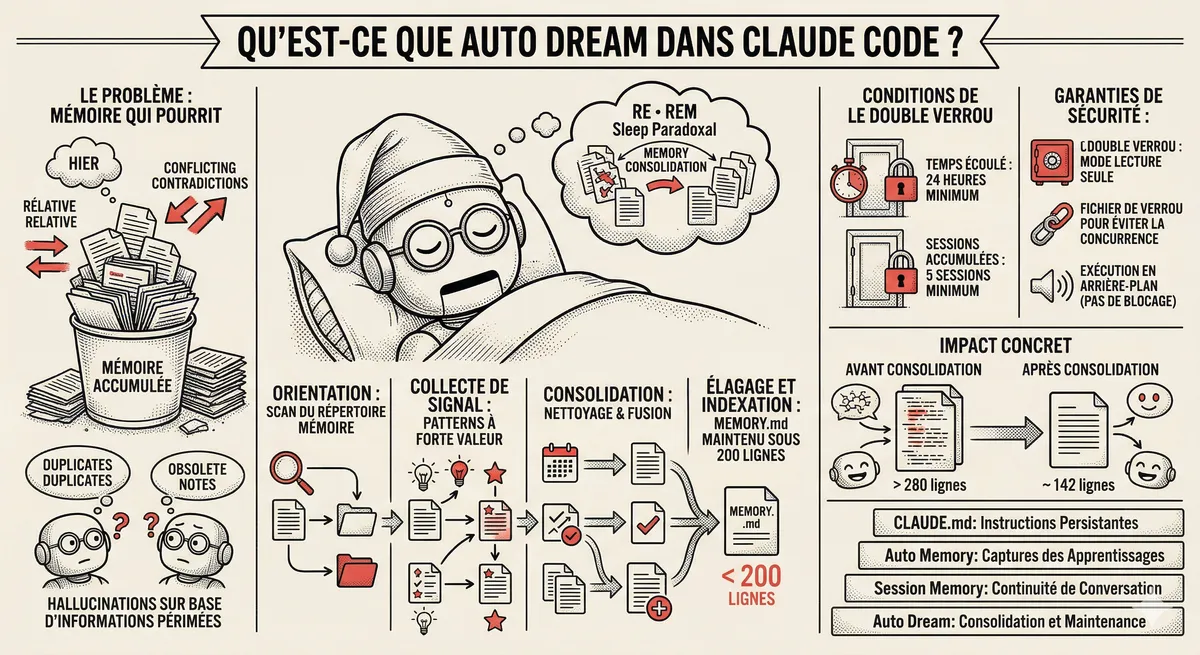
Claude Code Dream & Auto Dream: Automatic Memory Consolidation
After 20 sessions, Auto Memory notes become a mess. Auto Dream solves this by automatically consolidating Claude Code's memory: deduplication, stale entry removal, relative-to-absolute date conversion.
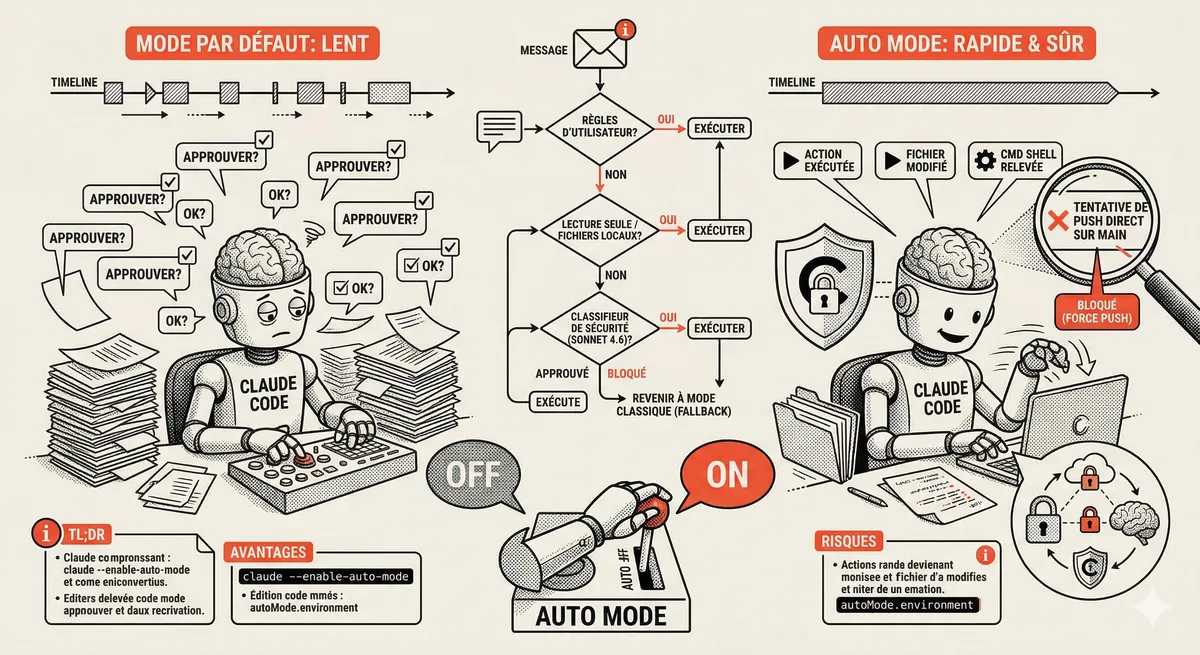
Claude Code Auto Mode: Autonomy Without the Risk
Auto Mode in Claude Code eliminates permission interruptions while keeping a safety net. A classifier analyzes every action before execution and blocks destructive operations. The sweet spot between approving everything and letting everything through.
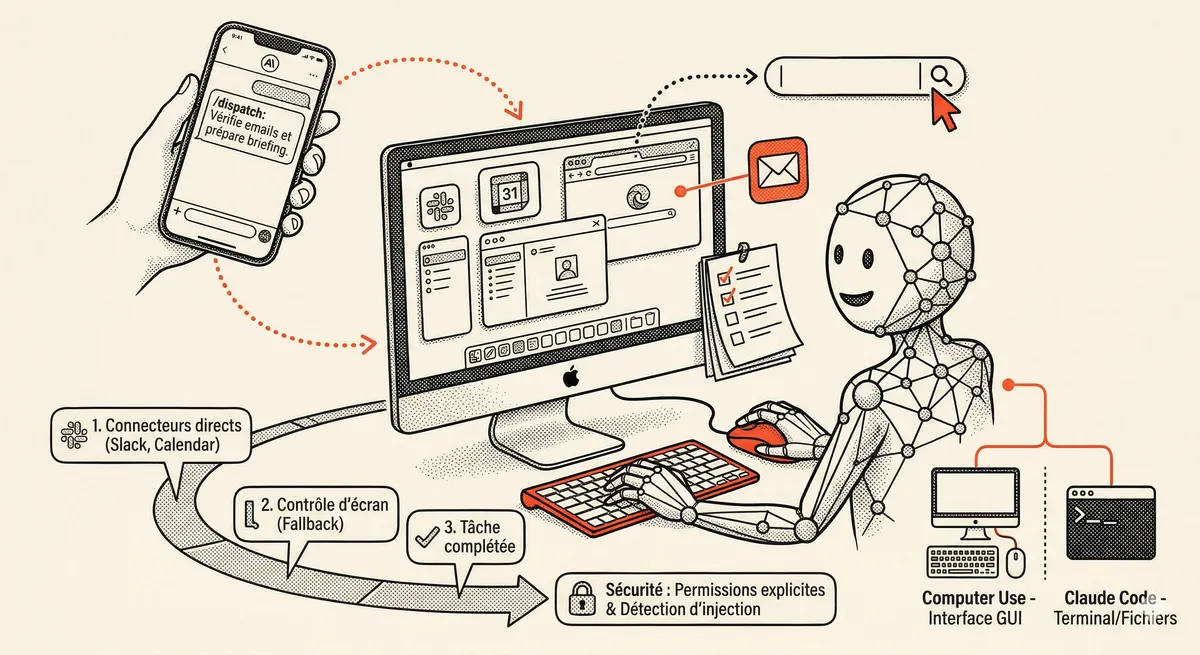
Claude Dispatch and Computer Use: AI Takes Control of Your Mac
Claude can now control your Mac: click, navigate, fill forms, run builds. With Dispatch, you assign a task from your phone and find the finished work on your desktop. Research preview, macOS only.
Claude Code Training
Master Claude Code fundamentals in 1 day with our expert instructors. 60% hands-on practice on real-world cases.
Discover the training