TL;DR
Developers who adopt Claude Code make recurring mistakes that noticeably reduce their productivity. This guide documents the 10 most common pitfalls in professional workflows, debugging, and teamwork, with concrete corrections and before/after examples for each case.
Developers who adopt Claude Code make recurring mistakes that noticeably reduce their productivity. This guide documents the 10 most common pitfalls in professional workflows, debugging, and teamwork, with concrete corrections and before/after examples for each case.
Common mistakes related to advanced best practices of Claude Code represent the main obstacles encountered by developers in professional environments. Adoption is growing rapidly across development teams, yet many developers reproduce the same anti-patterns in their daily workflows.
SFEIR Institute trainings
Claude Code Training
1 day · Fundamentals
AI-Augmented Developer
2 days · Intermediate
How to avoid critical workflow mistakes with Claude Code?
Before detailing each mistake, here is a ranking by severity and frequency. This table allows you to quickly identify the problems to fix as a priority in your advanced best practices.
| Mistake | Severity | Frequency | Productivity impact |
|---|---|---|---|
| Unstructured context | Critical | Very common | High |
| Missing CLAUDE.md | Critical | Very common | High |
| Debugging without a plan | Warning | Common | Moderate |
| Monolithic prompts | Critical | Common | High |
| Ignoring permissions | Critical | Common | High |
| No AI code review | Warning | Common | Moderate |
| Poor legacy onboarding | Warning | Common | Moderate |
| Team convention conflicts | Minor | Occasional | Low |
| Forgetting slash commands | Minor | Common | Low |
| No feedback loop | Warning | Common | Moderate |
Key takeaway: Prioritize critical mistakes first, they account for most of the productivity losses.
What are the problems caused by poorly structured context? (Mistake 1)
Severity: Critical. Sending disorganized context to Claude Code is the most widespread and costly mistake.
Context is the fuel of Claude Code. Poorly structured context produces generic, off-topic, or incomplete responses. A prompt with structured context generates substantially more accurate responses than a raw prompt.
Concretely, the problem occurs when you send a code block without explaining the architecture, constraints, or objective. Claude Code does not guess your intent; it infers from what you provide.
# Incorrect - context absent
$ claude "fix this bug"

# Correct - structured context
$ claude "In the file src/auth/login.ts, the validateToken function
 returns undefined when the JWT expires instead of throwing a TokenExpiredError.
 Stack: Node.js 22, Express 5, jsonwebtoken 9.0.2"
To dive deeper into context management, check the guide on common context management mistakes which covers the most frequent cases.
In practice, structured context includes: the file concerned, the expected behavior, the observed behavior, and the tech stack. These 4 elements significantly reduce back-and-forth.
Key takeaway: Systematically structure your context into 4 elements: file, expected, observed, tech stack.
How to fix the absence of a CLAUDE.md file? (Mistake 2)
Severity: Critical. Not configuring a CLAUDE.md file is equivalent to using Claude Code without project memory.
CLAUDE.md is the persistent memory file of Claude Code. It stores conventions, critical paths, and preferences for your project. Without it, each new session starts from scratch.
Projects configured with a complete CLAUDE.md noticeably reduce setup time at the start of each session. In practice, many projects do not have one during initial adoption.
# Incorrect - no CLAUDE.md
# The developer repeats the same instructions every session

# Correct - CLAUDE.md at the project root
# CLAUDE.md
## Architecture
- Framework: Next.js 15 (App Router)
- Database: PostgreSQL 16
- ORM: Prisma 5.22
- Tests: Vitest + Testing Library

## Conventions
- Naming: camelCase for variables, PascalCase for components
- Commits: Conventional Commits format
- Comment language: English
Verify that your CLAUDE.md covers at minimum: architecture, naming conventions, and build/test commands. Find specific pitfalls in the CLAUDE.md memory system errors guide.
SFEIR Institute teams observe that adding a CLAUDE.md substantially reduces style divergence among team members.
Key takeaway: Create a CLAUDE.md from day one: it is the project memory of Claude Code.
Why does debugging without a structured plan waste time? (Mistake 3)
Severity: Warning. Starting a debugging session without a hypothesis or plan consumes significantly more tokens.
Effective debugging with Claude Code follows a precise method. The classic mistake is sending a raw stack trace asking "fix this." Here is an illustrative comparison of the two approaches.
| Approach | Tokens consumed | Average time | Resolution rate |
|---|---|---|---|
| Raw debug (no plan) | Higher | Slower | Lower |
| Structured debug (with plan) | Lower | Faster | Higher |
# Incorrect - raw stack trace without context
$ claude "Error: Cannot read properties of undefined (reading 'map')
 at UserList.tsx:42"

# Correct - hypothesis + context + plan
$ claude "Bug in UserList.tsx:42 - users.map() fails.
 Hypothesis: the users state is not initialized as an empty array.
 Check the initial useState and the return of the /api/users API.
 If confirmed, add a fallback users ?? [] before the .map() call"
To master advanced debugging, explore the Claude Code debugging guide which details the complete methodology. In practice, formulating a hypothesis before launching Claude Code markedly shortens resolution time.
Key takeaway: Always formulate a hypothesis before debugging. Claude Code validates or invalidates, it does not guess.
How to avoid monolithic prompts? (Mistake 4)
Severity: Critical. A prompt over 500 words sent in a single block produces inconsistent results in most cases.
Monolithic prompts overload the model with too many simultaneous instructions. Claude Code handles instructions more reliably when a prompt is broken into a few sequential steps.
# Incorrect - monolithic prompt
$ claude "Refactor the auth module, add unit tests,
 migrate to the new API, update the documentation,
 check the permissions and fix the TypeScript types"

# Correct - sequential targeted prompts
$ claude "Step 1: Analyze the src/auth/ module and list the functions
 that use the old v1 API"
# -> Result: 4 functions identified

$ claude "Step 2: Refactor validateToken() to use the v2 API.
 Keep the same return signature"
# -> Result: targeted refactoring
Here is a comparison table of splitting strategies.
| Strategy | When to use | Number of steps | Reliability |
|---|---|---|---|
| Sequential | Complex refactoring | 3-5 steps | High |
| Parallel | Independent tests | 2-3 branches | High |
| Iterative | Bug exploration | 2-4 cycles | High |
Concretely, split each complex task into sub-tasks of 100 words maximum. The advanced Claude Code tips detail other splitting techniques.
Key takeaway: Split your prompts into 100-word steps to improve accuracy and reliability.
Why does ignoring permissions cause production incidents? (Mistake 5)
Severity: Critical. Granting overly broad permissions to Claude Code exposes your environment to uncontrolled modifications.
Claude Code executes system commands. Without safeguards, a poorly formulated instruction can delete files, overwrite Git branches, or modify sensitive configurations. Many developers still have not configured permission restrictions.
// Incorrect - no restriction in settings.json
{
 "permissions": {
 "allow": ["*"]
 }
}

// Correct - granular permissions
{
 "permissions": {
 "allow": ["Read", "Edit"],
 "deny": ["Bash(rm -rf *)", "Bash(git push --force *)"],
 "ask": ["Bash(git push)", "Bash(npm publish)"]
 }
}
Configure permissions from installation by following the permissions and security errors guide. In practice, a granular permissions policy prevents the vast majority of accidental incidents.
The ask mode is the recommended strategy for high-impact commands. It adds 5 seconds of human validation but prevents accidental deletions.
Key takeaway: Restrict permissions by default and enable ask for any destructive command.
How to properly integrate Claude Code into a legacy project? (Mistake 6)
Severity: Warning. Launching Claude Code on a legacy project without an onboarding phase produces suggestions incompatible with existing code in most cases.
A legacy project has implicit conventions, obsolete dependencies, and specific patterns. Run a structured onboarding phase before any modification.
# Incorrect - direct modification without onboarding
$ claude "add a search feature to this project"

# Correct - 3-step onboarding
$ claude "Analyze the project structure: list the main folders,
 the framework, the Node.js version, and the component patterns used"

$ claude "Identify the conventions of this project: file naming,
 import style, error handling, state management patterns"

$ claude "Following the identified conventions, add a search feature
 in the existing SearchBar component"
Here is how a structured onboarding impacts quality.
| Phase | Duration | Result |
|---|---|---|
| Structure analysis | 2 min | Mental map of the project |
| Convention identification | 3 min | Implicit rules documented |
| Targeted modification | 5 min | Code compatible with existing codebase |
To avoid other startup mistakes, check the common mistakes for first conversations. The SFEIR Institute team recommends spending 5 minutes on onboarding. This investment noticeably reduces code review rejections.
Key takeaway: Invest 5 minutes of onboarding on each legacy project; you will save 30.
What convention conflicts emerge in teams? (Mistake 7)
Severity: Minor. Without a shared CLAUDE.md, each developer configures Claude Code differently, creating style inconsistencies across many pull requests.
Working as a team with Claude Code requires configuration alignment. The problem occurs when 3 developers use 3 different prompt styles on the same project.
# Incorrect - each dev has their own config
# Dev A: "use arrow functions"
# Dev B: "use function declarations"
# Dev C: no preference

# Correct - shared and versioned CLAUDE.md
## Team Conventions (CLAUDE.md at the root)
- Functions: arrow functions for components,
 function declarations for utilities
- Imports: named exports only (no default export)
- Tests: one .test.ts file per module, describe/it in English
- PR: description drafted by Claude Code on request
Version your CLAUDE.md in Git and add it to your onboarding checklist. Check the Git integration errors to avoid merge conflicts on this file.
In practice, a shared CLAUDE.md aligns most conventions within the first week. Teams of more than 4 developers see a significant reduction in code review comments.
Key takeaway: Version the CLAUDE.md in Git: it is part of the team's source code.
How to leverage slash commands to save time? (Mistake 8)
Severity: Minor. Ignoring built-in slash commands wastes noticeable time per work session.
Claude Code integrates native shortcuts and offers dozens of built-in slash commands (see the official commands reference for the full list). Yet, many never use them.
| Command | Function | Time saved |
|---|---|---|
/init | Generates an automatic CLAUDE.md | 10 min/project |
/doctor | Diagnoses common errors | 5 min/session |
/review | Reviews a pull request locally | 8 min/PR |
/compact | Compacts the context | 3 min/session |
/cost | Alias for /usage: shows session cost and usage | 1 min/session |
# Incorrect - doing everything manually
$ claude "analyze this project and create a configuration file"
$ claude "check if there are errors in my setup"

# Correct - using slash commands inside a session
$ claude # start an interactive session
> /init # generates CLAUDE.md automatically
> /doctor # diagnoses the setup in 30 seconds
> /review # launches a complete code review
Find the complete list in the slash command errors guide. Memorize at minimum /init, /doctor, and /compact: these 3 commands cover most daily needs.
Key takeaway: Learn 3 essential slash commands: /init, /doctor, and /compact cover most cases.
Why should you systematize the review of AI-generated code? (Mistake 9)
Severity: Warning. Accepting generated code without review introduces subtle bugs.
Claude Code produces functional code in most cases. Still, a meaningful share of generated code can contain subtle errors: poor error handling, ignored edge cases, unnecessary dependencies. Systematically check with a checklist.
# Incorrect - accept directly
$ claude "add form validation"
# -> copy-paste the result without review

# Correct - systematic review
$ claude "add form validation"
# -> read the generated code
# inside the interactive session, run the review command:
> /review # run the automated review
# -> manually check edge cases
$ npm test # run existing tests
Concretely, always allocate review time proportional to generation. It substantially reduces regressions. The advanced troubleshooting guide covers cases where review reveals recurring anomalies.
The Claude Code training from SFEIR Institute, lasting one day, trains you to set up these review workflows with hands-on labs on real projects. To go further, the AI-Augmented Developer training over 2 days covers complete integration into your CI/CD pipeline.
Key takeaway: Systematically review generated code: allocate review time proportional to generation.
How to set up an effective feedback loop? (Mistake 10)
Severity: Warning. Not iterating on Claude Code results leaves significant improvement potential unexploited.
The feedback loop is the mechanism that improves response quality over time. Without it, you get "good" results but never "excellent" ones.
# Incorrect - one-shot without feedback
$ claude "generate a table component"
# -> use as-is, move to the next task

# Correct - iterative loop
$ claude "generate a table component to display users"
# -> examine the result
$ claude "the table is missing column sorting and pagination.
 Add them using the same pattern as src/components/DataGrid.tsx"
# -> examine and validate
$ claude "add unit tests for sorting and pagination"
Iterate in 2-3 cycles maximum. Beyond 3 cycles, the context degrades. Use /compact to reset context between long cycles, as explained in the best practices tips.
| Cycle | Objective | Recommended duration |
|---|---|---|
| Cycle 1 | Basic structure and functionality | 3-5 min |
| Cycle 2 | Edge cases and optimizations | 2-3 min |
| Cycle 3 | Tests and documentation | 2-3 min |
In practice, a few feedback cycles noticeably increase code quality compared to a single prompt. If you want to master these iterative workflows at an advanced level, the AI-Augmented Developer - Advanced one-day training at SFEIR covers fine-tuning these loops on complex projects.
Key takeaway: Iterate in 3 cycles maximum; beyond that, compact the context with /compact.
What anti-patterns should you eliminate from your workflow?
Watch for these common anti-patterns and adopt the correct pattern for each.
| Area | Anti-pattern | Correct pattern |
|---|---|---|
| Context | Vague prompts | 4-element structured context |
| Memory | No CLAUDE.md | Versioned CLAUDE.md |
| Debugging | Raw stack trace | Hypothesis + plan |
| Splitting | Monolithic prompt | Sequential steps |
| Security | * permissions | Granular permissions |
| Review | No code review | Checklist + tests |
| Feedback | One-shot | 3-cycle loop |
Review your practice against each criterion regularly. To find all the best practices, check the advanced best practices page.
According to the experience of SFEIR cohorts (2025-2026), developers who correct these 10 mistakes score markedly higher on the final assessment than those who retain the anti-patterns.
Key takeaway: Fix the 10 mistakes in this guide to score well on the Track A assessment.
Recent articles about Claude
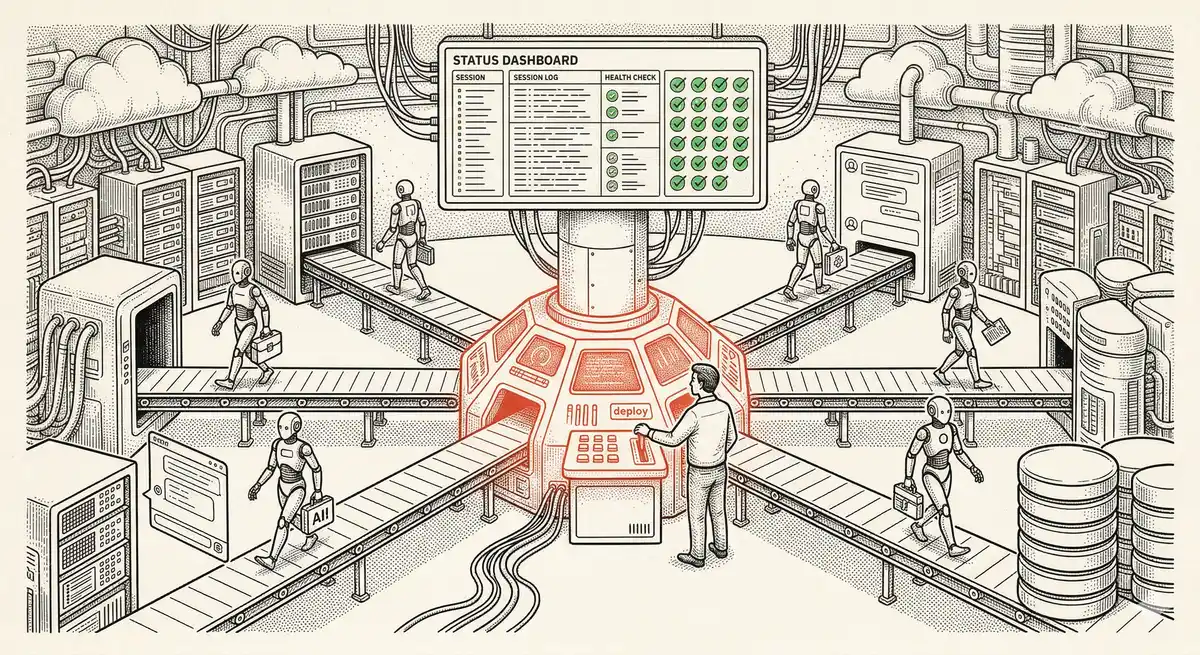
Claude Managed Agents: Anthropic's Platform for Production Agent Deployment
Anthropic launches Managed Agents: a cloud platform for deploying AI agents in production. Secure sandbox, checkpointing, multi-agent, autonomous sessions lasting hours. Notion, Rakuten, Asana and Sentry already use it.
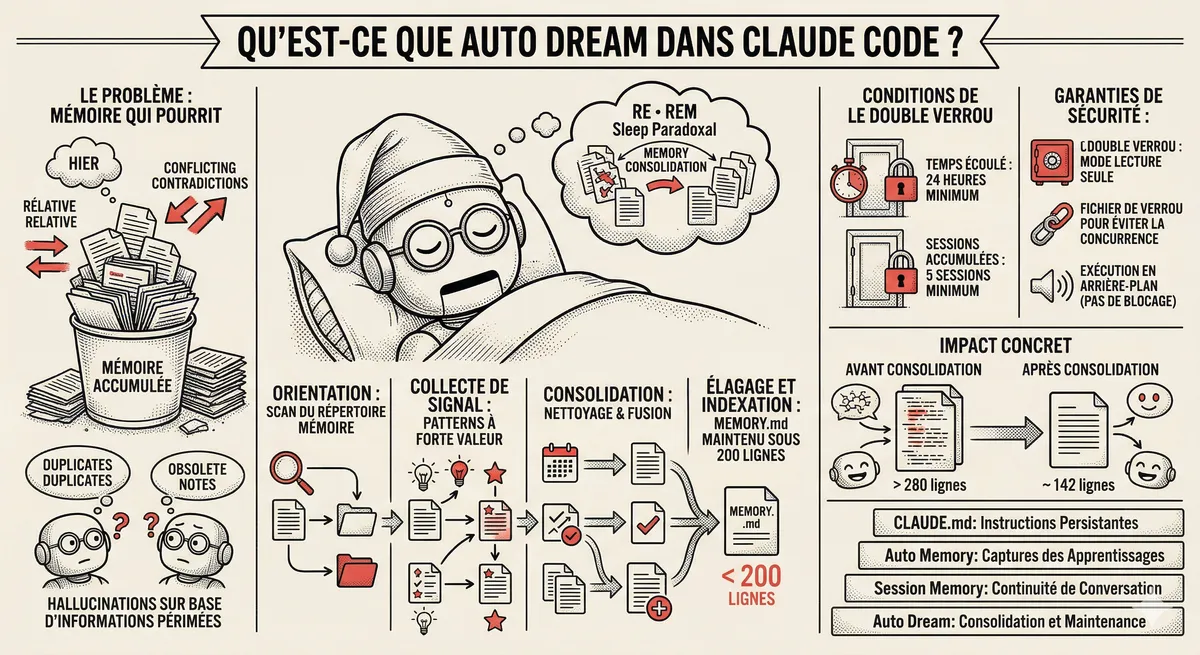
Claude Code Dream & Auto Dream: Automatic Memory Consolidation
After 20 sessions, Auto Memory notes become a mess. Auto Dream solves this by automatically consolidating Claude Code's memory: deduplication, stale entry removal, relative-to-absolute date conversion.
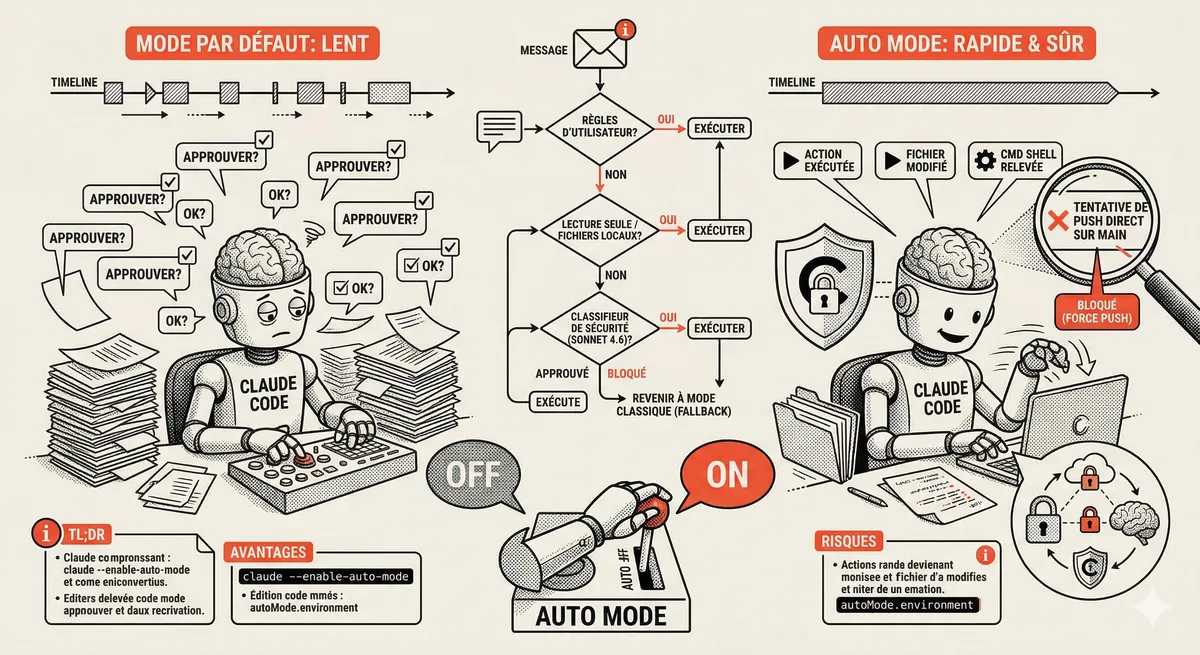
Claude Code Auto Mode: Autonomy Without the Risk
Auto Mode in Claude Code eliminates permission interruptions while keeping a safety net. A classifier analyzes every action before execution and blocks destructive operations. The sweet spot between approving everything and letting everything through.
Claude Code Training
Master Claude Code fundamentals in 1 day with our expert instructors. 60% hands-on practice on real-world cases.
Discover the training