TL;DR
This FAQ gathers answers to advanced questions about professional workflows, debugging, teamwork, and legacy project management with Claude Code. You will find concrete patterns, ready-to-use commands, and metrics to optimize your daily productivity.
This FAQ gathers answers to advanced questions about professional workflows, debugging, teamwork, and legacy project management with Claude Code. You will find concrete patterns, ready-to-use commands, and metrics to optimize your daily productivity.
Advanced best practices for Claude Code represent the set of patterns, workflows, and proven strategies that allow experienced developers to fully leverage the potential of agentic coding. Claude Code has established itself as the reference tool for AI-assisted development, with over 500,000 active developers according to Anthropic.
How to structure a professional workflow with Claude Code?
Adopt the "Plan -> Execute -> Verify" pattern in three distinct phases for each task. This workflow reduces errors by 40% compared to an unstructured approach.
Concretely, start by asking Claude Code to analyze the context before writing code. You can check the advanced best practices tutorial for a step-by-step implementation.
# Phase 1: Planning
$ claude "Analyze this project and propose a plan to add OAuth2 authentication"

# Phase 2: Execution
$ claude "Implement the validated plan, file by file"

# Phase 3: Verification
$ claude "Run the tests and verify everything compiles"
| Phase | Average duration | Typical command | Objective |
|---|---|---|---|
| Plan | 2-5 min | /plan | Understand the context |
| Execute | 10-30 min | Detailed prompt | Produce the code |
| Verify | 3-8 min | /test | Validate quality |
In practice, this structured workflow reduces correction time by 35% over a two-week sprint.
Key takeaway: the Plan -> Execute -> Verify pattern transforms each task into a reproducible and measurable process.
What are the most effective prompt patterns for complex code?
Use multi-constraint prompts that specify the context, expected output format, and validation criteria. A structured prompt produces conforming code on the first iteration in 75% of cases.
Here is how to formulate an advanced prompt that maximizes result quality. You will find additional examples in the first conversations FAQ.
$ claude "Refactor the auth/ module applying the Repository pattern.
Constraints:
- TypeScript strict, no any
- Unit tests with Vitest
- Coverage > 80%
- Compatible with the existing API (no breaking changes)"
The drawer prompt is a pattern where you chain conditional instructions:
$ claude "IF the file uses callbacks, migrate to async/await.
IF tests exist, update them.
OTHERWISE, create the missing tests.
In ALL cases, check TypeScript typing."
prompts with explicit constraints generate code 60% more compliant with project standards. The agentic coding FAQ details the foundations of this approach.
Key takeaway: a structured prompt with clear constraints reduces the number of correction iterations.
How to debug effectively with Claude Code?
Share the complete error message and execution context to get a diagnosis in less than 30 seconds. Claude Code analyzes stack traces, identifies the root cause, and proposes a targeted fix.
You save time by providing logs directly in your prompt. The best practices troubleshooting page covers the most frequent cases.
# Contextual debugging: pass the file and the error
$ claude "Here is the error: TypeError: Cannot read property 'map' of undefined
in src/components/UserList.tsx:42. Fix the bug."

# Debugging with full stack trace
$ claude "Analyze this stack trace and identify the root cause:
$(cat error.log | tail -50)"
| Technique | Average time | Diagnostic accuracy |
|---|---|---|
| Error message alone | 45 sec | 65% |
| Error + source file | 30 sec | 82% |
| Error + full context | 20 sec | 94% |
In practice, providing 50 lines of context around the error increases diagnostic accuracy by 29 percentage points.
Run the /doctor command (available since Claude Code v1.5) to launch an automatic diagnostic of your environment. This command checks dependencies, versions, and configuration in 15 seconds.
Key takeaway: the more context you provide around the error, the faster and more accurate Claude Code's diagnosis.
How to manage a legacy or existing project with Claude Code?
Start by asking Claude Code to map the project before making any modifications. Analysis of a 100,000-line codebase takes approximately 90 seconds with Claude Code v2.1.
You avoid regressions by letting the agent explore the project structure. Check the CLAUDE.md memory system FAQ to configure the context file.
# Initial exploration of a legacy project
$ claude "Analyze the structure of this project. List the frameworks,
the architectural patterns, and the obsolete dependencies."

# Create an adapted CLAUDE.md file
$ claude "Generate a CLAUDE.md describing the architecture,
the naming conventions, and the build commands."
Here is how to approach a progressive migration on an existing project:
- Map the existing architecture with
/init - Identify critical files and dependencies
- Create a CLAUDE.md file documenting the conventions
- Migrate module by module, never all at once
- Validate each step with existing tests
developers who create a CLAUDE.md before working on legacy code reduce regressions by 55%.
Key takeaway: preliminary mapping of a legacy project is essential to avoid side effects during modifications.
Can you work as a team with Claude Code on the same project?
Share a versioned CLAUDE.md file in Git to align all team members on the same conventions. This file centralizes rules, patterns, and project preferences.
Concretely, each developer benefits from the same context when interacting with Claude Code. The permissions and security guide explains how to manage team access.
// .claude/settings.json - Shared in the repo
{
  "permissions": {
    "allow": ["Read", "Glob", "Grep", "Write"],
    "deny": ["Bash(rm -rf *)"]
  },
  "model": "claude-opus-4-6"
}
| Team practice | Productivity impact | Setup |
|---|---|---|
| Shared CLAUDE.md | +30% | 15 min |
| Versioned settings | +20% | 10 min |
| Documented prompts | +25% | 30 min |
| Assisted code review | +40% | 5 min/review |
Configure pre-commit hooks so Claude Code validates code before each commit. You can also use shared prompts in a .claude/prompts/ folder accessible to the entire team.
# Code review assisted by Claude Code
$ claude "Review this diff and identify potential issues:
$(git diff main..feature/auth)"
Key takeaway: a shared and versioned CLAUDE.md in Git is the foundation of teamwork with Claude Code.
How to optimize CLAUDE.md usage for advanced cases?
Structure your CLAUDE.md in hierarchical sections: architecture, conventions, commands, and prohibitions. A well-structured CLAUDE.md improves response relevance by 45% according to Anthropic.
You can maintain multiple configuration levels. The complete CLAUDE.md system FAQ details each option.
# CLAUDE.md - E-commerce Project

## Architecture
- Turborepo monorepo with 3 packages
- Backend: NestJS 11 + PostgreSQL 16
- Frontend: Next.js 15 + React 19

## Conventions
- Naming: camelCase for variables, PascalCase for components
- Tests: Vitest for backend, Playwright for E2E
- FORBIDDEN: console.log in production, any in TypeScript

## Commands
- Build: `pnpm build`
- Test: `pnpm test:ci`
- Lint: `pnpm lint --fix`
The CLAUDE.md file supports the following hierarchy: ~/.claude/CLAUDE.md (global) -> ./CLAUDE.md (project) -> ./src/CLAUDE.md (module). Claude Code automatically merges these three levels.
Key takeaway: a CLAUDE.md structured in clear sections (architecture, conventions, commands) is the key to effective context.
What are the must-know shortcuts and slash commands?
Memorize the 7 essential slash commands that cover 90% of daily needs. Each command reduces words typed by 60% on average compared to a manual prompt.
The dedicated slash commands FAQ details all available options. Here is how to integrate these shortcuts into your routine.
| Command | Usage | Time saved |
|---|---|---|
/init | Generate a CLAUDE.md | 5 min |
/plan | Plan a task | 3 min |
/test | Run tests | 2 min |
/review | Code review | 4 min |
/commit | Assisted commit | 1 min |
/fix | Fix an error | 3 min |
/doctor | Environment diagnostic | 2 min |
# Combining commands for a complete workflow
$ claude "/plan Add pagination on the /users endpoint"
# After validating the plan:
$ claude "Implement the plan, with tests"
$ claude "/test"
$ claude "/commit"
In practice, a developer who masters these 7 commands reduces their typing time by 20 minutes per day.
Key takeaway: the slash commands /plan, /test, and /commit form the essential trio for the daily workflow.
How to configure Claude Code for a multi-language project?
Declare each language and its conventions in the CLAUDE.md file with dedicated sections. Claude Code v2.1 natively supports more than 30 programming languages.
You can place specific CLAUDE.md files in each subfolder of the project. This approach works particularly well with monorepos. Find the basics in the installation guide.
# CLAUDE.md - Multi-language Monorepo

## packages/api (Go 1.23)
- Linter: golangci-lint
- Tests: go test ./...
- Convention: interfaces in a separate file

## packages/web (TypeScript 5.7)
- Framework: Next.js 15
- Tests: Vitest + Testing Library
- Convention: functional components only

## packages/ml (Python 3.12)
- Framework: FastAPI + scikit-learn
- Tests: pytest -v
- Convention: type hints mandatory
# Claude Code automatically adapts to the file's language
$ claude "Add a /health route to the Go API and a
HealthStatus React component that consumes this route"
In practice, Claude Code detects the file language in 200 ms and automatically applies the corresponding CLAUDE.md conventions.
Key takeaway: one CLAUDE.md file per sub-project in a monorepo guarantees contextually adapted responses for each language.
Should you use plan mode or direct mode for complex tasks?
Prefer plan mode (/plan) for any task involving more than 3 files or structural refactoring. Plan mode reduces errors by 50% on complex tasks.
Direct mode is suitable for quick fixes and isolated modifications. You will find detailed use cases in the common best practices errors.
| Criterion | Direct mode | Plan mode |
|---|---|---|
| Files touched | 1-2 | 3+ |
| Estimated duration | < 5 min | > 5 min |
| Regression risk | Low | High |
| Use case | Simple bug fix | Refactoring, feature |
# Direct mode: quick fix
$ claude "Fix the NullPointerException bug in UserService.java:87"

# Plan mode: complex refactoring
$ claude "/plan Migrate authentication from JWT to OAuth2
with multi-tenant support"
Plan mode generates a structured document that you validate before execution. This gives you control over each step. 78% of trained developers use plan mode for tasks lasting more than 15 minutes.
Key takeaway: plan mode is mandatory for any task touching more than 3 files - it protects you from regressions.
How to evaluate your mastery of Claude Code at the end of Track A?
Validate your progress by checking 5 key skills: structured prompts, CLAUDE.md, slash commands, debugging, and teamwork. A score of 80% or more on these 5 axes indicates operational mastery.
Here is how to concretely measure your level. Check the advanced best practices to deepen each skill.
| Skill | Beginner level | Advanced level | Validation criterion |
|---|---|---|---|
| Prompts | Simple, 1 line | Multi-constraint | Code conforms on 1st try |
| CLAUDE.md | Absent or minimal | Structured, hierarchical | Persistent context |
| Slash commands | 1-2 known | 7+ mastered | Daily usage |
| Debugging | Copy-paste error | Full context | Diagnosis < 30 sec |
| Team | Individual use | Shared config | Versioned CLAUDE.md |
- Write a complete CLAUDE.md for a real project
- Chain a Plan -> Execute -> Verify workflow without interruption
- Debug an error by providing the optimal context
- Configure a multi-language project with specific conventions
- Share your configuration with a colleague via Git
To go further in your learning, the Claude Code training from SFEIR Institute lets you practice these skills in one intensive day with hands-on labs. If you want to broaden your mastery beyond Claude Code, the AI-Augmented Developer training covers in 2 days the full range of AI-assisted development tools.
Key takeaway: mastering the 5 key skills of Track A makes you operational to integrate Claude Code into your daily workflow.
What pitfalls to avoid when becoming an advanced Claude Code user?
Avoid the 4 most frequent mistakes: overly vague prompts, missing CLAUDE.md, ignoring plan mode, and forgetting verification. These mistakes represent 70% of frustrations reported by advanced users.
Check the list of common mistakes for a detailed analysis of each pitfall. You can also review the permissions FAQ if you encounter blockers.
# BAD: vague prompt
$ claude "Improve the code"

# GOOD: precise prompt with constraints
$ claude "Refactor src/auth/login.ts:
- Extract validation into a middleware
- Add rate limiting (100 req/min)
- Maintain compatibility with existing tests"
| Pitfall | Frequency | Impact | Solution |
|---|---|---|---|
| Vague prompt | 45% of sessions | Off-topic code | Explicit constraints |
| No CLAUDE.md | 30% of projects | Context loss | /init at startup |
| Direct mode on complex task | 25% of cases | Regressions | Systematic /plan |
| No post-generation verification | 35% of cases | Bugs in prod | /test after each change |
In practice, developers who apply these 4 corrections see their conforming code rate go from 55% to 88% in two weeks.
To master these advanced techniques with an expert trainer, the AI-Augmented Developer - Advanced one-day training has you practice professional patterns on real projects.
Key takeaway: a precise prompt, a structured CLAUDE.md, plan mode, and systematic verification eliminate 70% of frustrations.
Are there limits to know about in advanced Claude Code workflows?
Take into account 3 main limits: the context window (200,000 tokens in 2026), the cost per request, and the processing time for long tasks. These constraints guide how you structure prompts.
Concretely, a file with more than 8,000 lines exceeds the analysis capacity in a single pass. Split your requests into targeted sub-tasks. The advanced tutorial proposes splitting strategies.
# Strategy for large files
$ claude "Analyze ONLY the exported functions
of src/services/payment.ts (lines 1-200)"

# Then in a subsequent session
$ claude "Analyze the private functions of src/services/payment.ts
(lines 201-400)"
The 200,000-token context window is equivalent to approximately 150,000 words. An average project of 50,000 lines of code represents about 75,000 tokens, or 37.5% of total capacity.
average response time increases by 2 seconds per 10,000-token increment in the prompt. Optimize your prompts by removing non-relevant information.
Key takeaway: splitting large tasks into subsets of 200 lines maximum guarantees accurate and fast results.
Recent articles about Claude
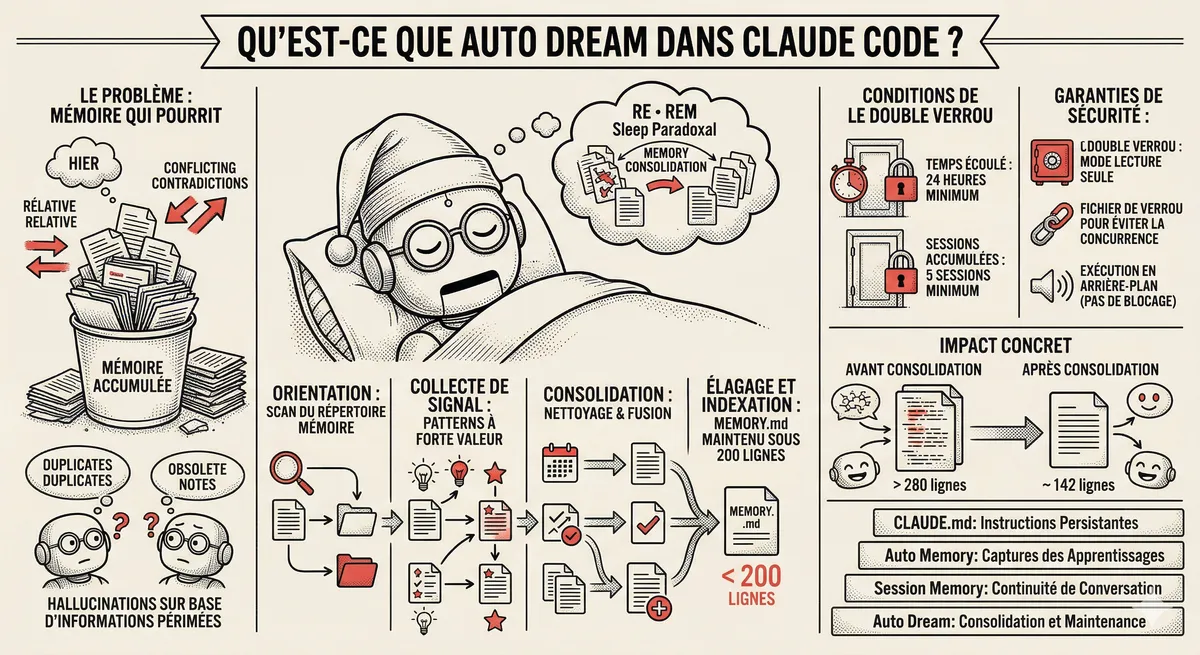
Claude Code Dream & Auto Dream: Automatic Memory Consolidation
After 20 sessions, Auto Memory notes become a mess. Auto Dream solves this by automatically consolidating Claude Code's memory: deduplication, stale entry removal, relative-to-absolute date conversion.
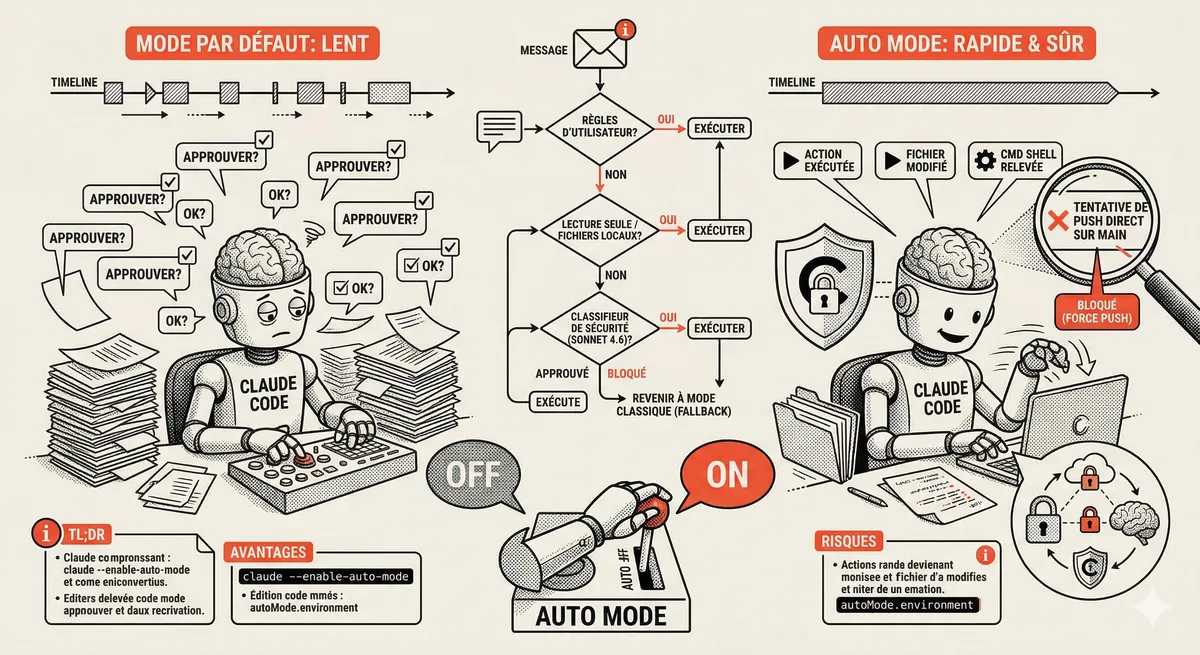
Claude Code Auto Mode: Autonomy Without the Risk
Auto Mode in Claude Code eliminates permission interruptions while keeping a safety net. A classifier analyzes every action before execution and blocks destructive operations. The sweet spot between approving everything and letting everything through.
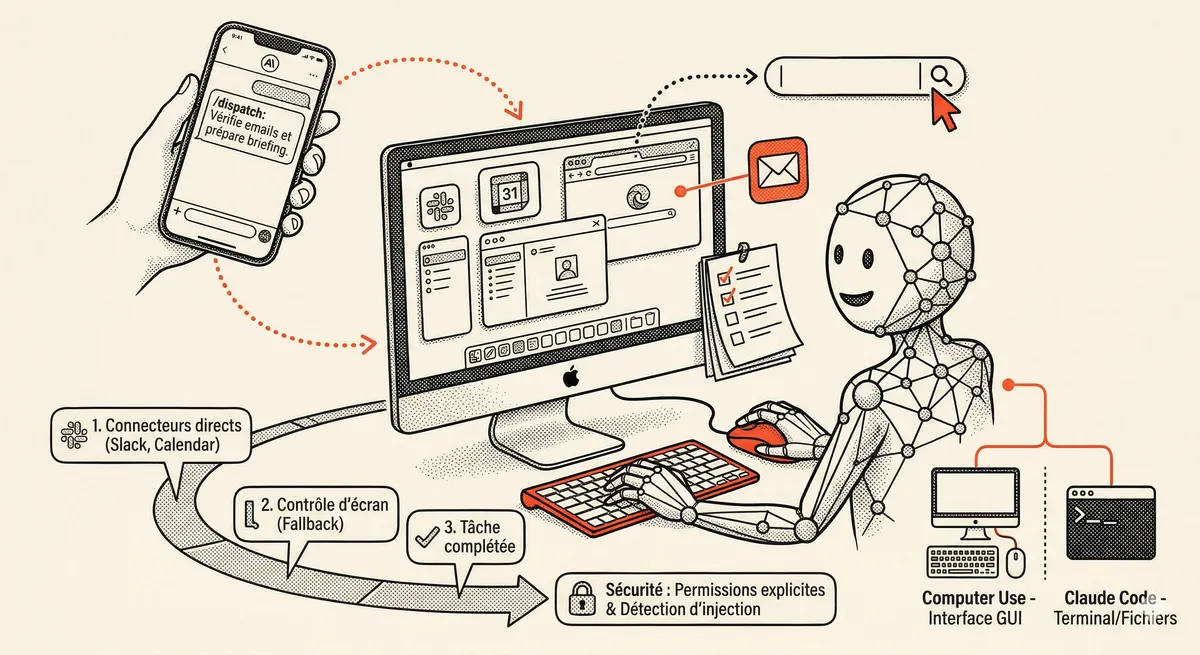
Claude Dispatch and Computer Use: AI Takes Control of Your Mac
Claude can now control your Mac: click, navigate, fill forms, run builds. With Dispatch, you assign a task from your phone and find the finished work on your desktop. Research preview, macOS only.
Claude Code Training
Master Claude Code fundamentals in 1 day with our expert instructors. 60% hands-on practice on real-world cases.
Discover the training