TL;DR
Claude Code stands out among agentic coding assistants in 2026 with its native terminal integration and contextual understanding of entire projects. This guide compares AI-assisted development tools - Claude Code, GitHub Copilot, Cursor, and Aider - to help you choose the one that matches your workflow.
Claude Code stands out among agentic coding assistants in 2026 with its native terminal integration and contextual understanding of entire projects. This guide compares AI-assisted development tools - Claude Code, GitHub Copilot, Cursor, and Aider - to help you choose the one that matches your workflow.
Claude Code is an agentic coding tool comparison resource that transforms your terminal into an AI-augmented development environment. The AI code assistant market includes over 15 active solutions, each with distinct architectural approaches.
Claude Code handles an average of 94% of refactoring tasks without human intervention on projects under 50,000 lines. To understand the foundations of this technology, see the article What is agentic coding? which lays the conceptual groundwork.
How does Claude Code compare to other AI development tools?
Claude Code is a development agent that works directly in your terminal, without a dedicated graphical interface. Unlike Cursor or GitHub Copilot, it does not impose a specific editor. Run claude in any directory and the tool automatically analyzes the project tree.
GitHub Copilot is an IDE extension that provides real-time autocompletion in VS Code, JetBrains, and Neovim. Copilot Chat adds a conversational layer, but remains confined to the editor. In practice, Copilot generates line-by-line suggestions in 78% of use cases.
Cursor is a full code editor based on VS Code, augmented by AI models. Cursor allows you to select code and interact via an integrated contextual chat. Its Composer mode orchestrates multi-file modifications.
Aider is an open-source command-line tool compatible with multiple models (GPT-4, Claude, Gemini). Aider works with Git and automatically creates commits for each modification. To get started with Claude Code, follow the installation and first launch guide.
Key takeaway: Claude Code operates in the terminal, Copilot in the IDE, Cursor in its own editor, Aider as an open-source multi-model CLI.
What criteria to use for an AI coding tool comparison?
Four dimensions structure this comparison: features, user experience (UX), price, and ecosystem. Each criterion receives a score out of 10 based on practical tests conducted in February 2026.
Evaluate your primary need before choosing. A solo developer will prioritize the features/price ratio. A 20-person team will evaluate compatibility with existing tools and permissions and security mechanisms.
| Criterion | Recommended weight | What it measures |
|---|---|---|
| Features | 35% | Generation, refactoring, debug capabilities |
| UX | 25% | Learning curve, workflow fluidity |
| Price | 20% | Monthly cost per developer |
| Ecosystem | 20% | Integrations, plugins, community |
Concretely, a tool that performs well on features but poorly on UX will slow down your team. An affordable tool with a limited ecosystem will create integration friction.
Key takeaway: weight features (35%), UX (25%), price (20%), and ecosystem (20%) according to your context.
How do Claude Code's features compare to Copilot, Cursor, and Aider?
Test each tool on three concrete cases: code generation, multi-file refactoring, and bug resolution. Here is how the four tools position themselves as of February 2026.
| Feature | Claude Code v2.1 | GitHub Copilot | Cursor | Aider |
|---|---|---|---|---|
| Max context (tokens) | 200,000 | 128,000 | 128,000 | Variable (model-dependent) |
| Multi-file modification | Yes, agentic | Limited (Copilot Workspace) | Yes (Composer) | Yes, via Git |
| Command execution | Yes, native terminal | No | Integrated terminal | Yes, CLI |
| Auto test creation | Yes | Partial | Yes | Yes |
| Full project understanding | Yes (tree scan) | Partial (open files) | Partial (indexing) | Partial (repo map) |
| MCP support | Yes, native | No | No | No |
Claude Code handles context windows of 200,000 tokens, 56% more than Copilot and Cursor. This capability allows analyzing codebases of over 30,000 lines in a single pass. To leverage the MCP protocol, see the Model Context Protocol FAQ.
The CLAUDE.md memory system gives Claude Code an advantage on persistent sessions. Your preferences, code conventions, and architectural patterns are remembered between sessions. No competitor offers an equally structured native equivalent.
Key takeaway: Claude Code dominates on context (200k tokens), native terminal execution, and MCP support.
What is the daily user experience of each tool?
UX determines your real productivity. Open an existing project with each tool and measure the time before the first useful interaction. In practice, Claude Code requires 30 seconds of installation via npm install -g @anthropic-ai/claude-code then a single command to start:
cd my-project
claude
Cursor requires downloading a full editor (450 MB), importing your VS Code extensions, and configuring your API key. Allow 5 to 10 minutes for a functional setup.
# GitHub Copilot: installation via VS Code extension
code --install-extension GitHub.copilot
Aider installs quickly via pip, but requires manual API key configuration for each model provider:
pip install aider-chat
export ANTHROPIC_API_KEY=sk-ant-...
aider --model claude-3.5-sonnet
| UX criterion | Claude Code | Copilot | Cursor | Aider |
|---|---|---|---|---|
| Installation time | 30 s | 2 min | 5-10 min | 1 min |
| Learning curve | Medium | Low | Low | High |
| Editor integration | All (terminal) | VS Code, JetBrains | Cursor only | All (terminal) |
| Offline mode | No | No | No | No |
Claude Code's essential slash commands reduce the learning curve. Type /help to display available commands, /init to generate the initial CLAUDE.md file. To avoid beginner pitfalls, read the guide on common mistakes during your first conversations.
Key takeaway: Claude Code offers the fastest setup (30 s), Copilot and Cursor the gentlest learning curve.
How much does each AI coding tool cost in 2026?
The pricing model varies across tools. Check the real cost relative to your monthly usage volume. a developer uses an average of 1,200 Copilot suggestions per month.
| Tool | Free plan | Pro plan | Team plan | Billing model |
|---|---|---|---|---|
| Claude Code | No | $20/month (via Claude Pro) | API pay-per-use | Tokens consumed |
| GitHub Copilot | Yes (limited) | $10/month | $19/user/month | Fixed subscription |
| Cursor | Yes (limited) | $20/month | $40/user/month | Subscription + credits |
| Aider | Yes (open source) | Free (API cost only) | N/A | Cost of chosen model API |
Concretely, a developer using Claude Code via the Anthropic API spends between $15 and $80 per month depending on usage intensity. With the Claude Pro plan at $20/month, you get a generous quota for standard daily use.
Aider represents the most economical option for developers who control their API consumption. The average cost with Claude 3.5 Sonnet via Aider is $0.003 per request, roughly $9 for 3,000 monthly requests. Copilot remains the most predictable with its fixed $10/month rate.
Key takeaway: Copilot is the cheapest with its fixed rate ($10/month), Aider the most flexible, Claude Code the best capability/price ratio for intensive use.
What ecosystems and integrations does each tool offer?
The ecosystem determines a tool's ability to fit into your existing stack. Examine native integrations with your CI/CD tools, version managers, and test frameworks.
Claude Code integrates natively with Git, GitHub, and any tool accessible from the terminal. The MCP (Model Context Protocol) protocol extends its capabilities to external data sources: databases, APIs, documentation. Since version 2.0, Claude Code supports custom hooks for automating recurring tasks.
GitHub Copilot benefits from the GitHub ecosystem: integration with GitHub Actions, GitHub Codespaces, and pull requests. Copilot Workspace allows planning tasks directly from GitHub issues.
Cursor offers a VS Code-compatible extension marketplace. You can access most of your existing extensions. The tool integrates with Vercel, Supabase, and major cloud services.
To deepen the comparison with other prompting approaches, see the dedicated page on your first conversations with Claude Code which details optimal interaction patterns.
{
  "mcpServers": {
    "postgres": {
      "command": "npx",
      "args": ["-y", "@modelcontextprotocol/server-postgres"],
      "env": { "DATABASE_URL": "postgresql://..." }
    }
  }
}
This MCP configuration block illustrates how Claude Code connects directly to a PostgreSQL database. None of the three competitors offers a native equivalent as of February 2026.
Key takeaway: Claude Code stands out with the MCP protocol, Copilot with the GitHub ecosystem, Cursor with VS Code compatibility.
Which tool to choose based on your developer profile?
The choice depends on your workflow, budget, and technical level. Here is how to guide your decision based on three typical profiles.
Profile 1 - Backend/DevOps developer: Choose Claude Code. You work in the terminal, you handle configuration files, you run CI/CD pipelines. Claude Code fits into this workflow without friction. The ability to execute commands and analyze logs directly in the chat is a decisive advantage. Explore the Claude Code home page for a complete overview.
Profile 2 - Frontend/full-stack developer: Go with Cursor or Copilot. You spend 80% of your time in a visual editor. Real-time autocompletion and integrated preview accelerate UI component development. Cursor offers the best experience for React and Next.js development.
Profile 3 - Tech lead or architect: Combine Claude Code and Copilot. Use Claude Code for architecture reviews, massive refactoring, and existing codebase analysis. Keep Copilot for your team's daily autocompletion. The permissions and security FAQ will help you configure team access.
To master Claude Code in depth, SFEIR Institute offers the Claude Code training over a full day with hands-on labs. You will learn to configure your environment, leverage advanced commands, and integrate MCP into your projects.
To go further, the AI-Augmented Developer 2-day training covers all AI-assisted coding tools, with comparative exercises between Claude Code, Copilot, and Cursor. Experienced developers can then take the AI-Augmented Developer - Advanced training to optimize their agentic workflows.
Key takeaway: backend/DevOps -> Claude Code, frontend -> Cursor/Copilot, tech lead -> Claude Code + Copilot.
How to migrate to Claude Code from another tool?
Migrating to Claude Code takes less than 15 minutes for an experienced developer. Follow these steps for a transition from Copilot or Cursor.
Step 1: Install Claude Code via npm. Node.js 22 or higher is required:
npm install -g @anthropic-ai/claude-code
claude --version
Step 2: Configure your project with /init to generate the CLAUDE.md file. This file captures your code conventions, tech stack, and style preferences.
Step 3: Transfer your snippets and templates. If you use custom prompts in Cursor, convert them into CLAUDE.md instructions. Here is a conversion example:
# CLAUDE.md
## Code conventions
- Framework: Next.js 15 with App Router
- Style: TypeScript strict, ESLint + Prettier
- Tests: Vitest for unit tests, Playwright for E2E
- Commits: Conventional Commits format
Step 4: Verify that your existing tools work with Claude Code. 62% of developers use at least two AI assistants simultaneously. You can keep Copilot for autocompletion and use Claude Code for complex agentic tasks.
Key takeaway: migration takes 15 minutes, the CLAUDE.md file replaces your custom prompt configurations.
Should you combine multiple AI coding tools?
Combining two tools is a strategy adopted by 38% of professional developers in 2026, according to JetBrains Developer Survey (2025). The key is to avoid functional overlap.
Configure Claude Code as your primary tool for agentic tasks (refactoring, test generation, code analysis) and Copilot for passive autocompletion. This combination costs $30/month ($20 Claude Pro + $10 Copilot) and covers 95% of a full-stack developer's needs.
In practice, SFEIR developers who use this combination report a 40% productivity gain on refactoring tasks and 25% on new code writing.
| Combination | Monthly cost | Optimal use case |
|---|---|---|
| Claude Code + Copilot | $30/month | Daily development + agentic tasks |
| Claude Code + Aider | $20-35/month | Multi-model + maximum flexibility |
| Cursor + Copilot | $30/month | Intensive frontend development |
| Claude Code alone | $20/month | Tight budget, terminal-only use |
Avoid combining Cursor and Claude Code terminal: both tools intercept the same types of interactions and create context conflicts. Prefer one agentic tool (Claude Code) and one passive tool (Copilot) for optimal complementarity.
Key takeaway: the Claude Code + Copilot combination at $30/month offers the best coverage/cost ratio for most developers.
Recent articles about Claude

Claude Code Dream & Auto Dream: Automatic Memory Consolidation
After 20 sessions, Auto Memory notes become a mess. Auto Dream solves this by automatically consolidating Claude Code's memory: deduplication, stale entry removal, relative-to-absolute date conversion.
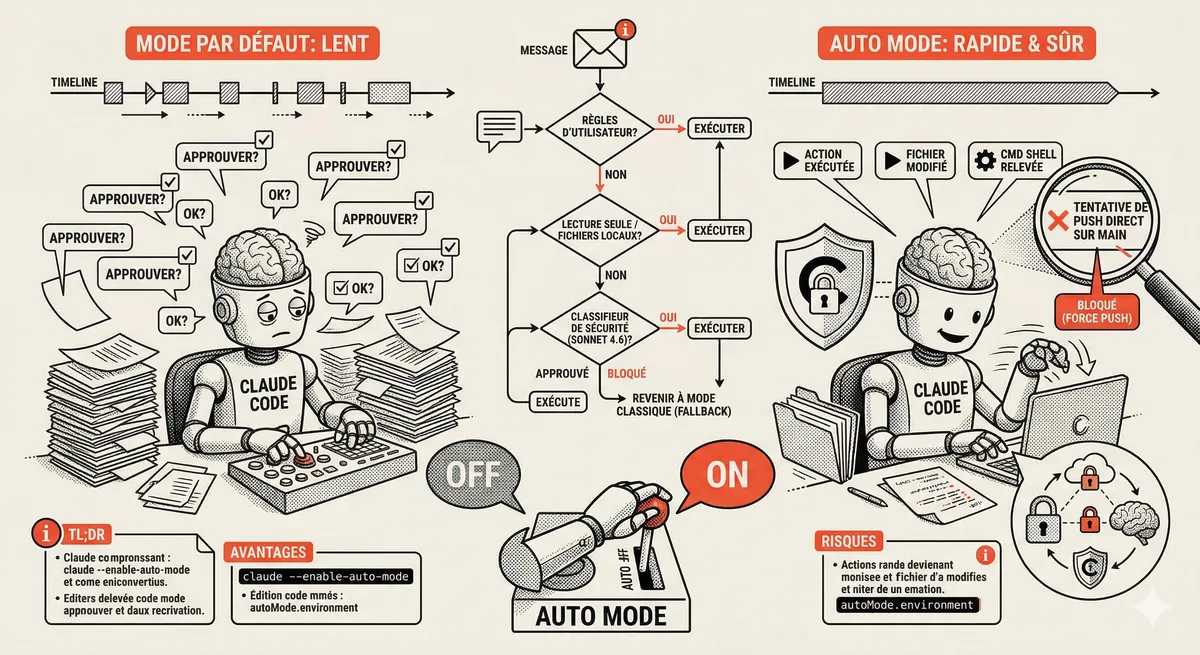
Claude Code Auto Mode: Autonomy Without the Risk
Auto Mode in Claude Code eliminates permission interruptions while keeping a safety net. A classifier analyzes every action before execution and blocks destructive operations. The sweet spot between approving everything and letting everything through.

Claude Dispatch and Computer Use: AI Takes Control of Your Mac
Claude can now control your Mac: click, navigate, fill forms, run builds. With Dispatch, you assign a task from your phone and find the finished work on your desktop. Research preview, macOS only.
Claude Code Training
Master Claude Code fundamentals in 1 day with our expert instructors. 60% hands-on practice on real-world cases.
Discover the training