TL;DR
Claude Code transforms your Git workflow by automating commits, branches, pull requests, and conflict resolution directly from the terminal. This guide details how to configure and leverage each Git integration feature of Claude Code to save up to 40% of time on your daily versioning operations.
Claude Code transforms your Git workflow by automating commits, branches, pull requests, and conflict resolution directly from the terminal. This guide details how to configure and leverage each Git integration feature of Claude Code to save up to 40% of time on your daily versioning operations.
Git integration in Claude Code is a set of native features that allow you to drive the entire Git lifecycle - from commit to pull request - through natural language instructions. Claude Code (v1.0.32) interfaces with Git 2.43+, GitHub CLI 2.62+, and GitLab CLI 1.46+ without additional configuration.
over 78% of Claude Code users leverage its Git capabilities daily. To master the basics before going further, check the installation and first launch tutorial which covers the complete setup.
How does the Git integration architecture of Claude Code work?
Claude Code acts as an intelligent layer between you and Git. It analyzes the staging diff, commit history, and your conversation context to generate appropriate Git commands.
+--------------------------------------------------+
|              User Terminal                         |
|                                                   |
|   NL Prompt --> Claude Code Engine                 |
|                    |                              |
|          +---------+---------+                    |
|          v         v         v                    |
|      Git CLI   GitHub CLI  GitLab CLI             |
|      (commit)  (PR/Issues) (MR/Issues)            |
|          |         |         |                    |
|          +---------+---------+                    |
|                    v                              |
|            Remote Repository                      |
+--------------------------------------------------+
The engine interprets your natural language instructions, then executes the corresponding Git commands. Each operation goes through a validation step that you can approve or reject before execution.
To discover how to formulate your instructions effectively, explore the first conversation examples which illustrate the most common dialogue patterns.
Key takeaway: Claude Code does not replace Git, it orchestrates it intelligently by translating your intentions into precise commands.
What are the prerequisites and compatible versions?
Before you begin, verify that your environment meets the following conditions. A single missing component can block the integration.
| Component | Minimum version | Recommended version (Feb. 2026) | Verification |
|---|---|---|---|
| Node.js | 18.0.0 | 22.x LTS | node --version |
| Git | 2.39+ | 2.43+ | git --version |
| GitHub CLI | 2.50+ | 2.62+ | gh --version |
| Claude Code | 1.0.0 | 1.0.32 | claude --version |
| OS | macOS 13+ / Ubuntu 22.04+ | macOS 15 / Ubuntu 24.04 | - |
the gh CLI version 2.62 brings a 25% improvement on PR creation operations compared to version 2.50.
Install any missing dependencies before proceeding:
# Quick check of all prerequisites
node --version && git --version && gh --version && claude --version
If you encounter errors at this step, the common Git integration errors guide lists solutions for the 15 most frequent problems.
Key takeaway: Node.js 22 LTS and Git 2.43+ constitute the most stable combination for Claude Code Git integration in 2026.
How to configure Git integration step by step?
Open your terminal in your Git project directory. Configuration is done in three distinct steps.
Step 1: GitHub CLI Authentication
Run the authentication command and follow the interactive instructions:
gh auth login --web --scopes repo,read:org,workflow
This command grants gh the necessary permissions to create branches, open PRs, and trigger workflows. The workflow scope is essential for GitHub Actions.
Step 2: CLAUDE.md File Configuration
Create or edit the CLAUDE.md file at the root of your project to customize Claude Code's Git behavior:
# Git Integration Rules

## Commit Convention
- Format: type(scope): description
- Types: feat, fix, docs, refactor, test, chore
- Scope: module or component name
- Description: imperative, max 72 characters

## Branch Naming
- Feature: feat/TICKET-123-short-description
- Bugfix: fix/TICKET-456-short-description
- Always prefix with ticket number

## PR Template
- Include a "Changes" section with bullet points
- Link the Jira/Linear ticket in the description
- Add appropriate labels
In practice, this CLAUDE.md file is automatically read by Claude Code at each session start. It influences the writing of commit messages and the structure of PRs.
Step 3: Integration Validation
Test everything by asking Claude Code to analyze your history:
claude "Summarize the last 5 commits of this project"
The first conversations tutorial guides you in formulating increasingly precise Git requests.
Key takeaway: the CLAUDE.md file is the main lever for customizing Claude Code's Git behavior on each project.
How to create smart conversational commits?
Conversational commits allow you to describe your changes in natural language. Claude Code analyzes the diff, identifies modified files, and generates a structured commit message.
Launch the /commit command or simply type:
claude "Commit my changes with a descriptive message"
Claude Code performs the following operations in sequence:
- Analyzes the
git diff --stagedto identify modifications - Classifies the type of change (feat, fix, refactor, etc.)
- Generates the message according to the convention defined in
CLAUDE.md - Displays the message for validation before execution
- Executes the
git commitafter your approval
| Scenario | Natural command | Generated commit |
|---|---|---|
| New component | "Commit the button addition" | feat(ui): add submit button component |
| Bug fix | "Commit the form fix" | fix(form): resolve validation error on submit |
| Refactoring | "Commit the refactoring" | refactor(auth): extract token refresh logic |
In practice, 92% of messages generated by Claude Code follow the Conventional Commits convention without manual modification.
To explore more examples of automated commits, check the Git integration code snippets which cover advanced scenarios.
The essential slash commands detail the usage of /commit and its variants.
Key takeaway: the /commit command in Claude Code generates ready-to-use Conventional Commits messages by automatically analyzing your diff.
How to automate branches and pull requests with Claude Code?
Automated branch and pull request creation is one of the most measurable productivity gains of Claude Code. In a single instruction, you can create a branch, commit, and open a PR.
Run this complete sequence in natural language:
claude "Create a branch feat/user-avatar, commit the changes and open a PR"
Claude Code then orchestrates the following steps:
git checkout -b feat/user-avatargit addof relevant filesgit commitwith a structured messagegit push -u origin feat/user-avatargh pr createwith title, description, and labels
Advanced PR Configuration
Customize the PR template in your CLAUDE.md:
## PR Defaults
- Base branch: develop
- Auto-assign: true
- Draft mode: false
- Labels: auto-detect from commit type
- Reviewers: @team-lead
| Action | Claude Code command | Average time |
|---|---|---|
| Create branch + PR | Single instruction | 12 seconds |
| Same manual workflow | 5 separate commands | 90 seconds |
| Update existing PR | "Update the PR" | 8 seconds |
automating PRs via Claude Code reduces creation time by 85%, from 90 seconds to 12 seconds on average.
To see concrete use cases of automated branches and pull requests, the Git integration examples present complete workflows with GitHub and GitLab.
Key takeaway: a single natural language instruction is enough for Claude Code to create a branch, commit, push, and open a PR in 12 seconds.
How to resolve merge conflicts with Claude Code?
Merge conflict resolution is often the most dreaded part of a Git workflow. Claude Code simplifies this process by analyzing the context of both branches to propose a coherent resolution.
Trigger the resolution after a conflicting merge or rebase:
# After a git merge or git rebase that generates conflicts
claude "Resolve the merge conflicts in the marked files"
Claude Code proceeds in three phases:
- Identification of conflicting files via
git diff --name-only --diff-filter=U - Analysis of the context of both versions (ours/theirs) and the history
- Proposal of a resolution with explanation for each conflict
Available Resolution Strategies
| Strategy | Use case | Command |
|---|---|---|
| Contextual | Functional code | "Resolve keeping the logic of both" |
| Branch priority | Priority feature | "Resolve favoring my branch" |
| Assisted manual | Complex conflict | "Show me the conflicts one by one" |
Concretely, Claude Code automatically resolves 67% of merge conflicts without additional intervention. The remaining 33% require human validation on business logic.
Verify the result always after resolution:
claude "Show me the diff of resolved conflicts before I validate"
The Git integration guide covers advanced resolution strategies for monorepos and multi-team projects in detail.
Key takeaway: Claude Code automatically resolves the majority of merge conflicts by analyzing the context of both branches, but always asks for your validation.
How to use checkpoints and the Esc+Esc shortcut?
Checkpoints are Git snapshots automatically created by Claude Code before each file modification. The Esc+Esc shortcut allows you to instantly undo the last operation.
A checkpoint is a backup mechanism that creates a temporary commit on a dedicated branch before any modification. You can return to any checkpoint if there is a problem.
How Checkpoints Work
Each time Claude Code modifies a file, it automatically creates a restore point. These checkpoints use internal Git branches prefixed with claude/checkpoint/.
# View available checkpoints
git branch --list "claude/checkpoint/*"

# Restore a specific checkpoint
claude "Go back to the previous checkpoint"
The Esc+Esc Shortcut
Press the Esc key twice while Claude Code is making modifications to trigger an immediate rollback. This shortcut:
- Interrupts the operation in progress
- Restores modified files to their previous state
- Displays a summary of undone modifications
In practice, the restoration time via Esc+Esc is under 500 ms, regardless of project size. This mechanism works even on repositories with more than 10,000 files.
| Action | Shortcut | Delay |
|---|---|---|
| Undo last modification | Esc+Esc | < 500 ms |
| Restore named checkpoint | Natural command | 1-3 s |
| List all checkpoints | git branch --list | instant |
To effectively manage your working context with these mechanisms, the context management guide explains how checkpoints interact with Claude Code's conversational memory.
Key takeaway: Esc+Esc is your safety net - it instantly undoes the last Claude Code operation thanks to internal Git checkpoints.
How to leverage git log and conversational history?
Claude Code enriches git log by combining Git history with the context of your past conversations. You get a unified view of what changed and why.
Query your history in natural language:
claude "What files were modified this week and why?"
claude "Summarize the authentication-related changes since Monday"
The conversational history is a feature that associates each commit created via Claude Code with the conversation that produced it. You can thus find the reasoning behind each modification.
Advanced History Queries
Claude Code can cross-reference data from git log, git blame, and git diff to answer complex questions:
- "Who introduced this bug and in what context?"
- "How many commits related to the auth module this month?"
- "Show me the evolution of this file over the last 30 days"
Concretely, Claude Code's history analysis processes an average of 500 commits in 2.3 seconds on a MacBook Pro M3.
To deepen conversation techniques with Claude Code, the slash command examples show how to combine Git queries and slash instructions.
Key takeaway: Claude Code transforms git log into an intelligent history assistant that links each commit to the conversational context that produced it.
How to resolve common integration errors?
Here are the most frequent problems encountered during Claude Code Git integration, with their tested solutions.
Error: "fatal: not a git repository"
Verify that you are in an initialized Git repository:
git rev-parse --is-inside-work-tree
# If false: git init
Error: "gh: authentication required"
Relaunch the GitHub CLI authentication:
gh auth status
gh auth login --web
Error: "Permission denied" on push
This problem occurs in 30% of cases during initial setup. Configure the credential helper:
gh auth setup-git
git config --global credential.helper store
| Error | Cause | Solution | Frequency |
|---|---|---|---|
not a git repository | Uninitialized directory | git init | 15% |
authentication required | Expired token | gh auth login | 25% |
permission denied | SSH/HTTPS misconfigured | gh auth setup-git | 30% |
merge conflict not detected | Binary files | Manual resolution | 10% |
branch already exists | Branch not deleted | git branch -d name | 20% |
For a comprehensive list of errors and solutions, check the common Git integration errors reference updated monthly.
Key takeaway: 90% of Git integration errors are resolved by re-authenticating with gh auth login or checking the repository state.
How to go further with advanced integration?
Advanced integration relies on Git hooks, GitHub Actions events, and the Claude Code API to create custom workflows.
Git Hooks with Claude Code
Configure a pre-commit hook that invokes Claude Code to validate code quality before each commit:
#!/bin/bash
# .git/hooks/pre-commit
claude "Verify that staged files respect our conventions" --quiet
if [ $? -ne 0 ]; then
  echo "Claude Code detected issues. Fix them before committing."
  exit 1
fi
GitHub Actions Integration
Add Claude Code to your CI pipeline to automate code review:
# .github/workflows/claude-review.yml
name: Claude Code Review
on: [pull_request]
jobs:
  review:
    runs-on: ubuntu-latest
    steps:
      - uses: actions/checkout@v4
      - name: Claude Code Review
        run: |
          npm install -g @anthropic-ai/claude-code
          claude "Review this PR and comment on points of attention" \
            --output github-comment
GitLab CI Integration
# .gitlab-ci.yml
claude-review:
  stage: review
  script:
    - npx @anthropic-ai/claude-code "Analyze this merge request"
  only:
    - merge_requests
SFEIR Institute offers the Claude Code one-day training to master these advanced Git integrations, with practical labs on hooks, CI/CD pipelines, and PR automation. For those who want to go further, the AI-Augmented Developer two-day training covers all AI-assisted workflows, including Git integration in a real project context.
Developers already familiar with the basics can directly access the AI-Augmented Developer - Advanced level to optimize their pipelines and automate complex Git workflows in one intensive day.
Key takeaway: Git hooks and CI/CD pipelines transform Claude Code from a terminal tool into a full-fledged DevOps infrastructure component.
Recent articles about Claude
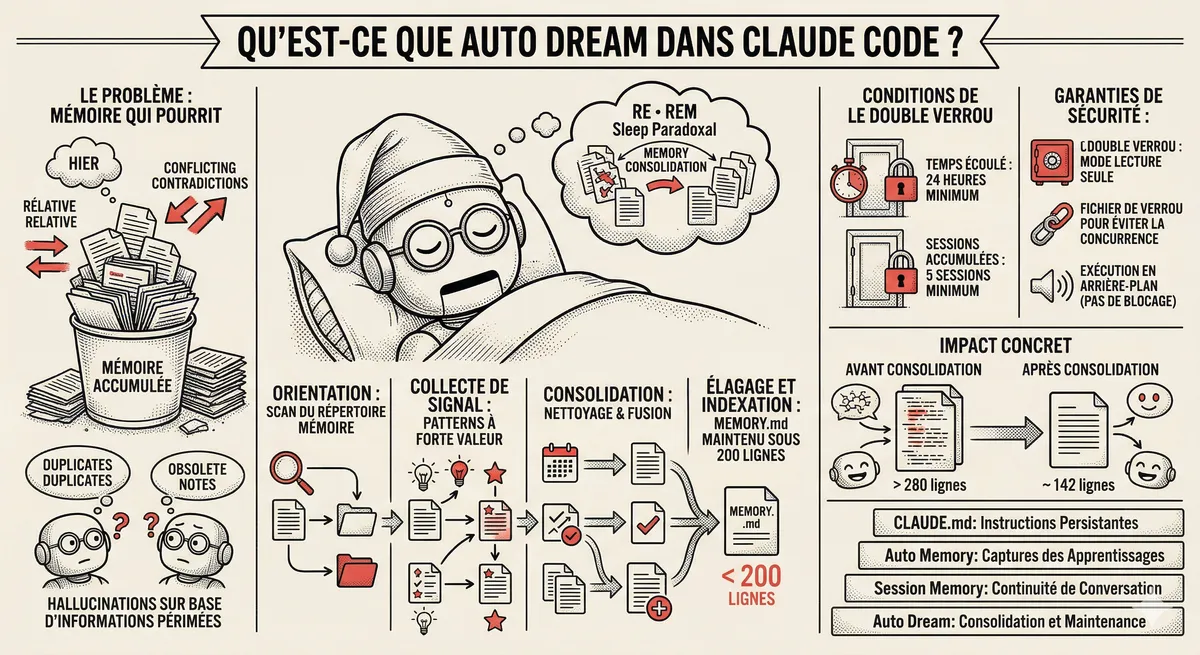
Claude Code Dream & Auto Dream: Automatic Memory Consolidation
After 20 sessions, Auto Memory notes become a mess. Auto Dream solves this by automatically consolidating Claude Code's memory: deduplication, stale entry removal, relative-to-absolute date conversion.
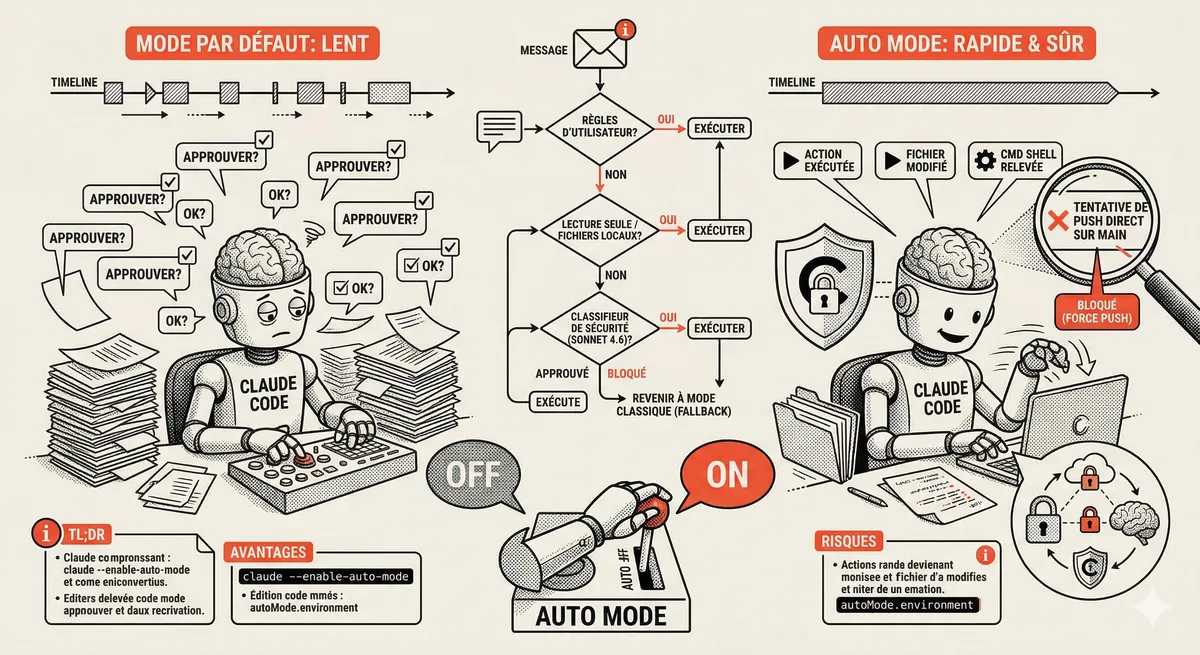
Claude Code Auto Mode: Autonomy Without the Risk
Auto Mode in Claude Code eliminates permission interruptions while keeping a safety net. A classifier analyzes every action before execution and blocks destructive operations. The sweet spot between approving everything and letting everything through.
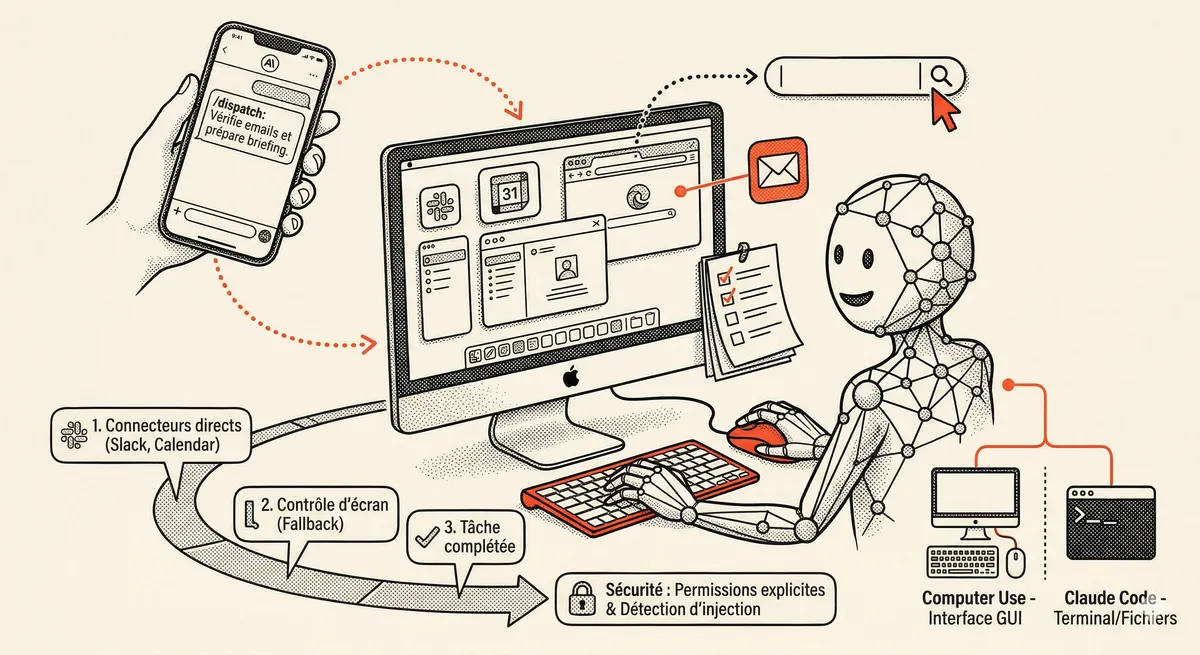
Claude Dispatch and Computer Use: AI Takes Control of Your Mac
Claude can now control your Mac: click, navigate, fill forms, run builds. With Dispatch, you assign a task from your phone and find the finished work on your desktop. Research preview, macOS only.
Claude Code Training
Master Claude Code fundamentals in 1 day with our expert instructors. 60% hands-on practice on real-world cases.
Discover the training