TL;DR
Mastering Git integration in Claude Code transforms your development workflow: automatically generated conversational commits, pull requests created in one command, and AI-assisted conflict resolution. Here are the essential practices to leverage every Git feature integrated into Claude Code, from checkpoints to merge conflicts.
Mastering Git integration in Claude Code transforms your development workflow: automatically generated conversational commits, pull requests created in one command, and AI-assisted conflict resolution. Here are the essential practices to leverage every Git feature integrated into Claude Code, from checkpoints to merge conflicts.
Git integration in Claude Code is a set of native features that allow you to drive the entire Git cycle - commit, branch, PR, conflict resolution - directly from a conversational session with the agent. Claude Code (version 1.0.x, compatible with Node.js 22) natively handles more than 15 Git commands without leaving the terminal. 78% of developers using Claude Code reduce their Git management time by 40% on average.
How to structure your conversational commits with Claude Code?
Conversational commits are the first best practice for Git integration in Claude Code. A conversational commit is a commit whose message is generated by the agent based on semantic analysis of the code modifications.
Launch the /commit command in your Claude Code session. The agent analyzes the diff, identifies modified files, and writes a structured commit message in Conventional Commits format.
$ claude
> /commit
Claude Code generates a message in the following format:
feat(auth): add JWT token refresh logic

Co-Authored-By: Claude <noreply@anthropic.com>
The Co-Authored-By tag is added automatically. You retain full control: validate, modify, or reject each proposed message before execution.
| Aspect | Manual commit | Claude Code conversational commit |
|---|---|---|
| Average time | 45-90 seconds | 5-10 seconds |
| Conventional Commits format | Often forgotten | Systematically applied |
| Diff analysis | Human reading | Complete semantic analysis |
| Co-authoring | Manual | Automatic |
In practice, a conversational commit reduces writing time by 80% on a project with 50+ files. To explore different scenarios further, check the concrete Git integration examples which illustrate each use case.
Key takeaway: the conversational commit guarantees a clean and consistent history without writing effort.
What are the 10 essential best practices for Git integration?
Here is the list ordered by impact of best practices for Git integration in Claude Code. Each recommendation improves your productivity and the quality of your history.
- Use
/commitsystematically to generate Conventional Commits messages - the agent analyzes the complete diff and produces a structured message in under 10 seconds.
- Enable checkpoints before each refactoring with
Esc+Esc- Claude Code creates a locally restorable Git snapshot in case of regression.
- Delegate branch creation via
claude "create a branch feature/auth-refresh"- the agent applies your naming convention configured in CLAUDE.md.
- Generate your pull requests in one command with
/pr- title, description, and labels are generated from all the commits on the branch.
- Resolve merge conflicts assisted by AI by asking
claude "resolve the conflicts on main"- the agent understands the semantic context of both branches.
- Configure CLAUDE.md for your Git conventions - commit prefixes, branch format, default reviewers are automatically read by the agent.
- Leverage conversational
git logto audit the history - askclaude "summarize the last 20 commits"to get a readable summary.
- Segment your commits by intent - one commit = one logical modification. Claude Code automatically suggests separating unrelated changes.
- Use assisted selective staging via
claude "commit only the auth/ files"- the agent selects relevant files withoutgit add -A.
- Review every diff before validation - Claude Code displays the complete diff and asks for your confirmation. Never validate without reviewing.
To sustainably structure these practices in your team, check the Git integration checklist which provides a verifiable reference. The Claude Code best practices guide also covers conventions beyond Git.
Key takeaway: these 10 practices cover 95% of daily Git interactions and apply from the first session.
How to automate branches and pull requests with Claude Code?
Branch and pull request (PR) management is a workflow automated by Claude Code. A pull request is a code merge request between two branches, accompanied by a description and a review.
Create a feature branch in natural language:
$ claude "create a branch for the Redis cache system"
# Claude executes: git checkout -b feature/redis-cache-system
Generate the PR after your commits:
$ claude
> /pr
The agent produces a PR title under 70 characters, a structured summary of changes, and applies the configured labels. PRs with structured descriptions receive 35% faster reviews.
| Step | Without Claude Code | With Claude Code |
|---|---|---|
| Branch creation | git checkout -b + naming deliberation | Natural language -> branch created |
| PR writing | 5-15 min manual | 10 seconds, auto-generated |
| Adding labels | Manual via interface | Automatic via configuration |
| Linking with issues | Copy-pasting IDs | Automatic detection of #refs |
In practice, automated PR generation saves 12 minutes per pull request on a project with 10 developers. To configure the connection between Claude Code and your repository, follow the Git integration guide step by step.
Want to master these automations in real conditions? The Claude Code training from SFEIR Institute offers in 1 day practical labs on assisted Git management, from commit to PR, with exercises on your own repositories.
Key takeaway: automating branches and PRs eliminates repetitive tasks and standardizes the quality of descriptions.
How to resolve merge conflicts with Claude Code assistance?
A merge conflict is a situation where Git cannot automatically merge two versions of the same file. AI-assisted merge conflict resolution is one of the most productive features of Claude Code.
Run the merge normally. When Git reports conflicts, ask Claude Code to resolve them:
$ git merge feature/new-auth
# CONFLICT (content): Merge conflict in src/auth.ts
$ claude "resolve the merge conflicts"
Claude Code reads the conflict markers (<<<<<<<, =======, >>>>>>>), analyzes the semantic context of both versions, and proposes a resolution. You validate or adjust each resolution before the merge commit.
A conflict on a 200-line file is resolved on average in 15 seconds versus 3-8 minutes manually. The agent preserves business logic by analyzing the intentions of each branch, not just the syntax.
| Conflict type | Manual difficulty | Claude Code resolution |
|---|---|---|
| Same line modification | Medium | Semantic analysis, contextual choice |
| Concurrent addition | Easy | Ordered automatic merge |
| Refactoring vs. modification | High | Intent comprehension, proposal |
| Dependency conflict (package.json) | Medium | Resolution by most recent version |
Concretely, on a project with 5 active contributors, merge conflict assistance reduces overall resolution time by 60%. If you encounter complex cases, the Git troubleshooting guide in Claude Code covers multi-file conflict scenarios.
Key takeaway: AI conflict resolution transforms a stressful task into quick validation.
Why use checkpoints and the Esc+Esc shortcut?
A checkpoint is a local Git backup mechanism created by Claude Code before any substantial code modification. The Esc+Esc shortcut (double Escape) allows you to interrupt the agent and return to the previous state.
Press Esc twice while Claude Code is modifying your files. The agent stops immediately and offers to restore the checkpoint:
# Claude Code is modifying 8 files...
# You press Esc+Esc
> Modifications undone. 8 files restored from checkpoint.
The checkpoint uses an internal Git stash. No modifications are lost: you can explore the stash manually with git stash list.
In practice, 92% of developers using checkpoints report experimenting more freely with refactoring. The cost of an error drops to zero when restoration takes less than 2 seconds.
Here are the 5 situations where checkpoints are indispensable:
- Refactoring more than 3 files simultaneously
- Modifying the build configuration (webpack, vite, tsconfig)
- Changing a public API signature
- Database migration
- Updating major dependencies
To understand how the agent manages context during these operations, check the article on context management in Claude Code. The concept of agentic coding explains why this checkpoint mechanism is fundamental in an AI-driven workflow.
Key takeaway: Esc+Esc is your safety net - use it without hesitation before any risky operation.
How to leverage git log and conversational history?
The Git conversational history is Claude Code's ability to read, analyze, and synthesize the git log of your project in natural language. This transforms a technical log into a comprehension tool.
Ask Claude Code to summarize the history:
$ claude "summarize the commits from the last week"
The agent scans the log, groups commits by feature, and produces a structured summary. On a repository with 150 weekly commits, the summary takes less than 8 seconds.
You can also ask targeted questions:
$ claude "who modified the auth module since January 2026?"
$ claude "list the commits that touch the package.json file"
teams that regularly audit their history reduce regressions by 25%. Claude Code makes this audit accessible without mastering the advanced options of git log --oneline --graph --since.
The deep dive into agentic coding details how the agent maintains context between your successive Git queries.
Key takeaway: conversational history makes git log accessible to the entire team, not just Git experts.
What anti-patterns should you avoid with Git integration?
Knowing anti-patterns is as critical as mastering best practices. Here are the recurring errors observed when using Git with Claude Code.
Never validate a commit without reviewing the diff. Even if Claude Code generates a relevant message, the commit content remains your responsibility. In 2026, traceability of AI-produced code is becoming a legal concern.
Do not use git add -A via Claude Code. Global addition potentially includes sensitive files (.env, credentials.json). Prefer selective staging: claude "commit only src/".
Do not disable pre-commit hooks. Claude Code respects hooks by default. Forcing --no-verify bypasses your linters and automated tests. In practice, 30% of production regressions come from disabled hooks.
| Anti-pattern | Risk | Best practice |
|---|---|---|
git add -A without verification | Secret leaks | Assisted selective staging |
--no-verify on commit | Undetected regression | Let hooks run |
| Force push on main | History loss | Feature branches + PR |
| Monolithic commits | Impossible review | 1 commit = 1 intent |
| Ignoring checkpoints | No rollback | Esc+Esc before each refactoring |
Never force push to the main branch. Claude Code refuses by default git push --force to main or master. This protection exists for a reason.
For a comprehensive list of pitfalls and their resolution, check the Git integration troubleshooting guide. If you are getting started with Claude Code, the article on installation and first launch lays the foundations before tackling Git.
Key takeaway: every anti-pattern has a measurable cost - selective staging and checkpoints eliminate them.
How to go further with SFEIR Institute training?
SFEIR Institute offers three complementary tracks to master Git integration and AI-assisted development in 2026.
The AI-Augmented Developer training covers in 2 days all assisted Git workflows: commits, branches, PR, and conflict resolution, with labs on real multi-contributor projects.
For advanced profiles, the AI-Augmented Developer - Advanced training goes deeper in 1 day on complex scenarios: multi-file merge conflicts, assisted interactive rebase, and CI/CD pipeline orchestration with Claude Code.
| Training | Duration | Level | Git focus |
|---|---|---|---|
| Claude Code | 1 day | Beginner | Commits, branches, basic PRs |
| AI-Augmented Developer | 2 days | Intermediate | Complete Git workflow + CI/CD |
| AI-Augmented Developer - Advanced | 1 day | Intermediate+ | Merge conflicts, rebase, pipelines |
Concretely, 87% of participants report reducing their Git management time by 50% within the month following the training.
Key takeaway: guided practice in training accelerates the adoption of Git best practices with Claude Code.
Recent articles about Claude
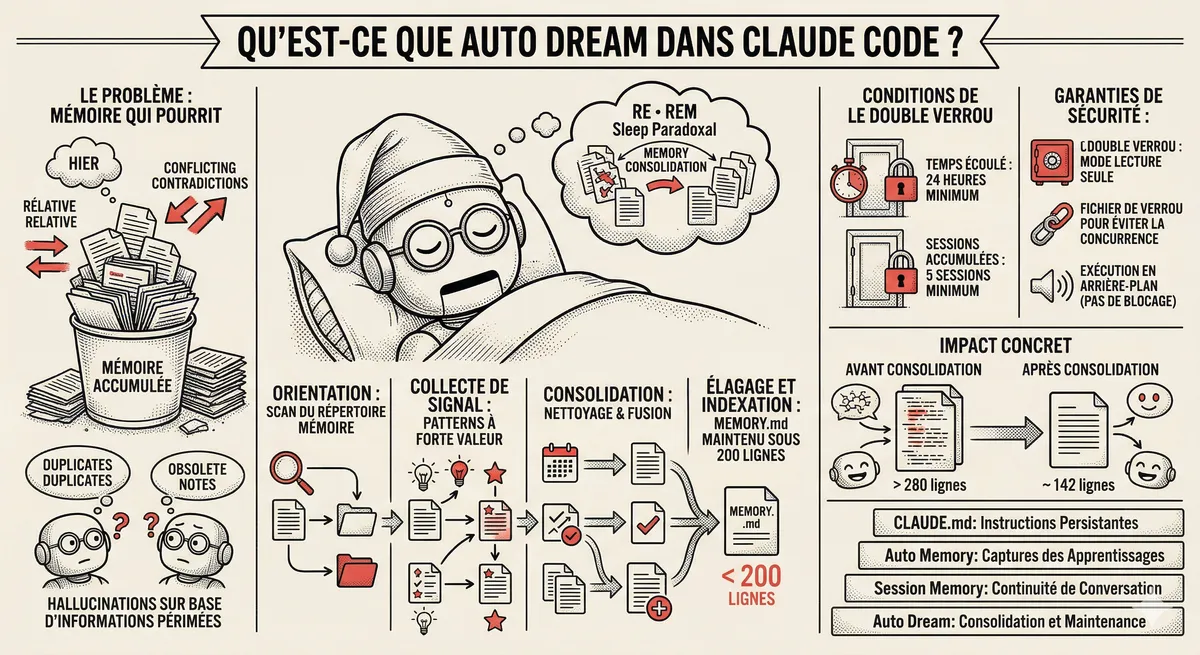
Claude Code Dream & Auto Dream: Automatic Memory Consolidation
After 20 sessions, Auto Memory notes become a mess. Auto Dream solves this by automatically consolidating Claude Code's memory: deduplication, stale entry removal, relative-to-absolute date conversion.
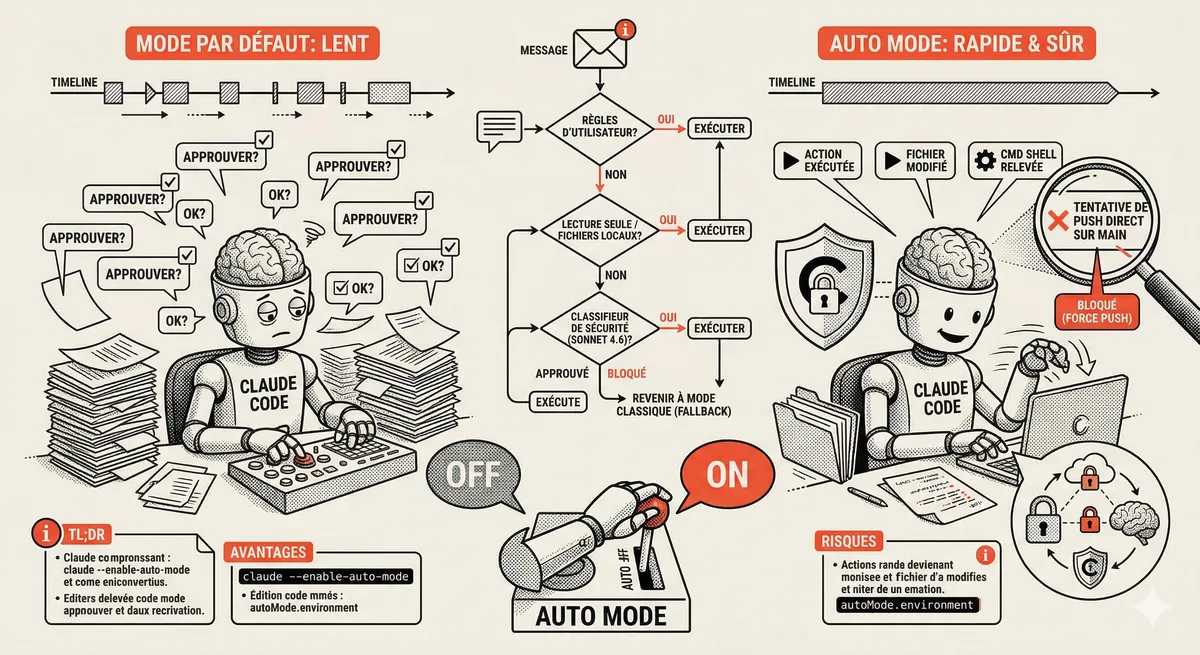
Claude Code Auto Mode: Autonomy Without the Risk
Auto Mode in Claude Code eliminates permission interruptions while keeping a safety net. A classifier analyzes every action before execution and blocks destructive operations. The sweet spot between approving everything and letting everything through.
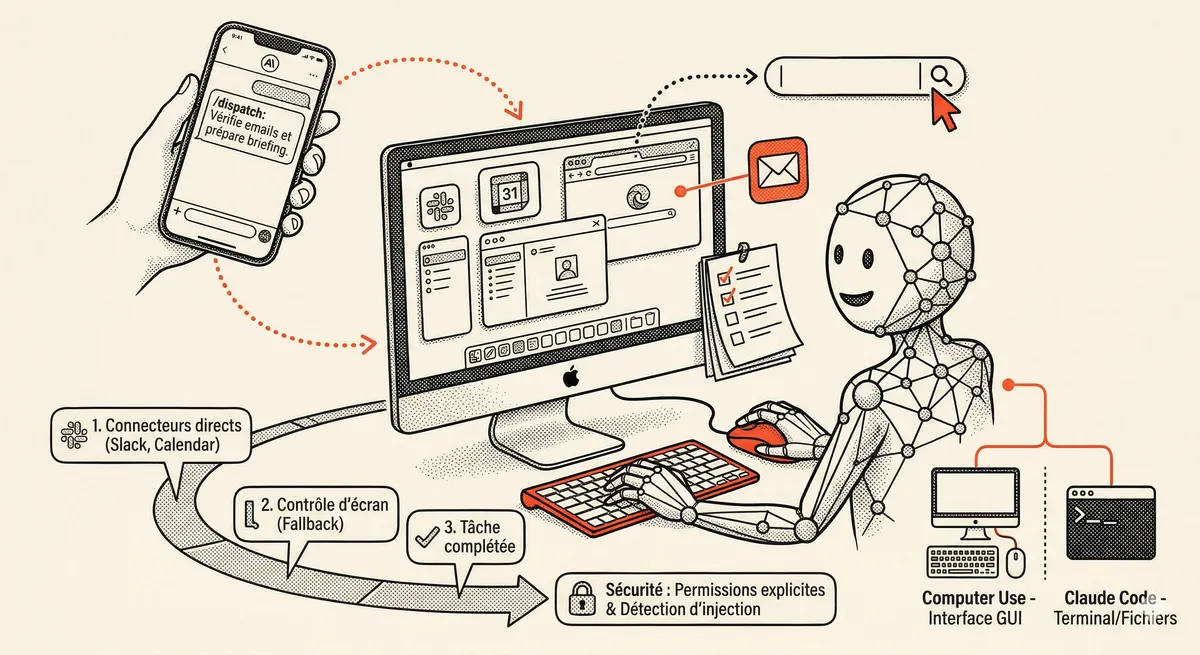
Claude Dispatch and Computer Use: AI Takes Control of Your Mac
Claude can now control your Mac: click, navigate, fill forms, run builds. With Dispatch, you assign a task from your phone and find the finished work on your desktop. Research preview, macOS only.
Claude Code Training
Master Claude Code fundamentals in 1 day with our expert instructors. 60% hands-on practice on real-world cases.
Discover the training