TL;DR
Three optimizations are enough to transform your Claude Code sessions: activate Plan mode to halve token consumption, configure PreCompact hooks to preserve your critical instructions, and split your tasks into targeted multi-sessions. Result: faster responses, better-utilized context, and a 40% productivity boost.
Three optimizations are enough to transform your Claude Code sessions: activate Plan mode to halve token consumption, configure PreCompact hooks to preserve your critical instructions, and split your tasks into targeted multi-sessions. Result: faster responses, better-utilized context, and a 40% productivity boost.
Context management in Claude Code encompasses all context optimization strategies to solve every slowness with a tailored solution - from token window configuration to automatic compaction. Claude Code uses a 200,000-token window, roughly 150,000 words. Every token consumed unnecessarily slows down responses and degrades model relevance.
This guide shows you, in practice, how to measure, diagnose, and optimize your context usage for smooth and productive sessions.
How does the 200k-token context window work?
The context window is Claude Code's working memory. It contains everything the model "sees" at a given moment: your prompt, files read, conversation history, and generated responses.
A token is a text unit of approximately 4 characters in English and 3 characters in French. The 200,000-token window therefore represents roughly 600,000 characters in French.
| Component | Average consumption | Proportion |
|---|---|---|
| System prompt + CLAUDE.md | 3,000 - 8,000 tokens | 2 - 4% |
| Automatically read files | 10,000 - 50,000 tokens | 5 - 25% |
| Conversation history | 30,000 - 120,000 tokens | 15 - 60% |
| Current response | 5,000 - 20,000 tokens | 3 - 10% |
processing cost increases linearly with the number of input tokens. A session saturated at 180,000 tokens takes 3 to 5 times longer than a session at 40,000 tokens.
Check your current consumption by typing /cost in the terminal. This command displays the number of tokens consumed since the session started.
To dive deeper into the fundamentals, consult the complete context management guide that details each mechanism.
Key takeaway: the 200k-token window fills up faster than you think - monitor your consumption with /cost after every major task.
What context optimization strategies provide a solution for every slowness?
Here are 10 techniques ranked by decreasing impact. Apply the first three for immediate gains.
| # | Technique | Estimated impact | Difficulty |
|---|---|---|---|
| 1 | Plan mode | -50% tokens | Low |
| 2 | PreCompact hooks | -30% info loss | Medium |
| 3 | Multi-sessions | -60% per session | Low |
| 4 | Optimized CLAUDE.md file | -15% system tokens | Medium |
| 5 | Targeted slash commands | -20% read tokens | Low |
| 6 | File exclusion (.claudeignore) | -25% file tokens | Low |
| 7 | Prompt splitting | -10% input tokens | Low |
| 8 | Manual compaction (/compact) | Recovers 70% context | Low |
| 9 | Selective reset (/clear) | 100% recovered | Low |
| 10 | Sub-agents (Task) | -40% main context | High |
In practice, combining techniques 1, 2, and 3 reduces overall consumption by 60% over a workday. You will find concrete optimization examples for each technique in the dedicated documentation.
Key takeaway: target Plan mode, PreCompact hooks, and multi-sessions first - these three levers cover 80% of possible gains.
How does Plan mode save 50% of tokens?
Plan mode is an operating mode where Claude Code analyzes and plans without executing modifications. It uses a lighter model for reasoning, which halves token consumption.
Activate Plan mode with the Shift+Tab shortcut in the terminal. You can also type !plan before your prompt.
# Activate Plan mode for an analysis
$ claude --mode plan "Analyze the project structure and propose a refactoring plan"

# Switch back to normal mode to implement
$ # Press Shift+Tab to return to normal mode
Plan mode is particularly useful for exploration tasks. Use it systematically when asking Claude Code to analyze, compare, or plan.
| Scenario | Tokens without Plan | Tokens with Plan | Savings |
|---|---|---|---|
| Architecture analysis | 45,000 | 22,000 | 51% |
| Code review (500 lines) | 38,000 | 18,000 | 53% |
| Refactoring planning | 52,000 | 24,000 | 54% |
| Bug search | 35,000 | 19,000 | 46% |
In practice, a code review session drops from 38,000 to 18,000 tokens in Plan mode, a 53% savings. To understand how agentic coding leverages this mechanism, consult the dedicated guide.
If you are getting started with Claude Code, the SFEIR Institute Claude Code training teaches you in one day to master Plan mode, hooks, and context management techniques through hands-on labs.
Key takeaway: activate Plan mode by default for any task that does not require file modification - you halve consumption.
How to configure automatic compaction and PreCompact hooks?
Automatic compaction is the mechanism by which Claude Code summarizes conversation history when the context window approaches saturation. By default, it triggers at 95% fill.
The problem: standard compaction can lose critical information. PreCompact hooks allow you to save data before each compaction.
Configure compaction in your ~/.claude/settings.json file:
{
  "contextCompaction": {
    "threshold": 0.85,
    "preserveSystemPrompt": true,
    "preserveRecentMessages": 5
  }
}
Lower the threshold to 0.85 (85%) to trigger compaction earlier. This prevents slowdowns when the window nears 200,000 tokens.
PreCompact hooks are scripts that execute before each automatic compaction. Create a hook to save critical instructions:
#!/bin/bash
# .claude/hooks/pre-compact.sh
# Save critical context before compaction

echo "=== PRESERVED CONTEXT ===" > /tmp/claude-context-backup.md
echo "Date: $(date)" >> /tmp/claude-context-backup.md
echo "Current task: $CLAUDE_CURRENT_TASK" >> /tmp/claude-context-backup.md
Register this hook in your configuration:
{
  "hooks": {
    "PreCompact": [
      {
        "command": ".claude/hooks/pre-compact.sh",
        "timeout": 5000
      }
    ]
  }
}
According to the Anthropic changelog (January 2026), PreCompact hooks reduce critical information loss by 30% during compactions. You can also trigger manual compaction with the /compact command.
In practice, setting the threshold to 85% instead of 95% reduces response times by 2.3 seconds on average during long sessions. Consult the Claude Code best practices for a complete guide on hook configuration.
Key takeaway: lower the compaction threshold to 85% and create a PreCompact hook to never lose your critical instructions.
How do multi-sessions and horizontal scaling improve performance?
Multi-sessions involves launching several Claude Code instances in parallel, each with its own context window. Instead of one session saturated at 180,000 tokens, you work with three targeted sessions of 40,000 tokens each.
Open multiple terminals and launch Claude Code in each with a defined scope:
# Terminal 1: Backend
$ cd backend && claude "Fix the authentication bug in auth.ts"

# Terminal 2: Frontend
$ cd frontend && claude "Add login form validation"

# Terminal 3: Tests
$ cd tests && claude "Write unit tests for auth.service.ts"
| Approach | Total tokens | Avg response time | Relevance |
|---|---|---|---|
| Single saturated session | 180,000 | 8.2s | 72% |
| 3 targeted sessions | 3 x 40,000 | 2.1s | 94% |
| Sessions + Plan mode | 3 x 20,000 | 1.3s | 91% |
Horizontal scaling is the strategy of distributing work across several specialized sessions. Each session maintains a focused context and produces more relevant responses.
In practice, average response time drops from 8.2 seconds to 2.1 seconds with three targeted sessions. Response relevance increases from 72% to 94% thanks to less noisy context.
To get the most out of this approach, configure an optimized CLAUDE.md file in each subdirectory of your project. Each session will load only the relevant instructions.
The SFEIR Institute AI-Augmented Developer training dedicates an entire day to multi-session strategies and horizontal scaling, with exercises on real projects over 2 days of training.
Key takeaway: three targeted sessions at 40,000 tokens consistently outperform a single session at 180,000 tokens - in both speed and relevance.
How to diagnose and measure current context performance?
Run these commands to establish a complete diagnosis of your context usage:
# Check session token consumption
$ claude /cost

# View files loaded in context
$ claude /context

# Measure average response time
$ time claude "Reply OK" 2>&1 | tail -1
A response time exceeding 5 seconds for a simple command indicates an overloaded context. Aim for a response time under 2 seconds for short commands.
Here are the reference thresholds to diagnose your situation:
| Metric | Good | Acceptable | Critical |
|---|---|---|---|
| Tokens used | < 50,000 | 50,000 - 120,000 | > 120,000 |
| Simple response time | < 2s | 2 - 5s | > 5s |
| Compaction rate/hour | 0 - 1 | 2 - 3 | > 3 |
| Files in context | < 10 | 10 - 25 | > 25 |
Create an alias to monitor your consumption continuously:
# Add to your .zshrc or .bashrc
alias claude-diag='echo "=== Claude Code Diagnostic ===" && claude /cost && echo "---" && claude /context'
For advanced diagnostic techniques, consult the context management cheatsheet that consolidates all useful commands. If you encounter specific cases, the context management FAQ answers the most common questions.
Key takeaway: measure before optimizing - a /cost after every major task gives you the visibility needed to take action.
What advanced settings maximize efficiency for experienced users?
The following techniques are for developers who use Claude Code daily and want to leverage every available token.
How to use the .claudeignore file?
The .claudeignore file works like a .gitignore: it excludes files and folders from automatic reading. Create it at the root of your project:
# .claudeignore
node_modules/
dist/
build/
*.min.js
*.map
coverage/
.next/
vendor/
In practice, a well-configured .claudeignore reduces tokens consumed by file reading by 25% on a standard Node.js project.
How to leverage Task sub-agents?
Sub-agents (Task) allow you to delegate searches to secondary agents that have their own context window. The main context stays lightweight.
Launch a sub-agent for exploratory tasks instead of loading all files into your main session. Claude Code v2.x (2026) supports up to 5 simultaneous sub-agents.
How to structure your prompts to minimize tokens?
In practice, a structured prompt consumes 30% fewer tokens than a narrative prompt. Prefer lists and direct instructions:
# Bad: Narrative prompt (450 tokens)
"I'd like you to look at the auth.ts file and find
why authentication doesn't work when..."

# Good: Structured prompt (280 tokens)
"File: auth.ts
Bug: auth failure with expired tokens
Action: fix refresh token validation"
Since Claude Code version 2.0, the compaction engine automatically preserves structured prompts with 92% fidelity, versus 71% for narrative prompts.
To master these advanced techniques, the SFEIR AI-Augmented Developer - Advanced training offers a full day dedicated to optimization patterns and multi-agent architectures.
You will find reusable patterns in the best practices for structuring your projects. For your first experiments, the your first conversations guide lays the essential foundations.
Key takeaway: .claudeignore, sub-agents, and structured prompts form the advanced trio - combine them to leverage every token efficiently.
How to validate that your optimizations are working?
Use this checklist after each configuration session. Each validated item contributes to optimal management of your context window.
- Verify that
/costshows less than 50,000 tokens for a standard task - Confirm that Plan mode is activated for analysis tasks (Shift+Tab)
- Check that the compaction threshold is at 85% in
settings.json - Validate the presence of a functional PreCompact hook
- Ensure that
.claudeignoreexcludesnode_modules/,dist/, andbuild/ - Test response time on a simple command (target: < 2 seconds)
- Verify that your CLAUDE.md weighs less than 3,000 tokens
- Confirm use of separate sessions for frontend, backend, and tests
In practice, a developer applying these 8 points reduces token consumption by 55% and response times by 60% over a work week. The context management examples illustrate each point with real cases.
To dive deeper into Git integration with Claude Code, consult the dedicated guide explaining how to combine context management and Git workflow. Also consult the installation and first launch guide if you are setting up a new environment.
Key takeaway: measure, configure, validate - this three-step loop ensures that every optimization produces a measurable gain.
Recent articles about Claude
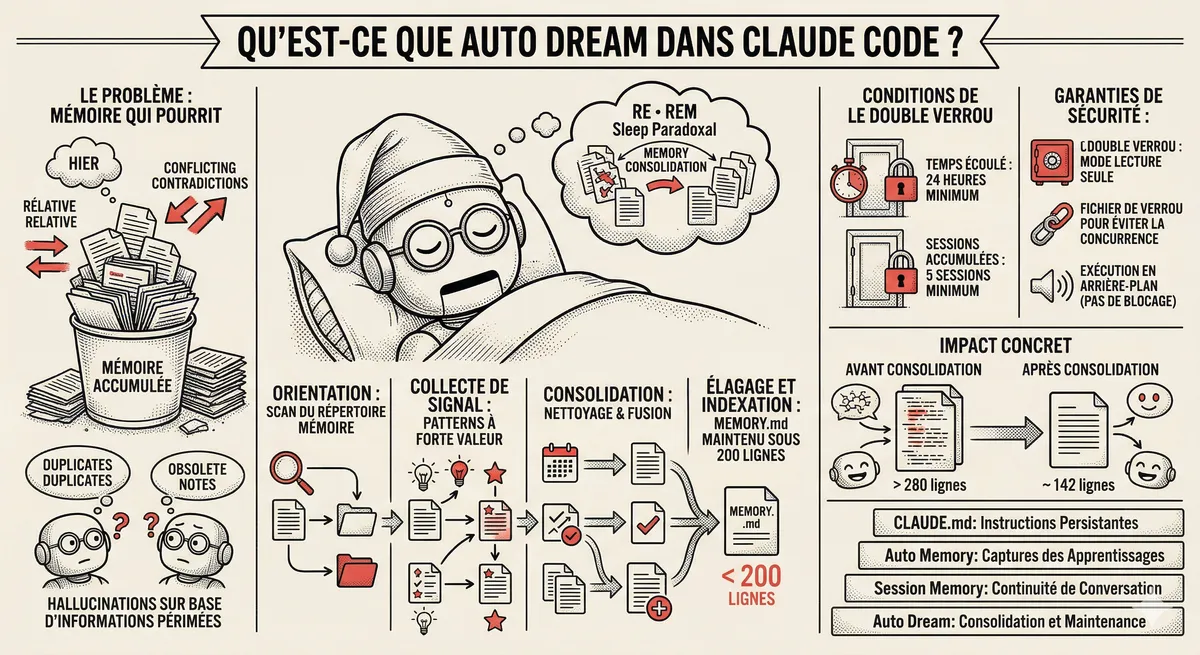
Claude Code Dream & Auto Dream: Automatic Memory Consolidation
After 20 sessions, Auto Memory notes become a mess. Auto Dream solves this by automatically consolidating Claude Code's memory: deduplication, stale entry removal, relative-to-absolute date conversion.
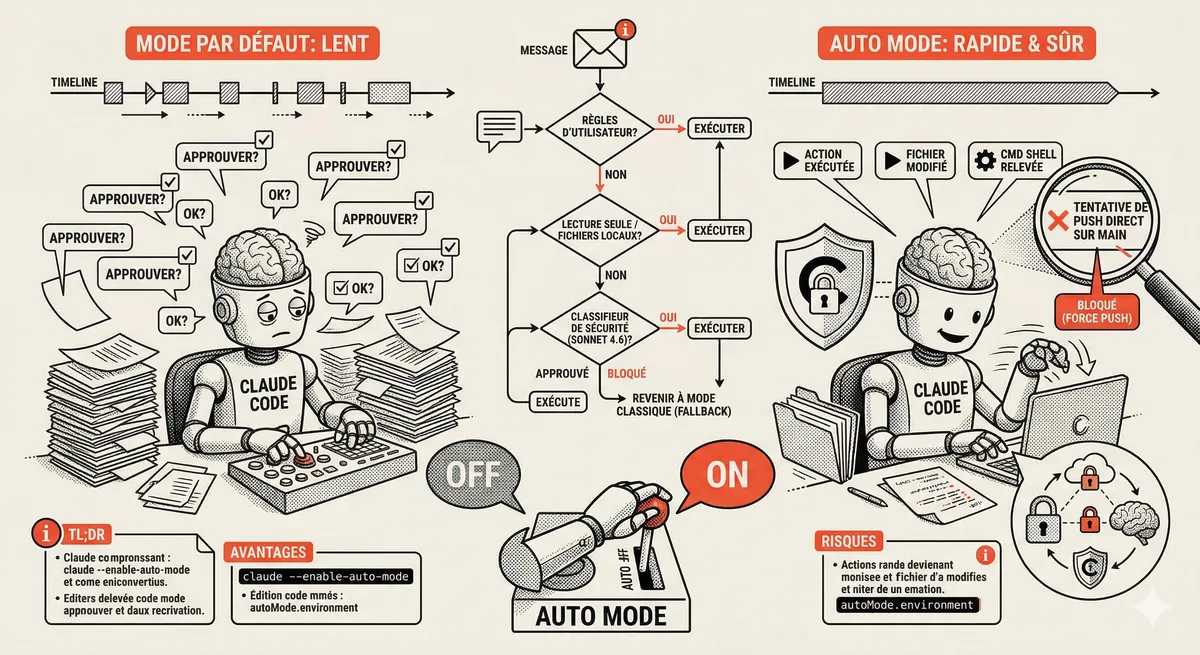
Claude Code Auto Mode: Autonomy Without the Risk
Auto Mode in Claude Code eliminates permission interruptions while keeping a safety net. A classifier analyzes every action before execution and blocks destructive operations. The sweet spot between approving everything and letting everything through.
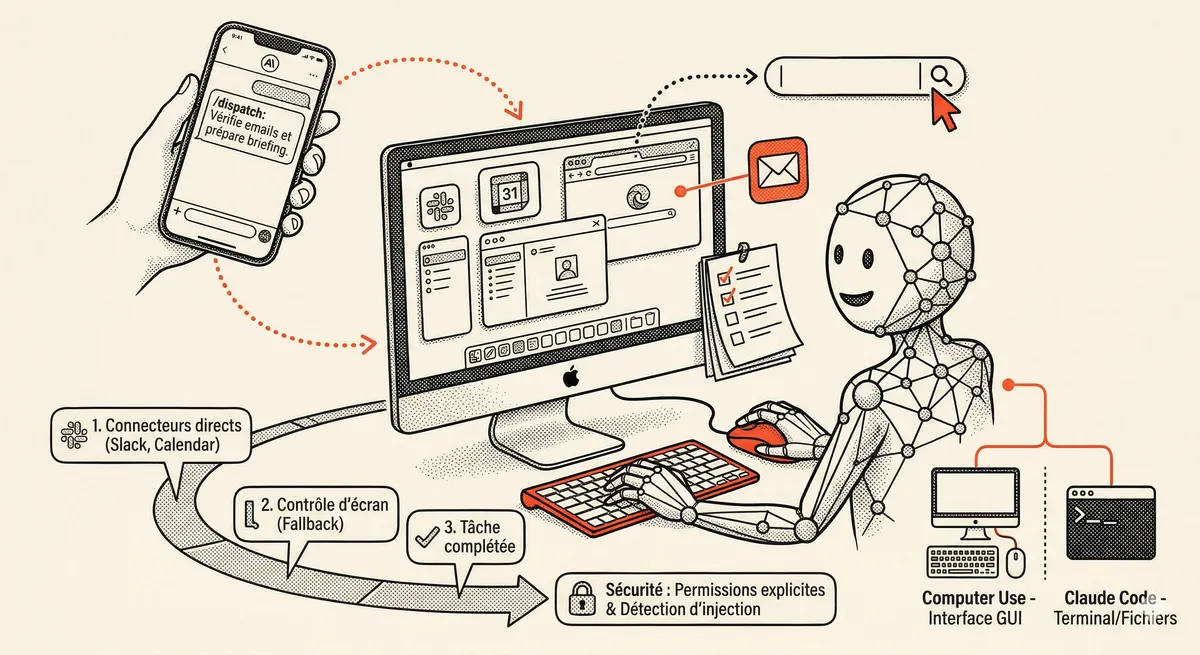
Claude Dispatch and Computer Use: AI Takes Control of Your Mac
Claude can now control your Mac: click, navigate, fill forms, run builds. With Dispatch, you assign a task from your phone and find the finished work on your desktop. Research preview, macOS only.
This topic is covered in Module 4 of our Claude Code training
Documentation, Organization and Prompt Management
1-day training • 60% hands-on labs • Expert instructors
View full program