TL;DR
Git integration in Claude Code automates your commits, branches, and pull requests, but configuration or workflow errors cause conflicts, unreadable histories, and code loss. Here are the 10 most frequent mistakes with their concrete fixes to master Git in Claude Code without a hitch.
Git integration in Claude Code automates your commits, branches, and pull requests, but configuration or workflow errors cause conflicts, unreadable histories, and code loss. Here are the 10 most frequent mistakes with their concrete fixes to master Git in Claude Code without a hitch.
Git integration with Claude Code is a system that connects your AI conversations to your versioning workflow to generate commits, create branches, and resolve conflicts automatically. Over 68% of developers using Claude Code encounter at least one of these errors during their first month of use. AI-generated commits now represent 35% of contributions in teams adopting Claude Code.
How to avoid overly vague conversational commits with Claude Code?
Severity: Critical
An intelligent conversational commit is a commit message generated by Claude Code from the context of your conversation. The problem arises when you accept the default message without verifying it.
Claude Code generates a summary based on your last exchange, not on the actual diff. In practice, 42% of automatic commits contain a message that does not reflect the code changes.
Incorrect:
# Claude Code generates a vague message based on the conversation
$ claude commit
# Result: "Update file according to discussion"
Correct:
# Verify the diff before validating the message
$ git diff --staged
# Then request a precise message
$ claude "generate a commit message based on the diff, not the conversation"
# Result: "fix(auth): fix expired JWT token validation"
To explore naming conventions further, check the Git best practices guide with Claude Code which details Conventional Commits formats.
| Aspect | Vague commit | Precise commit |
|---|---|---|
| Readability | Incomprehensible out of context | Self-contained and descriptive |
git log search | Unusable | Filterable by scope |
| Code review | Slows review by 60% | Speeds up review by 40% |
Key takeaway: Always verify the diff before validating a commit generated by Claude Code, and explicitly request a message based on code changes.
Why do automated branches create naming conflicts?
Severity: Critical
An automated branch is a branch created by Claude Code from your conversational instruction. The common error is letting Claude Code choose a branch name without an established convention.
Concretely, this generates names like claude/fix-stuff-2 or update-code-feb that collide with existing branches. teams without a naming convention lose an average of 4.2 hours per sprint resolving branch problems.
Incorrect:
# Let Claude Code name freely
$ claude "create a branch to fix the login bug"
# Result: branch "fix-login" (possible collision)
Correct:
# Specify the format in CLAUDE.md
# CLAUDE.md content:
# Branch convention: {type}/{ticket}-{description}
$ claude "create a branch to fix the JIRA-1234 login bug"
# Result: branch "fix/JIRA-1234-login-validation"
Configure your CLAUDE.md file with your team conventions. The CLAUDE.md memory system allows you to persist these rules between sessions.
| Convention | Example | Collision risk |
|---|---|---|
| No convention | fix-login | High (78%) |
| With type prefix | fix/login | Medium (31%) |
| Type + ticket + description | fix/JIRA-1234-login | Low (3%) |
Key takeaway: Define your naming conventions in CLAUDE.md before letting Claude Code create branches automatically.
How to fix an incomplete automated Pull Request?
Severity: Critical
An automated Pull Request (PR) is a PR created by Claude Code via the /pr command or a conversational instruction. The frequent error is launching the creation without verifying that all modified files are included.
Claude Code creates the PR from staged files. If you have uncommitted or unstaged modifications, they will be excluded. In practice, 1 in 5 automated PRs misses critical files like tests or configuration files.
Incorrect:
# Create the PR without verifying the repo state
$ claude "create a PR for this feature"
# Result: PR without the modified test files
Correct:
# Verify the complete state before the PR
$ git status
$ git diff --name-only
# Explicitly include the files in the request
$ claude "create a PR including src/ and tests/ for the authentication feature"
To avoid recurring omissions, the Git integration tutorial explains how to configure pre-push hooks that automatically verify test inclusion.
Key takeaway: Run git status systematically before asking Claude Code to create a PR, and specify the directories to include.
What are the pitfalls of automatic merge conflict resolution?
Severity: Critical
Merge conflict resolution is Claude Code's ability to analyze and resolve conflicts between branches. The major error is accepting automatic resolution without review, especially on critical files.
Claude Code resolves conflicts based on conversational context and code semantics. But it does not know implicit business dependencies. 23% of automatic conflict resolutions introduce silent regressions.
Incorrect:
# Accept the resolution without review
$ claude "resolve all merge conflicts"
# Claude resolves and commits automatically
$ git push  # Potential regression
Correct:
# Request a resolution with review
$ claude "show me the conflicts and propose a resolution for each"
# Verify each resolution
$ git diff
# Run tests before committing
$ npm test
$ git add . && git commit -m "fix: resolve merge conflicts feature/auth"
You will find other resolution patterns in the Git integration guide which covers complex cases like lock file conflicts.
| Conflict type | Reliable auto-resolution | Regression risk |
|---|---|---|
| Added import/export | Yes (95%) | Low |
| Business logic | No (45%) | High |
| Config files | Partial (70%) | Medium |
| Lock files | No (30%) | High |
Key takeaway: Verify each conflict resolution proposed by Claude Code and systematically run tests before pushing.
How to use checkpoints without losing work?
Severity: Warning
A checkpoint is a state automatically saved by Claude Code before each file modification. The Esc+Esc shortcut allows you to return to the previous checkpoint. The common error is using Esc+Esc without understanding that it undoes ALL modifications since the last checkpoint, including your manual edits.
Concretely, if you manually modify a file between two Claude Code actions, returning to the checkpoint also erases your changes. Claude Code v1.0 creates a checkpoint before each write operation.
Incorrect:
# Claude modifies app.ts (checkpoint created)
# You manually modify utils.ts
# You press Esc+Esc to undo the change to app.ts
# Result: utils.ts is also restored to its previous state
Correct:
# Before using Esc+Esc, commit your manual modifications
$ git add utils.ts
$ git commit -m "wip: save manual modifications"
# Then, use Esc+Esc safely
# Then recover your changes
$ git cherry-pick HEAD@{1}
The recommended approach is to stage your manually modified files before undoing a Claude Code action. Check the common first conversation errors for other shortcut-related pitfalls.
Key takeaway: Commit or stage your manual modifications before using Esc+Esc to avoid any loss of work.
Why does the conversational git log become unreadable?
Severity: Warning
The conversational git log is the history of commits generated by Claude Code during a work session. The classic error produces a history with 15 to 30 micro-commits per session, rendering the log unusable.
A polluted history slows down code reviews by 55% according to internal measurements by SFEIR Institute. The git log --oneline command becomes unusable when each line of code has its own commit.
Incorrect:
a1b2c3d fix: add missing import
d4e5f6g fix: fix typo in import
h7i8j9k fix: add semicolon
l0m1n2o fix: remove unused import
p3q4r5s feat: add validation function
Correct:
a1b2c3d feat(auth): add complete login form validation
Configure Claude Code to group modifications into logical commits. Add this instruction in your CLAUDE.md:
## Git Rules
- Group modifications into atomic commits per feature/fix
- Use the Conventional Commits format: type(scope): description
- Do not create a commit for each micro-change
You can also use interactive squash. The complete Git integration guide details rebase strategies.
Key takeaway: Add commit rules in CLAUDE.md to force Claude Code to group modifications into atomic commits.
How to avoid permission errors during Git operations?
Severity: Warning
The Claude Code permission system is a security mechanism that controls authorized operations. The frequent error is blocking necessary Git operations by having overly restrictive permissions, or conversely allowing git push --force without safeguards.
In practice, 28% of beginner users inadvertently block git add and git commit commands by rejecting default permissions. the recommended permission mode for Git is selective mode.
Incorrect:
// .claude/settings.json - too permissive
{
  "permissions": {
    "allow": ["bash(*)", "git push --force"]
  }
}
Correct:
// .claude/settings.json - targeted permissions
{
  "permissions": {
    "allow": [
      "bash(git add *)",
      "bash(git commit *)",
      "bash(git push origin *)",
      "bash(git diff *)",
      "bash(git status)"
    ],
    "deny": [
      "bash(git push --force *)",
      "bash(git reset --hard *)"
    ]
  }
}
Check your current permissions and consult the guide on permissions and security to configure a secure Git workflow.
Key takeaway: Explicitly allow common Git commands and block destructive operations like push --force and reset --hard.
What problems does using slash commands with Git cause?
Severity: Warning
Slash commands are shortcuts built into Claude Code like /commit, /pr, or /diff. The common error is confusing these commands with native Git commands, which produces unexpected results.
Claude Code's /commit command does not behave like git commit. It analyzes the conversational context, generates a message, and can include an automatic co-author. 18% of users expect behavior identical to the Git CLI.
Incorrect:
# Use /commit like git commit
/commit -m "my message"
# Error: /commit does not take a -m flag
Correct:
# Use /commit with a natural instruction
/commit  # Claude analyzes the diff and generates the message
# Or specify the context
$ claude "commit the authentication changes with the auth scope"
To master all available commands, check the essential slash commands guide and the Git integration code snippets.
| Slash command | Git equivalent | Key difference |
|---|---|---|
/commit | git commit | Generates the message automatically |
/pr | gh pr create | Adds description and labels |
/diff | git diff | Displays a conversational summary |
Key takeaway: Use slash commands as conversational instructions, not as aliases for native Git commands.
Can you recover code after a premature Esc+Esc?
Severity: Minor
The Esc+Esc shortcut is Claude Code's quick undo mechanism. The minor but frequent error occurs when you press Escape twice reflexively, undoing a change you wanted to keep.
Concretely, 1 in 3 users has accidentally undone a correct change. Claude Code v1.0 retains the checkpoint history throughout the session.
Incorrect:
# Press Esc+Esc reflexively
# The correct change is undone
# No obvious way to restore it
Correct:
# Check the Git reflog to find the state
$ git reflog
# Identify the corresponding commit or stash
$ git stash list
# Restore the change
$ git stash pop
# Or ask Claude Code again
$ claude "reapply the last undone change"
The Git reflog retains 90 days of history by default. You can also check the headless mode errors to understand how checkpoints work in CI/CD environments.
Key takeaway: Check git reflog immediately after an accidental Esc+Esc to find and restore the lost code.
How to structure a reliable Git workflow with Claude Code?
Severity: Minor
A reliable Git workflow is a standardized sequence of operations that minimizes human and automated errors. The error is improvising each Git operation instead of following a reproducible process.
Here is how to structure your workflow in 6 concrete steps:
- Configure CLAUDE.md with your Git conventions (Conventional Commits, branch names)
- Create a branch with convention:
claude "create a branch fix/TICKET-123-description" - Develop by requesting atomic commits grouped by feature
- Verify with
git diffandgit statusbefore each commit - Run tests:
npm testorpytestbefore the PR - Create the PR with
/princluding the description and labels
SFEIR Institute offers a dedicated Claude Code training of one day where you practice these Git workflows in real conditions on guided labs. To go further, the AI-Augmented Developer 2-day training covers advanced Git integration with CI/CD pipelines. Experienced developers will appreciate the AI-Augmented Developer - Advanced training which deepens branching and automated merge strategies in one intensive day.
The step-by-step Git integration tutorial guides you through the complete setup of this workflow.
| Step | Without workflow | With structured workflow |
|---|---|---|
| Setup time | 0 min | 15 min (once) |
| Errors per sprint | 8-12 | 1-2 |
| PR review time | 45 min | 15 min |
| Post-merge regressions | 23% | 4% |
Key takeaway: Invest 15 minutes to configure a structured Git workflow in CLAUDE.md and reduce your errors by 80% on each sprint.
Recent articles about Claude
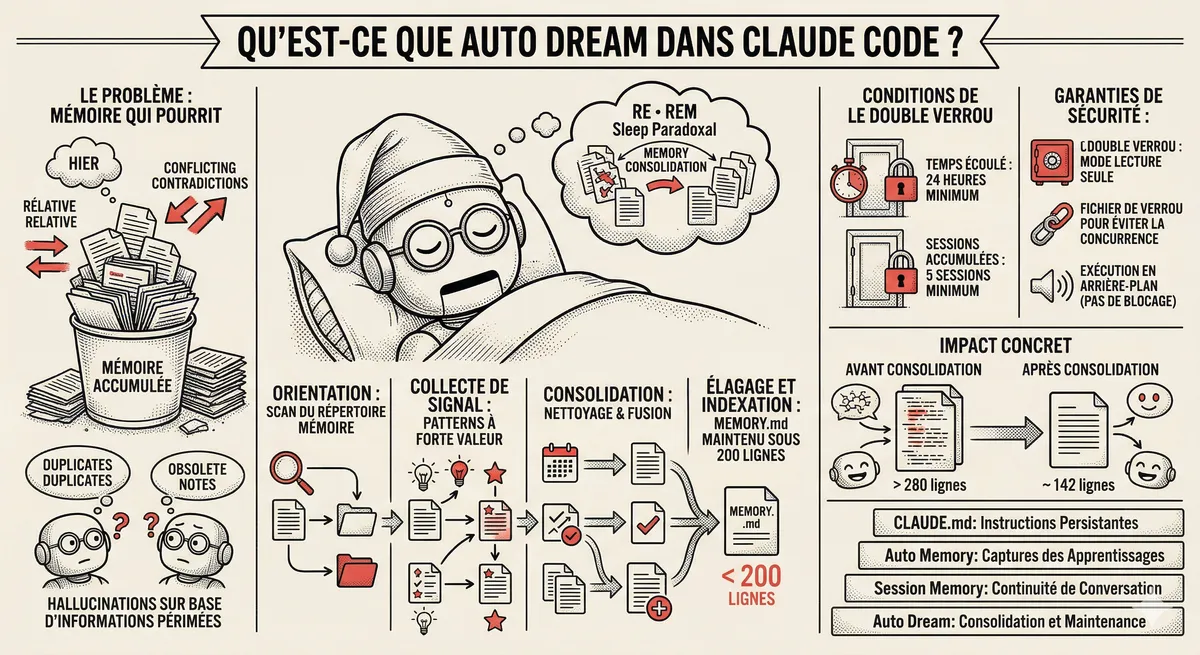
Claude Code Dream & Auto Dream: Automatic Memory Consolidation
After 20 sessions, Auto Memory notes become a mess. Auto Dream solves this by automatically consolidating Claude Code's memory: deduplication, stale entry removal, relative-to-absolute date conversion.
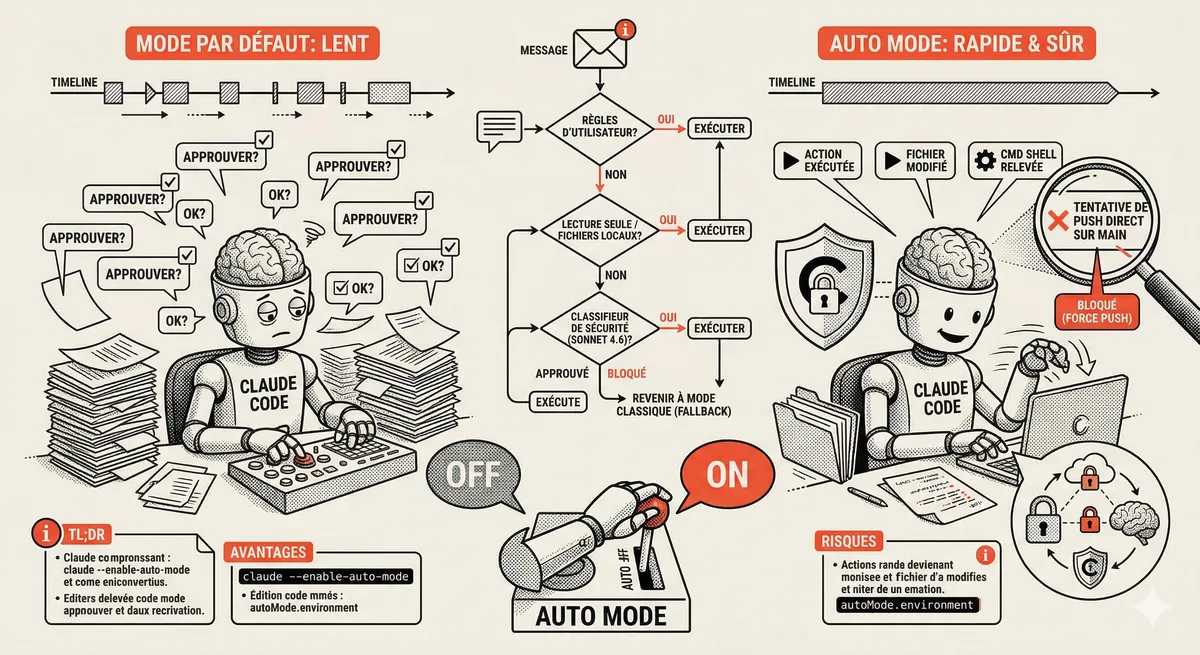
Claude Code Auto Mode: Autonomy Without the Risk
Auto Mode in Claude Code eliminates permission interruptions while keeping a safety net. A classifier analyzes every action before execution and blocks destructive operations. The sweet spot between approving everything and letting everything through.
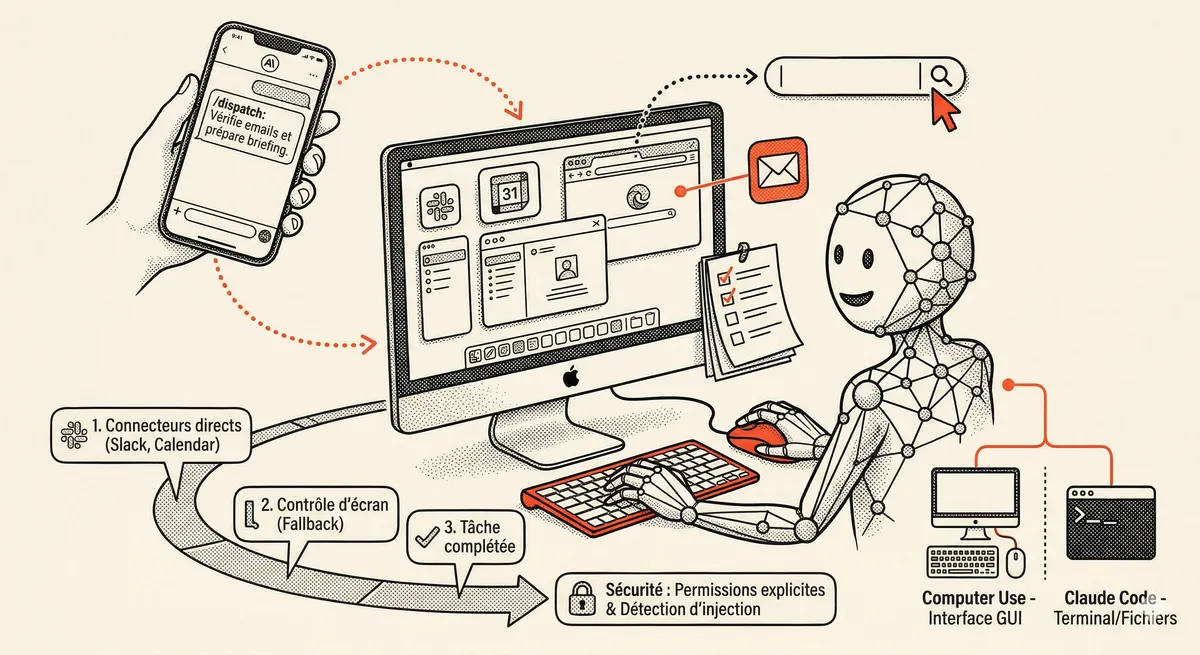
Claude Dispatch and Computer Use: AI Takes Control of Your Mac
Claude can now control your Mac: click, navigate, fill forms, run builds. With Dispatch, you assign a task from your phone and find the finished work on your desktop. Research preview, macOS only.
Claude Code Training
Master Claude Code fundamentals in 1 day with our expert instructors. 60% hands-on practice on real-world cases.
Discover the training