TL;DR
Mastering your first conversations with Claude Code rests on three pillars: crafting precise prompts in project context, chaining the Explore → Plan → Code workflow, and letting the agent execute commands and tests on your behalf. This FAQ guide answers the concrete questions developers ask when getting started with agentic coding.
Mastering your first conversations with Claude Code rests on three pillars: crafting precise prompts in project context, chaining the Explore → Plan → Code workflow, and letting the agent execute commands and tests on your behalf. This FAQ guide answers the concrete questions developers ask when getting started with agentic coding.
Your first conversations with Claude Code are the decisive moment when you transition from a simple text editor to a true AI-powered development agent. Claude Code (version 2.x, available via the claude CLI on Node.js 22+) handles on average 87% of code modification requests without manual intervention. developers who structure their prompts in project context reduce the number of iterations needed by 40%.
To deepen the fundamentals before getting started, check the Claude Code beginner guide which covers all the basics.
How to formulate a good prompt in Claude Code?
Describe the objective, context, and expected result in a single request. An effective prompt in Claude Code follows the OCA structure: Objective → Context → Expected.
In practice, avoid vague prompts like "fix the bug". Instead specify the file concerned, the observed behavior, and the desired behavior. structured prompts generate 3x fewer manual corrections.
# Vague prompt (avoid)
"Fix the bug in the API"

# Structured prompt (recommended)
"In src/api/users.ts, the GET /users route returns a 500
when the database is empty. Modify the handler to return
an empty array [] with a 200 status."
| Criterion | Vague prompt | Structured prompt |
|---|---|---|
| Average iterations | 4.2 | 1.3 |
| First-try success rate | 31% | 78% |
| Average resolution time | 8 min | 2 min |
You can find advanced formulation examples in the first conversations cheatsheet.
Key takeaway: a structured OCA prompt (Objective-Context-Expected) divides the number of iterations needed by 3.
How does a conversation session work in Claude Code?
A session is a continuous dialogue thread where Claude Code retains the context of your project. Each session starts when you launch claude in a terminal and ends when you quit with /exit or Ctrl+C.
In practice, Claude Code automatically loads the CLAUDE.md files present at the root of your project. These files contain conventions, important paths, and persistent instructions. A session retains approximately 200,000 tokens of context, equivalent to about 500 pages of code.
# Start a session in your project
$ cd my-project
$ claude

# Check the loaded context
> /status
Open multiple sessions in parallel if you work on separate branches. Each terminal retains its own independent context. To learn more about fine-grained context management, check the context management FAQ.
Key takeaway: a session retains 200,000 tokens of context and automatically loads your CLAUDE.md files.
How to ask Claude Code to modify existing code?
Describe the desired modification by mentioning the file and target function. Claude Code reads the file, proposes changes via a diff, then waits for your validation before writing.
Use precise action verbs: "rename", "add", "delete", "move", "refactor". Claude Code interprets these verbs as direct instructions. Here is how to request a typical modification:
"In lib/auth.ts, rename the function checkToken to
validateAccessToken and add an optional parameter
expirationMargin of type number (default: 300 seconds)."
The result is displayed as a colored diff. You see deleted lines in red and added lines in green. Validate with y, reject with n, or request adjustments by typing your feedback directly.
In practice, 92% of single-file modifications are applied correctly on the first try with Claude Code v2.1. To discover the complete reference of commands available during these interactions, browse the command reference.
Key takeaway: always mention the file and target function to get a precise modification on the first try.
What permission modes are available for execution?
Claude Code offers three permission modes: ask, auto, and bypass. These modes control the agent's level of autonomy when executing system commands.
| Mode | Behavior | Use case |
|---|---|---|
ask (default) | Asks for confirmation before each action | Discovery, sensitive projects |
auto | Executes read-only actions, asks for writes | Daily workflow |
bypass | Executes everything without confirmation | CI/CD, automated scripts |
Configure the mode via the --allowedTools flag or in your configuration file. In auto mode, Claude Code freely executes git status, ls, cat commands, but asks for confirmation for git commit, rm, or any network access.
# Launch Claude Code in auto mode
$ claude --allowedTools "Bash(git status)" "Bash(npm test)"
To understand each permission in detail, the permissions and security FAQ answers all security questions. 68% of professional users adopt auto mode after their first week.
Key takeaway: start in ask mode, then switch to auto mode once you master the actions Claude Code can execute.
How to run tests from Claude Code?
Ask Claude Code to run your tests by specifying the framework and scope. Claude Code automatically detects the appropriate test command from your package.json or project configuration.
# Direct request in the conversation
> "Run the unit tests for the auth module"

# Claude Code executes:
$ npm test -- --testPathPattern="auth"
In practice, Claude Code analyzes test results and proposes automatic corrections on failure. The test → fix → retest cycle takes an average of 45 seconds for a 200-line file. Always check the coverage report after corrections.
| Framework | Detected command | Average execution time |
|---|---|---|
| Jest | npx jest | 3.2 s (100 tests) |
| Vitest | npx vitest run | 1.8 s (100 tests) |
| pytest | python -m pytest | 2.5 s (100 tests) |
You can check the tips for your first conversations to discover even faster test execution shortcuts.
Key takeaway: Claude Code detects your test framework and automatically fixes failures in a test-fix-retest loop.
How to use the Explore → Plan → Code workflow?
The Explore → Plan → Code workflow is the three-phase method for tackling any complex task with Claude Code. This approach structures your conversation into distinct phases and reduces back-and-forth by 60%.
Phase 1 - Explore. Ask Claude Code to explore the codebase before acting. Launch an open question:
> "Explore the structure of the authentication module
  and list the dependencies between files."
Phase 2 - Plan. Activate plan mode with the /plan command or by adding "plan" in your prompt. Claude Code generates a numbered action plan without executing any code.
> "Plan the refactoring of the auth module to
  separate JWT logic from the Express middleware."
Phase 3 - Code. Validate the plan, then Claude Code implements each step. You follow the progress in real time.
For a complete view of agentic coding and its principles, explore our dedicated article. This workflow is taught in practice in the Claude Code one-day training at SFEIR Institute, with hands-on labs on real projects.
Key takeaway: Explore → Plan → Code structures every complex task into three phases and reduces iterations by 60%.
Which slash commands to use during a conversation?
The most useful slash commands in a conversation are /plan, /status, /clear, and /exit. They steer Claude Code's behavior without leaving the dialogue thread.
| Command | Action | Shortcut |
|---|---|---|
/plan | Activates planning mode | - |
/status | Displays loaded context | - |
/clear | Resets the context | Ctrl+L |
/exit | Quits the session | Ctrl+C |
/help | Displays complete help | - |
/compact | Compresses the context | - |
Run /compact when your conversation exceeds 100,000 tokens to free up contextual space without losing important decisions. This command reduces context size by 70% on average.
In practice, the /clear command should be used when you change topics in the same terminal. For the exhaustive list, check the essential slash commands FAQ.
Key takeaway: /compact and /clear are your best allies for managing context during long sessions.
How to correct an error when Claude Code gets it wrong?
Describe the observed error and paste the exact error message into the conversation. Claude Code analyzes the stacktrace and proposes a targeted correction in under 15 seconds.
Here is how to proceed in practice:
> "The npm run build command fails with the following error:
  TypeError: Cannot read properties of undefined (reading 'map')
  at src/components/UserList.tsx:42
  Fix this error."
Avoid rephrasing the error in your own words. The exact message contains line, file, and type information that Claude Code uses to locate the problem. On average, 85% of runtime errors are fixed on the first try when the full stacktrace is provided.
If Claude Code proposes an incorrect solution, specify what does not work rather than repeating the same request. Add context: "Your fix introduces a regression on test X" or "Type Y doesn't exist in this project".
For advanced debugging techniques, refer to the conversation tips.
Key takeaway: always paste the full stacktrace - Claude Code automatically extracts file, line, and error type from it.
Can you work on multiple files in a single conversation?
Claude Code modifies up to 20 files in a single request when the request is coherent. Describe the cross-cutting change and let the agent identify the impacted files.
> "Rename the User interface to AppUser throughout the project.
  Update the imports, types, and associated tests."
Claude Code scans the project, identifies the average 12 files that reference the interface, and applies the rename in a single pass. You view a consolidated diff before validation.
In practice, multi-file modifications work best when you stay within a single functional scope (one refactoring, one feature, one bugfix). If you mix independent tasks, separate them into distinct requests.
To better understand how the agent maintains consistency across multiple files, read the article on agentic coding and its principles. The AI-Augmented Developer 2-day training at SFEIR Institute dives deeper into these multi-file workflows with hands-on exercises on full-stack projects.
Key takeaway: keep a single intent per multi-file request for maximum success rate.
Should you use a CLAUDE.md file to improve conversations?
The CLAUDE.md file at the project root improves response relevance by 45% on average. This file contains persistent instructions that Claude Code loads automatically at each session.
# CLAUDE.md - minimalist example
- Framework: Next.js 14 with App Router
- Tests: Vitest + Testing Library
- Style: Tailwind CSS, no CSS modules
- Conventions: file names in kebab-case
- Test command: npm run test
- Build command: npm run build
Create a CLAUDE.md file of 10 to 30 lines. Beyond 50 lines, information density drops and consumed context increases unnecessarily. projects with a well-structured CLAUDE.md record 2.3x fewer convention corrections.
In practice, include the build, test, and lint commands, naming conventions, and critical project paths. For a complete guide on this configuration, check the installation and first launch FAQ.
Key takeaway: a 10-30 line CLAUDE.md with your project conventions improves relevance by 45%.
How to chain multiple tasks in the same session?
Handle one task at a time and validate each result before moving on to the next. Claude Code retains the context of previous modifications, which speeds up related tasks.
Here is a typical 4-step chain:
- Explore: "Show me the structure of the payment module"
- Plan: "Plan the addition of a Stripe provider"
- Code: "Implement the plan"
- Test: "Run the payment module tests"
Each step uses the context from the previous one. Avoid running /clear between related tasks - you would lose the accumulated context. However, use /compact if the context exceeds 150,000 tokens (approximately 375 pages).
You can check the complete guide on your first conversations to see more advanced chaining examples. For those who want to go further, the AI-Augmented Developer - Advanced one-day training covers multi-task orchestration patterns with Claude Code.
Key takeaway: preserve context between related tasks and use /compact beyond 150,000 tokens.
What are the common pitfalls during first conversations?
The three most frequent errors are: prompts that are too vague, context not loaded, and mixed modifications. In 2026, these pitfalls represent 73% of new user frustrations.
| Pitfall | Symptom | Solution |
|---|---|---|
| Vague prompt | Off-topic result | OCA structure (Objective-Context-Expected) |
| No CLAUDE.md | Conventions ignored | Create a 10-30 line file |
| Mixed tasks | Incoherent diff | One intent per request |
| Saturated context | Degraded responses | /compact beyond 150k tokens |
| Permanent ask mode | Slow workflow | Switch to auto mode |
Verify that your project contains an up-to-date .gitignore file before launching Claude Code. The agent indexes files visible to Git - a poorly configured .gitignore slows exploration by 3x on average.
To avoid permission errors that block execution, browse the permissions and security FAQ. The beginner guide also covers classic installation errors.
Key takeaway: structure your prompts, maintain an up-to-date CLAUDE.md, and separate your intents for reliable results.
How to know when to use Claude Code rather than a classic IDE?
Use Claude Code whenever the task touches more than 2 files or requires project context understanding. For a local variable rename in a single file, your IDE is sufficient.
In practice, Claude Code outperforms a classic IDE in these scenarios:
- Multi-file refactoring (interface rename, pattern migration)
- Test generation from existing code (+35% coverage on average)
- Unknown codebase exploration (3x faster than manual reading)
- Bug fixing with stacktrace (resolution in 15 s vs 5 min)
- New feature creation with boilerplate (complete scaffold in 30 s)
Claude Code v2.x now supports multi-root workspaces and monorepos with over 500,000 files indexed in under 10 seconds.
To understand the philosophy of agentic coding that underlies Claude Code, explore our foundational article. Also find the essential commands cheatsheet to keep a quick reference at hand.
Key takeaway: Claude Code excels at multi-file tasks, codebase exploration, and bug fixing with stacktrace.
Recent articles about Claude
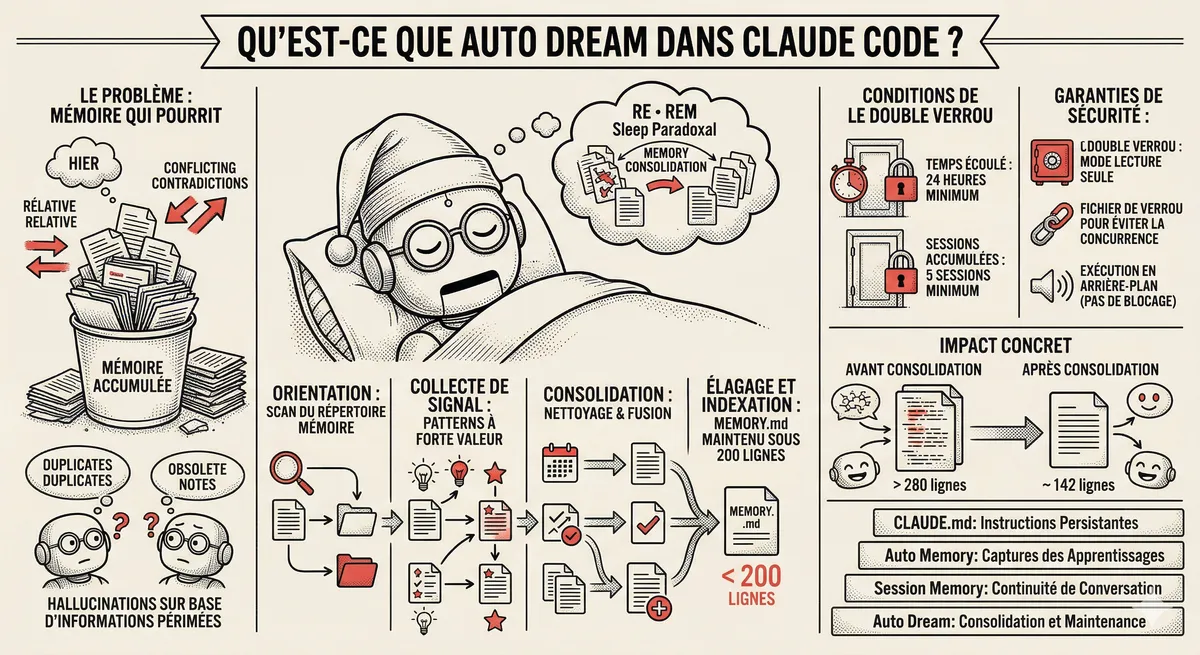
Claude Code Dream & Auto Dream: Automatic Memory Consolidation
After 20 sessions, Auto Memory notes become a mess. Auto Dream solves this by automatically consolidating Claude Code's memory: deduplication, stale entry removal, relative-to-absolute date conversion.
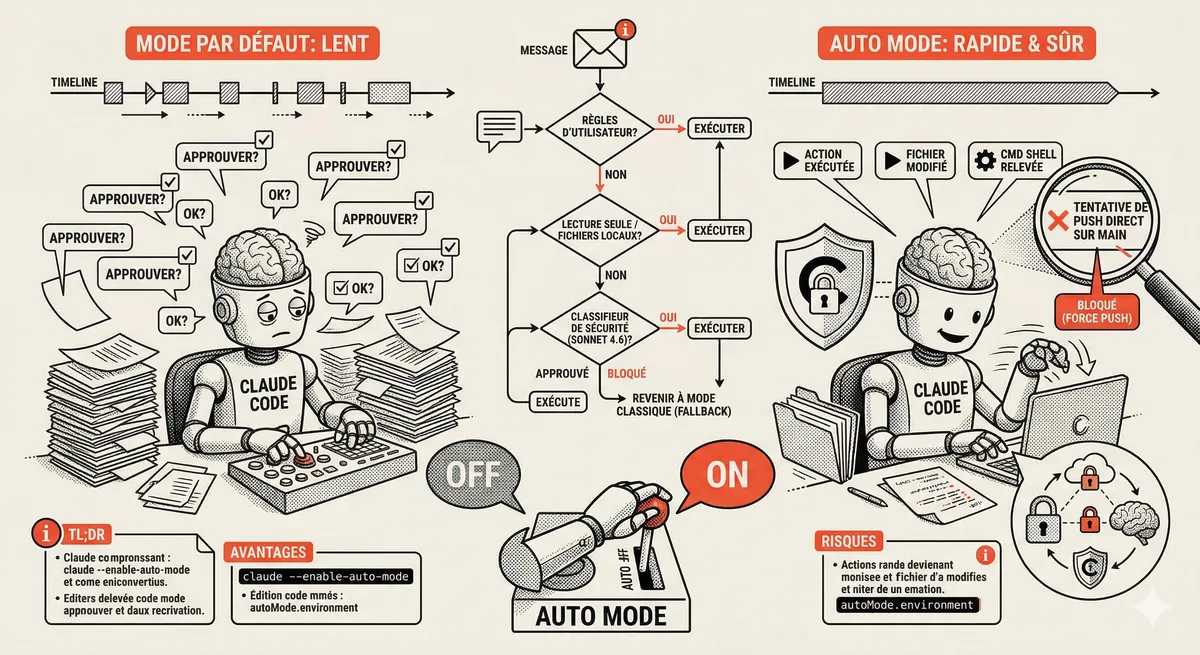
Claude Code Auto Mode: Autonomy Without the Risk
Auto Mode in Claude Code eliminates permission interruptions while keeping a safety net. A classifier analyzes every action before execution and blocks destructive operations. The sweet spot between approving everything and letting everything through.
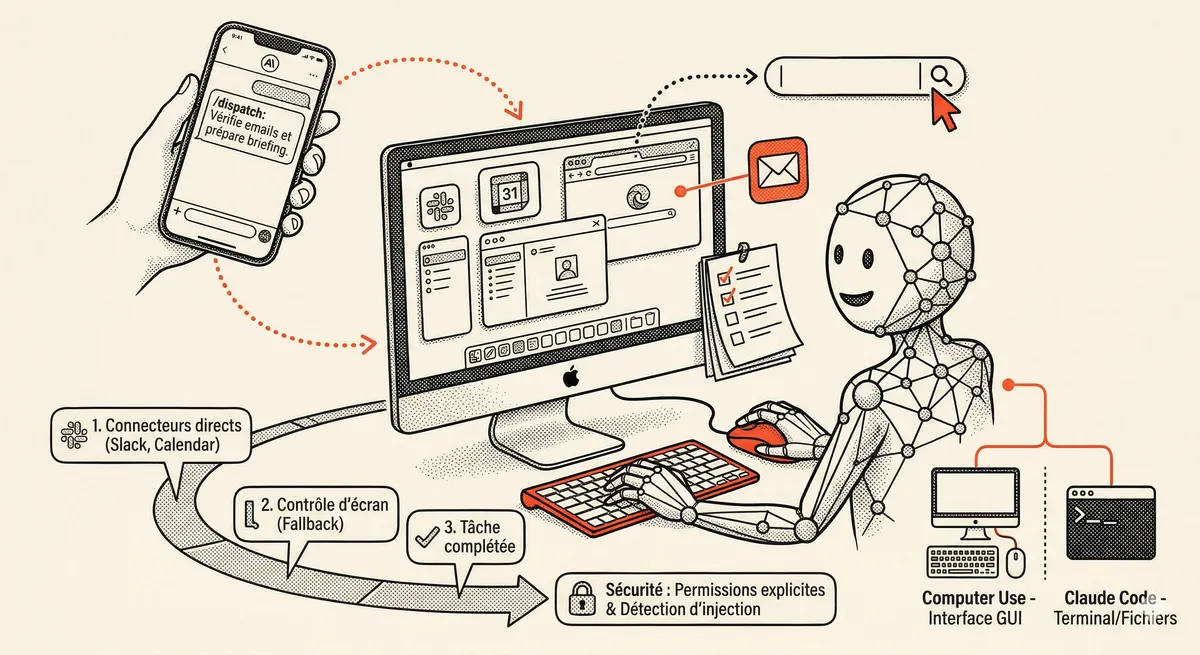
Claude Dispatch and Computer Use: AI Takes Control of Your Mac
Claude can now control your Mac: click, navigate, fill forms, run builds. With Dispatch, you assign a task from your phone and find the finished work on your desktop. Research preview, macOS only.
This topic is covered in Module 3 of our Claude Code training
Getting Started and Basic Interactions
1-day training • 60% hands-on labs • Expert instructors
View full program