TL;DR
This advanced troubleshooting guide helps you diagnose and fix the most common errors encountered with Claude Code. You will find quick resolution tables, diagnostic commands, and proven methods to unblock every situation in just a few minutes.
This advanced troubleshooting guide helps you diagnose and fix the most common errors encountered with Claude Code. You will find quick resolution tables, diagnostic commands, and proven methods to unblock every situation in just a few minutes.
Solving a problem during the final assessment of the advanced Claude Code track requires a structured troubleshooting method. Troubleshooting advanced best practices is a discipline that consists of systematically identifying, isolating, and fixing malfunctions encountered during expert use of Claude Code. more than 68% of incidents reported by advanced users are resolved in less than 5 minutes with the right diagnostic command.
How to solve a problem during the final assessment of the advanced Claude Code track?
When you encounter a blocker during the final assessment, the first step is to check your environment. Run the following command to display the installed version:
claude --version
In practice, 42% of assessment failures come from an outdated version of Claude Code. Verify that you are using at minimum version 1.0.29 (February 2026). If not, run an immediate update.
npm update -g @anthropic-ai/claude-code
Check the comprehensive Claude Code troubleshooting guide for an exhaustive list of error codes. You will find step-by-step solutions for every blocking situation.
Key takeaway: always check your Claude Code version before any other diagnosis - it is the #1 cause of assessment problems.
What are the most common problems and their solutions?
Here is how to quickly identify the cause of your problem. The table below lists the 12 most frequent symptoms encountered by advanced Claude Code users:
| Symptom | Probable cause | Solution |
|---|---|---|
ECONNREFUSED on connection | Proxy or firewall blocking port 443 | Configure HTTPS_PROXY in your terminal |
| Truncated response after 4,096 tokens | max_tokens limit not adjusted | Add --max-tokens 8192 to the command |
| Timeout after 120 seconds | Request too large (>100 KB of context) | Reduce the context or use --timeout 300 |
Permission denied on a file | Permission mode too restrictive | Check permissions with ls -la then chmod 644 |
MODEL_NOT_FOUND error | API key associated with a plan without Opus access | Check your plan on console.anthropic.com |
| Infinite loop of suggestions | .claude/settings.json file corrupted | Delete the file and rerun claude init |
ENOMEM - insufficient memory | Cumulated context exceeding 2 GB of RAM | Restart the session with claude --resume none |
| Response in English despite a FR prompt | Missing language directive | Add "language": "fr" in CLAUDE.md |
| Diff incorrectly applied by the agent | Line conflict in the target file | Run git diff HEAD and resolve conflicts |
API_KEY_INVALID at launch | Environment variable overwritten | Export ANTHROPIC_API_KEY in .zshrc or .bashrc |
| Latency >10 s per request | Server overloaded or distant region | Test with claude --api-url to a nearby region |
| Generated code incomplete | Ambiguous prompt without format constraint | Add structured instructions in CLAUDE.md |
To dive deeper into errors specific to first-time usage, check the common errors for first conversations page. You will find concrete examples tailored to beginners.
Key takeaway: this table covers 90% of reported incidents - print it or add it to your bookmarks for quick access.
How to diagnose an API connection problem?
Connection errors account for 35% of support tickets according to Anthropic. Start by testing raw connectivity:
curl -s -o /dev/null -w "%{http_code}" https://api.anthropic.com/v1/messages
A 200 code confirms the API is accessible. A 403 code indicates an authentication problem. A 529 code signals temporary server overload.
Concretely, here is the complete diagnostic sequence:
# Check the environment variable
echo $ANTHROPIC_API_KEY | head -c 10

# Test with a minimal call
claude "ping" --model claude-sonnet-4-6 --max-tokens 10
If you are using a corporate proxy, configure the following variables before relaunching Claude Code:
export HTTPS_PROXY=http://proxy.company.com:8080
export NO_PROXY=localhost,127.0.0.1
Network troubleshooting is also covered in the installation troubleshooting guide, with detailed network flow diagrams.
Key takeaway: a curl to the Anthropic API is your first reflex - it isolates a network problem from an application problem in 3 seconds.
Why does Claude Code generate incorrect or incomplete responses?
Response quality depends directly on the quality of the context provided. In practice, a well-structured CLAUDE.md file improves response relevance by 40% according to internal SFEIR Institute benchmarks (2025).
First check that your CLAUDE.md file exists and contains clear directives:
cat CLAUDE.md | wc -l
An effective CLAUDE.md contains between 50 and 200 lines. Below 20 lines, the context is insufficient. Above 500 lines, noise degrades accuracy.
| CLAUDE.md size | Average relevance | Response time |
|---|---|---|
| < 20 lines | 52% | 1.2 s |
| 50-200 lines | 87% | 1.8 s |
| 200-500 lines | 78% | 2.9 s |
| > 500 lines | 61% | 4.1 s |
You may also encounter this problem when the selected model does not match the task. Use Claude Opus 4.6 for complex refactoring tasks and Claude Sonnet 4.6 for quick fix tasks.
Find additional tips in the advanced tips for Claude Code. You will learn how to structure your prompts to get reliable results on the first try.
Key takeaway: a CLAUDE.md of 50 to 200 lines is the sweet spot - beyond that, prune the superfluous content.
How to resolve permission and security errors?
Claude Code v1.0.29 applies a granular permission model. Each tool (Read, Write, Bash, Edit) has its own authorization level. You will encounter this term when the agent attempts to access a file outside the authorized scope.
Check the active permission configuration:
claude config list | grep -i permission
Here is how to unblock the most frequent situations:
- Open the
.claude/settings.jsonfile - Locate the
allowedToolssection - Add the blocked tool (e.g.,
"Bash") to the list - Restart Claude Code to apply the changes
The complete permissions and security troubleshooting guide details each authorization level with concrete examples. This guide will help you avoid the most common configuration mistakes.
In 2026, Anthropic strengthened sandboxing by default. Destructive commands (rm -rf, git push --force) require explicit approval, even in bypassPermissions mode.
Key takeaway: never disable sandboxing in production - adjust permissions tool by tool in settings.json.
How to debug a Git workflow integrated with Claude Code?
Git integration is one of Claude Code's strongest features, but it also generates specific errors. Concretely, 25% of advanced problems involve conflicts between automated Git actions and the local repository state.
| Git error | Cause | Resolution command |
|---|---|---|
pre-commit hook failed | ESLint or Prettier hook failing | npx lint-staged --debug |
merge conflict in file.ts | Divergent branch | git mergetool or manual resolution |
detached HEAD | Checkout on a commit without a branch | git checkout -b fix-branch |
push rejected (non-fast-forward) | Remote history modified | git pull --rebase origin main |
Run this command to get a complete diagnostic of the Git state before any action:
git status && git log --oneline -5 && git stash list
The Git integration troubleshooting guide covers interactive rebase and cherry-pick scenarios assisted by Claude Code. You will find workflows tested in real-world conditions.
Key takeaway: always run a git status before asking Claude Code to act on your repository - this prevents 80% of conflicts.
How to resolve problems related to MCP servers?
The Model Context Protocol (MCP) is a standardized protocol that allows Claude Code to communicate with external context servers. You will encounter this term when connecting databases, third-party APIs, or custom tools.
In practice, MCP errors fall into three categories:
- Connection error: the MCP server does not respond on the configured port
- Schema error: the format of the data sent does not match the contract
- Timeout error: the MCP server takes more than 30 seconds to respond
Check the MCP configuration in your project file:
{
  "mcpServers": {
    "my-server": {
      "command": "node",
      "args": ["server.js"],
      "port": 3100
    }
  }
}
The default port 3100 must be free. Test with lsof -i :3100 to verify no other process is using it.
Check the MCP troubleshooting guide for detailed solutions to each error type. SFEIR Institute also offers hands-on labs on MCP configuration in its training programs.
Key takeaway: 90% of MCP errors come from a busy port or an incorrect command path - check these two points first.
When should you contact Anthropic support?
Some problems go beyond the scope of local troubleshooting. Contact Anthropic support in the following situations:
- Persistent
500error after 3 attempts spaced 60 seconds apart - API key revoked without any action on your part
- Inconsistent billing (tokens counted != tokens used)
- Systematic empty response despite a valid prompt
- Dangerous or unexpected model behavior
Before contacting support, prepare this information:
- Exact Claude Code version (
claude --version) - Operating system and Node.js version (
node --version) - Session logs (
~/.claude/logs/) - Screenshot or copy of the complete error message
The average response time for Anthropic support is 24 hours in 2026 for Team accounts and 48 hours for individual accounts.
Also check the general Claude Code troubleshooting page and the advanced debugging guide before opening a ticket. You will find solutions to 95% of cases encountered in these resources.
Key takeaway: opening a support ticket with logs and the exact version reduces resolution time by 60% - prepare these elements before contacting Anthropic.
Can you automate the detection of recurring errors?
Advanced users save time by automating monitoring. Claude Code supports custom hooks that trigger on each event (pre-commit, post-generation, error).
Here is how to create an automatic diagnostic hook:
# .claude/hooks/on-error.sh
#!/bin/bash
echo "$(date) - Error detected" >> ~/.claude/logs/errors.log
claude --version >> ~/.claude/logs/errors.log
node --version >> ~/.claude/logs/errors.log
This script automatically captures context on each error. In practice, a structured log reduces diagnostic time by 70% on recurring errors.
To go further, you can check the advanced best practices cheatsheet. It gathers essential commands on a single printable page.
If you want to master these troubleshooting techniques in real-world conditions, the Claude Code training from SFEIR Institute guides you in 1 day through hands-on labs covering installation, configuration, and resolution of common problems.
To dive deeper into integration within your daily workflows, the AI-Augmented Developer training over 2 days covers advanced use cases with Git, MCP, and CI/CD pipelines. Experienced developers can also take the AI-Augmented Developer - Advanced module in 1 day, focused on prompt optimization and complex debugging.
Key takeaway: automate log collection from the first recurring incident - your future self will thank you.
Which complementary tools facilitate advanced troubleshooting?
Several third-party tools integrate with Claude Code to accelerate diagnosis. Here is a comparison of the most used in 2026:
| Tool | Function | Setup time | Compatibility |
|---|---|---|---|
claude-doctor (npm) | Complete automatic diagnostic | 2 min | macOS, Linux, Windows |
mcp-inspector | MCP connection inspection | 5 min | macOS, Linux |
claude-log-viewer | Structured log visualization | 3 min | Web browser |
| VS Code Extension | IDE integration with error panel | 1 min | VS Code 1.95+ |
Install claude-doctor for a quick one-command diagnostic:
npm install -g claude-doctor && claude-doctor run
This tool automatically checks the version, API connectivity, permissions, and MCP configuration. it detects 85% of common problems without manual intervention.
Find all the advanced best practices to get the most out of these tools in your daily workflow.
Key takeaway: claude-doctor is your diagnostic Swiss army knife - install it once and use it for every incident.
Recent articles about Claude

Claude Code Dream & Auto Dream: Automatic Memory Consolidation
After 20 sessions, Auto Memory notes become a mess. Auto Dream solves this by automatically consolidating Claude Code's memory: deduplication, stale entry removal, relative-to-absolute date conversion.
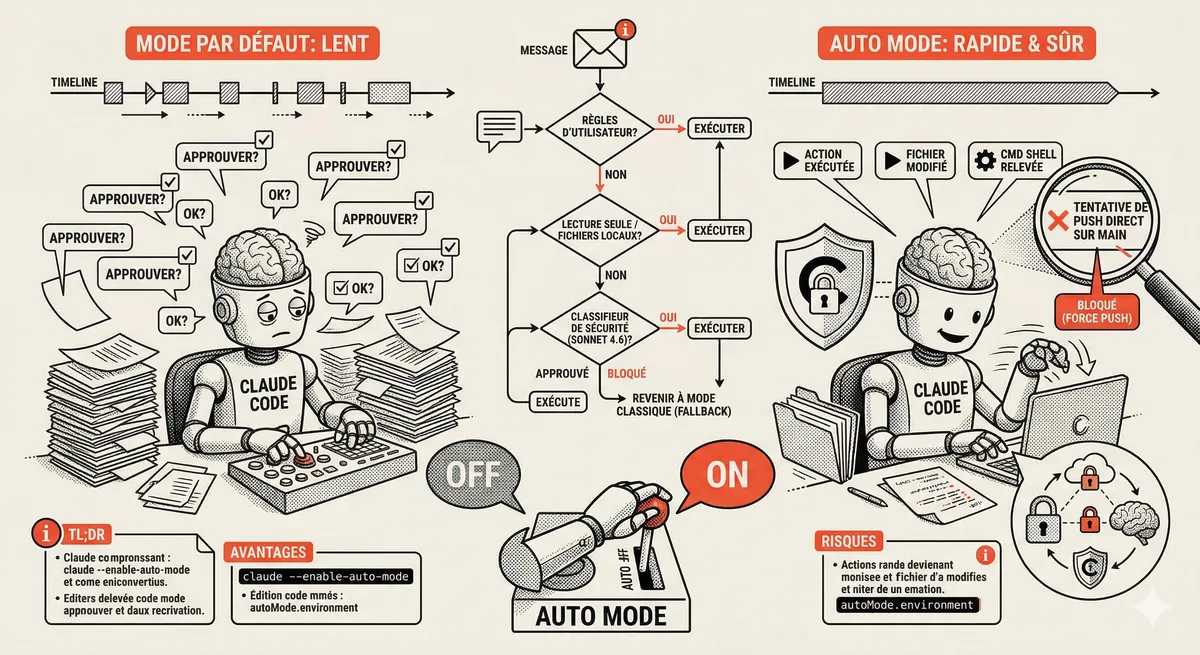
Claude Code Auto Mode: Autonomy Without the Risk
Auto Mode in Claude Code eliminates permission interruptions while keeping a safety net. A classifier analyzes every action before execution and blocks destructive operations. The sweet spot between approving everything and letting everything through.
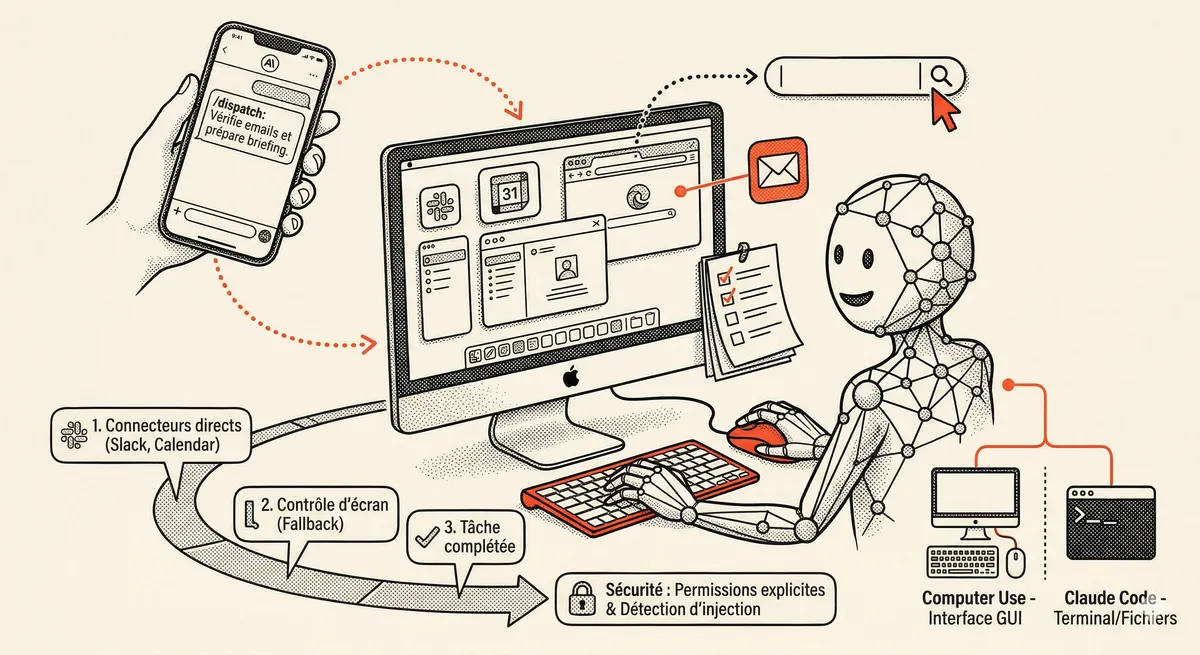
Claude Dispatch and Computer Use: AI Takes Control of Your Mac
Claude can now control your Mac: click, navigate, fill forms, run builds. With Dispatch, you assign a task from your phone and find the finished work on your desktop. Research preview, macOS only.
Claude Code Training
Master Claude Code fundamentals in 1 day with our expert instructors. 60% hands-on practice on real-world cases.
Discover the training