What Changes for Product Managers with Generative AI?
TL;DR
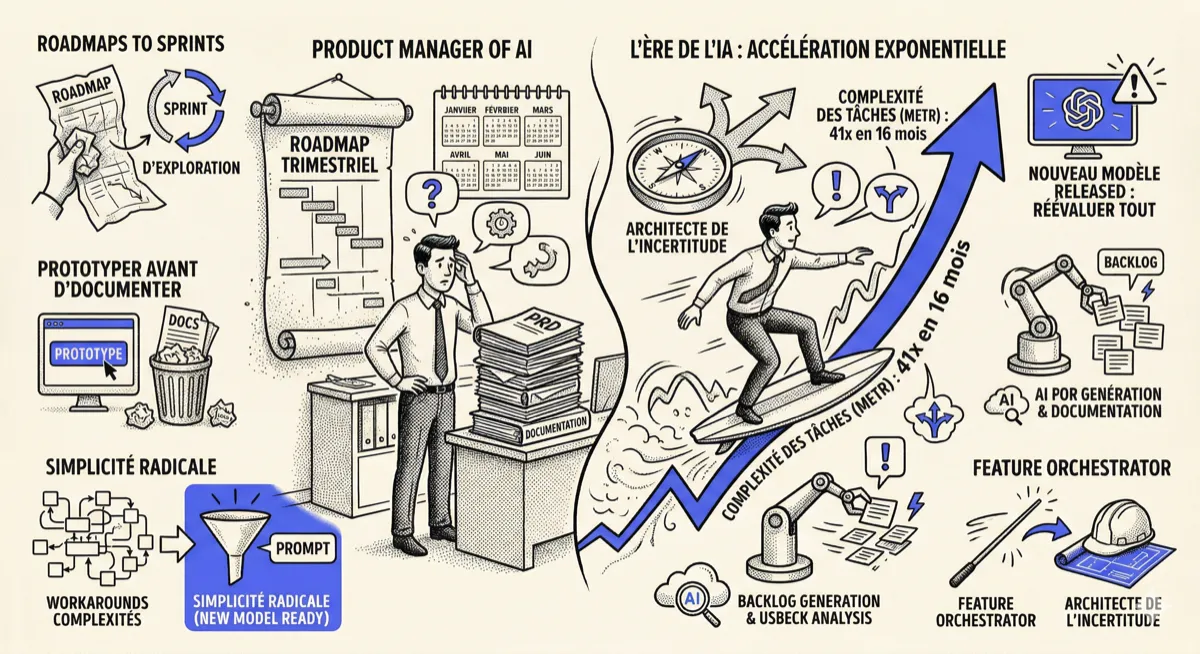
Generative AI has shattered product management's foundational assumption: technological stability during a project cycle. According to METR measurements, models now handle tasks 41x more complex than 16 months ago (from 21 human-minutes to nearly 12 hours). PMs must shift from fixed roadmaps to exploration sprints, prototype before documenting, reassess at every model jump, and embrace radical simplicity. The role evolves from "Feature Orchestrator" to "Architect of Uncertainty."
For years, product management was built on an implicit assumption: what is technically possible at the start of a project remains roughly the same at the end. You define scope, plan sprints, deliver. The framework is stable, constraints predictable.
Generative AI has shattered this assumption.
In March 2026, Cat Wu, Head of Product for Claude Code at Anthropic, published Product Management on the AI Exponential. She describes a recurring test: building a table tool for Excalidraw with each new Claude version. Sonnet 3.5 failed regularly. Opus 4 succeeded occasionally. Opus 4.6, a few months later, was reliable enough to demo live in front of thousands of developers.
According to METR measurements, Sonnet 3.5 could complete tasks taking a human about 21 minutes. Opus 4.6 handles tasks of nearly 12 hours. A 41x complexity leap in 16 months. When technology evolves at this speed, the quarterly roadmap becomes fiction.
What Are the Four PM Shifts in the Exponential Era?
1. From Roadmaps to Exploration Sprints
Six-month plans lose their meaning when a new model can make an entire feature obsolete, or suddenly possible. Cat Wu talks about "side quests": half-day experiments to test what just became feasible. Features like Claude Code Desktop emerged at Anthropic from these kinds of "side quests," not from a classic strategic plan.
Reserve structured time for experimentation, not just execution. A backlog that leaves no room for discovery is a backlog that ages poorly.
2. Prototype Before You Document
The cost-to-learning ratio has flipped. Building a prototype now takes a few hours, while writing a detailed PRD can take just as long. The new reflex: demo first, document after.
Bad bets cost little when built in a morning rather than a quarter. PMs at Datadog and Decagon, interviewed by Anthropic in the same article, report this compression of time between ideation and testable prototype.
3. Reassess at Every Model Leap
Each new model generation is an invitation to reassess existing work. A feature deemed unfeasible 6 months ago may be trivial today. Yesterday's elaborate workarounds become tomorrow's technical debt when the model can now handle the case directly.
PMs must integrate a systematic "re-scan" moment into their rituals at every major model release. You no longer check technology news out of curiosity, you check it to steer decisions.
4. Keep It Simple, Radically
The temptation is great to build complex systems to work around AI's current limitations. But if those limitations recede exponentially, the simplest implementation is often the most durable. Less code, fewer workarounds, more adaptability.
A well-written prompt that fails today might work in three months with zero modifications. A 12-step pipeline built to compensate for a model's weaknesses becomes a burden when the next model no longer has those weaknesses.
The table below summarizes these four shifts:
| Classic Approach | Exponential Shift | Why |
|---|---|---|
| 6-month roadmap | Exploration sprints | Capabilities change faster than plans |
| Detailed PRD before coding | Prototype first, document after | Building costs less than specifying |
| Passive technology watch | Re-scan at every model release | Workarounds become debt |
| Complex architecture | Simplest possible implementation | Simplicity survives acceleration better |
How Does the PM Role Evolve with AI Projects?
The Product Manager no longer controls a deterministic product experience. They navigate a probabilistic environment. GenAI projects introduce uncertainty at every layer: outputs vary, capabilities evolve, use cases emerge continuously.
The 2026 PM must know how to:
- Distinguish real use cases from false good ideas. AI can process everything, but shouldn't process everything. Product judgment remains the critical skill.
- Drive quality with adapted metrics. You don't measure an AI product like a classic CRUD. Output success rates, perceived latency, and response relevance demand new evaluation frameworks.
- Master the regulatory landscape (GDPR, AI Act) without being paralyzed by it.
- Understand the technical building blocks (LLM, RAG, Fine-tuning, Agents) to dialogue with teams without being a developer.
AI acts as a productivity amplifier, not a replacement for human judgment. The Product Owner who uses AI to generate their backlog in minutes instead of days saves time, but it's their domain expertise that validates, adjusts, and prioritizes.
How AI Transforms the PM's Daily Work: Five Concrete Cases
Product Managers getting the most from AI use it on high-recurrence tasks:
1. Backlog generation and structuring. AI produces a structured first draft in minutes, which the PM refines based on business context.
2. User Story industrialization. Standardized stories with acceptance criteria and test scenarios, produced in minutes rather than hours.
3. Product documentation. Transformation of technical specs into user guides and FAQs, with appropriate tone and detail level.
4. User feedback analysis. Categorization, sentiment analysis, pattern detection at volumes that manual processing can no longer absorb.
5. Agile ceremony preparation. Sprint planning agendas, structured sprint reviews, ready-to-use metrics summaries.
These gains are only real if the PM maintains critical control over outputs. AI proposes, the PM disposes.
Training for AI-Augmented Product Management
Facing this acceleration, training is no longer optional. AI adoption among product teams is accelerating, and PMs who don't invest in upskilling risk falling behind quickly.
WEnvision, SFEIR Group's strategic consulting firm, offers two targeted programs. The first, Product Management & GenAI: Strategic Fundamentals (half-day), provides a critical framework for evaluating and steering AI products: shifting from determinism to probabilism, model landscape (LLM, RAG, Agents), regulation (GDPR, AI Act) and token FinOps. The second, Augmented Product Management (full day), is a product sprint simulation where AI becomes the PM's partner, from ideation to functional prototype.
Product management has always been a profession of adaptation. But AI's pace of evolution demands a regime change: accepting that practices must evolve continuously, at the pace of technology itself. The PMs who thrive on this exponential will combine curiosity to experiment, rigor to validate every hypothesis, and humility to question what worked yesterday.
Going Further
This article draws from Cat Wu's post published March 19, 2026: Product Management on the AI Exponential. To go deeper, check out the Product Management & GenAI training and Augmented Product Management training from WEnvision. See also our article on the AI-augmented developer for a complementary engineering perspective.